
From this episode
Recommended books
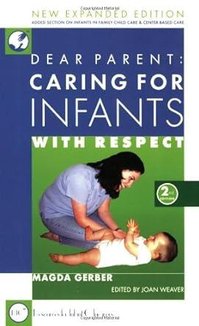
Dear Parent: Caring for Infants With Respect (2nd Edition)
Author:
Magda Gerber
Internationally renowned infant specialist Magda Gerber, M.A., the founder of RIE, offers a healthy new approach to infant care based on a profound respect for each baby's individual needs and abilities.
Internationally renowned infant specialist Magda Gerber, M.A., the founder of RIE, offers a healthy new approach to infant care based on a profound respect for each baby's individual needs and abilities.
Find this book on:


Siblings Without Rivalry: How to Help Your Children Live Together So You Can Live Too
Authors:
Adele Faber,
Elaine Mazlish
The #1 New York Times best-selling guide to reducing hostility and generating goodwill between siblings. Already best-selling authors with How to Talk So Kids Will Listen & Listen So Kids Will Talk , Adele Faber and Elaine Mazlish turned their minds to the battle of the siblings.
The #1 New York Times best-selling guide to reducing hostility and generating goodwill between siblings. Already best-selling authors with How to Talk So Kids Will Listen & Listen So Kids Will Talk , Adele Faber and Elaine Mazlish turned their minds to the battle of the siblings. Parents themselves, they were determined to figure out how to help their children get along. The result was Siblings Without Rivalry . This wise, groundbreaking book gives parents the practical tools they need to cope with conflict, encourage cooperation, reduce competition, and make it possible for children to experience the joys of their special relationship. With humor and understanding―much gained from raising their own children―Faber and Mazlish explain how and when to intervene in fights, provide suggestions on how to help children channel their hostility into creative outlets, and demonstrate how to treat children unequally and still be fair. Updated to incorporate fresh thoughts after years of conducting workshops for parents and professionals, this edition also includes a new afterword.
Find this book on:
The Hurried Child (25th anniversary edition)
Author:
David Elkind
"David Elkind [is] one of psychology's leading lights."-- Washington Post With the first edition of The Hurried Child , David Elkind emerged as the voice of parenting reason, calling our attention to the crippling effects of hurrying our children through life. He showed that by blurring the boundaries of what is age appropriate, by expecting--or imposing--too much too soon, we force our kids to grow up too fast, to mimic adult sophistication while they secretly yearn for time to act their age.
"David Elkind [is] one of psychology's leading lights."-- Washington Post With the first edition of The Hurried Child , David Elkind emerged as the voice of parenting reason, calling our attention to the crippling effects of hurrying our children through life. He showed that by blurring the boundaries of what is age appropriate, by expecting--or imposing--too much too soon, we force our kids to grow up too fast, to mimic adult sophistication while they secretly yearn for time to act their age. In the more than two decades since this book first appeared, our society has inadvertently stepped up the assault on childhood through the media, in schools, and at home. In this twenty-fifth anniversary edition of this classic, Dr. Elkind adds important new commentary to put a quarter century of trends and change into perspective for parents today, including a detailed, up-to-the-minute look at the Internet, classroom culture, school violence, and movies and television. Showing parents and teachers where hurrying occurs and why, Elkind offers insight, advice, and hope for encouraging healthy development while protecting the joy and freedom of childhood. "A landmark book."-- Chicago Sun-Times
Find this book on:
Biased: Uncovering the Hidden Prejudice That Shapes What We See, Think, and Do
Author:
Jennifer L. Eberhardt PhD
"Poignant....important and illuminating."— The New York Times Book Review "Groundbreaking."—Bryan Stevenson, New York Times bestselling author of Just Mercy From one of the world’s leading experts on unconscious racial bias come stories, science, and strategies to address one of the central controversies of our time How do we talk about bias? How do we address racial disparities and inequities?
"Poignant....important and illuminating."— The New York Times Book Review "Groundbreaking."—Bryan Stevenson, New York Times bestselling author of Just Mercy From one of the world’s leading experts on unconscious racial bias come stories, science, and strategies to address one of the central controversies of our time How do we talk about bias? How do we address racial disparities and inequities? What role do our institutions play in creating, maintaining, and magnifying those inequities? What role do we play? With a perspective that is at once scientific, investigative, and informed by personal experience, Dr. Jennifer Eberhardt offers us the language and courage we need to face one of the biggest and most troubling issues of our time. She exposes racial bias at all levels of society—in our neighborhoods, schools, workplaces, and criminal justice system. Yet she also offers us tools to address it. Eberhardt shows us how we can be vulnerable to bias but not doomed to live under its grip. Racial bias is a problem that we all have a role to play in solving.
Find this book on:
Episode overview
This is one of those episodes I feel I need to sell. Because on one level, it’s about an unusual theory of parenting known by the acronym RIE — for the nonprofit group Resources for Infant Educarers, which promotes its principles — that I’ve become interested in. But this isn’t a parenting podcast, and I know many of you don’t have young kids. The reason I’m doing this episode is that I think there’s something bigger here.
RIE is centered on the idea that infants and toddlers are whole people worthy of respect. It gets attention for some weird recommendations, like how we should ask babies’ permission before changing a diaper or picking them up and how we should avoid distracting toddlers from a tantrum or seating them in a high chair. But underneath all that is something profound. A theory of how to build a relationship based on respect when words fail or are absent. A view of what it means to treat others with respect when we can’t count on respect being returned. And a recognition that in any interaction with another person, all we can really control is ourselves — the boundaries we draw, the energy we carry and the values we express.
This is a profound way to think about adult relationships. And it’s a profound way to think about political relationships, too, if you extend the teachings outward.
Janet Lansbury is a RIE educator and the author of the books “No Bad Kids” and “Elevating Child Care.” She also hosts a popular parenting podcast, “Janet Lansbury Unruffled.” It was through her work that I learned about RIE, so she was the perfect person to invite on for this discussion.