
From this episode
Recommended books
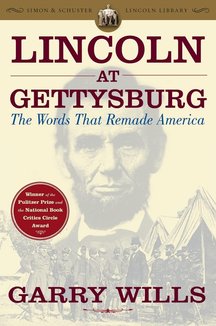
In a masterly work, Garry Wills shows how Lincoln reached back to the Declaration of Independence to write the greatest speech in the nation’s history. The power of words has rarely been given a more compelling demonstration than in the Gettysburg Address.
In a masterly work, Garry Wills shows how Lincoln reached back to the Declaration of Independence to write the greatest speech in the nation’s history. The power of words has rarely been given a more compelling demonstration than in the Gettysburg Address. Lincoln was asked to memorialize the gruesome battle. Instead he gave the whole nation “a new birth of freedom” in the space of a mere 272 words. His entire life and previous training and his deep political experience went into this, his revolutionary masterpiece. By examining both the address and Lincoln in their historical moment and cultural frame, Wills breathes new life into words we thought we knew, and reveals much about a president so mythologized but often misunderstood. Wills shows how Lincoln came to change the world and to effect an intellectual revolution, how his words had to and did complete the work of the guns, and how Lincoln wove a spell that has not yet been broken.
Find this book on:


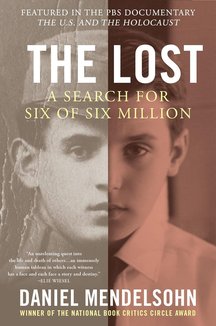
The Lost: A Search for Six of Six Million
Author:
Daniel Mendelsohn
Soon to be featured in the Ken Burns documentary The U.S. and the Holocaust , premiering on PBS September 18 th A New York Times Notable Book • Winner of the National Jewish Book Award • Winner of the National Book Critics Circle Award • A Los Angeles Times Book Prize Finalist “A gripping detective story, a stirring epic, a tale of ghosts and dark marvels, a thrilling display of scholarship, a meditation on the unfathomable mystery of good and evil, a testimony to the enduring power of the ancient archetypes that haunt one Jewish family and the greater human family, The Lost is as complex and rich with meaning and story as the past it seeks to illuminate.
Soon to be featured in the Ken Burns documentary The U.S. and the Holocaust , premiering on PBS September 18 th A New York Times Notable Book • Winner of the National Jewish Book Award • Winner of the National Book Critics Circle Award • A Los Angeles Times Book Prize Finalist “A gripping detective story, a stirring epic, a tale of ghosts and dark marvels, a thrilling display of scholarship, a meditation on the unfathomable mystery of good and evil, a testimony to the enduring power of the ancient archetypes that haunt one Jewish family and the greater human family, The Lost is as complex and rich with meaning and story as the past it seeks to illuminate. A beautiful book, beautifully written.”—Michael Chabon In this rich and riveting narrative, a writer's search for the truth behind his family's tragic past in World War II becomes a remarkably original epic—part memoir, part reportage, part mystery, and part scholarly detective work—that brilliantly explores the nature of time and memory, family and history. The Lost begins as the story of a boy who grew up in a family haunted by the disappearance of six relatives during the Holocaust—an unmentionable subject that gripped his imagination from earliest childhood. Decades later, spurred by the discovery of a cache of desperate letters written to his grandfather in 1939 and tantalized by fragmentary tales of a terrible betrayal, Daniel Mendelsohn sets out to find the remaining eyewitnesses to his relatives' fates. That quest eventually takes him to a dozen countries on four continents and forces him to confront the wrenching discrepancies between the histories we live and the stories we tell. And it leads him, finally, back to the small Ukrainian town where his family's story began, and where the solution to a decades-old mystery awaits him. Deftly moving between past and present, interweaving a world-wandering odyssey with childhood memories of a now-lost generation of immigrant Jews and provocative ruminations on biblical texts and Jewish history, The Lost transforms the story of one family into a profound, morally searching meditation on our fragile hold on the past. Deeply personal, grippingly suspenseful, and beautifully written, this literary tour de force illuminates all that is lost, and found, in the passage of time.
Find this book on:
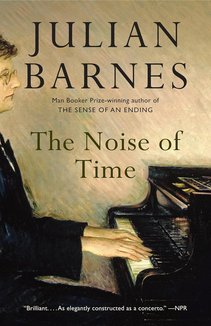
The Noise of Time: A Novel (Vintage International)
Author:
Julian Barnes
From the bestselling, Booker Prize-winning author of The Sense of an Ending comes an extraordinary fictional portrait of the relentlessly fascinating Russian musician and composer Dmitri Shostakovich and a stunning meditation on the meaning of art and its place in society. • “Brilliant….
From the bestselling, Booker Prize-winning author of The Sense of an Ending comes an extraordinary fictional portrait of the relentlessly fascinating Russian musician and composer Dmitri Shostakovich and a stunning meditation on the meaning of art and its place in society. • “Brilliant…. As elegantly constructed as a concerto.” —NPR 1936: Dmitri Shostakovich, just thirty years old, reckons with the first of three conversations with power that will irrevocably shape his life. Stalin, hitherto a distant figure, has suddenly denounced the young composer’s latest opera. Certain he will be exiled to Siberia (or, more likely, shot dead on the spot), Shostakovich reflects on his predicament, his personal history, his parents, his daughter—all of those hanging in the balance of his fate. And though a stroke of luck prevents him from becoming yet another casualty of the Great Terror, he will twice more be swept up by the forces of despotism: coerced into praising the Soviet state at a cultural conference in New York in 1948, and finally bullied into joining the Party in 1960. All the while, he is compelled to constantly weigh the specter of power against the integrity of his music.
Find this book on:
Episode overview
Right after the election, I talked about how the results reminded me of 2004. George W. Bush won re-election that year — and unlike four years earlier, the popular vote, too. Democrats were truly, undeniably in the wilderness. But two years later, they found their way out. Democrats won the House for the first time in 12 years. And two years after that, with the election of Barack Obama, they completed their trifecta. Does that comeback story have any lessons for Democrats today?
Rahm Emanuel is the person to ask. He helped orchestrate that 2006 Democratic victory as the chair of the Democratic Congressional Campaign Committee. He was Obama’s first chief of staff. And before that, Emanuel was a senior adviser to President Bill Clinton. Emanuel has been a central player in most of the biggest Democratic victories of the past few decades. And people like David Axelrod and Steve Israel have been floating his name to lead the Democratic National Committee to help guide Democrats out of the wilderness once more. But Emanuel is also a controversial figure in the party. And the eras of Democratic politics he represents have complicated legacies and aren’t remembered with unanimous warmth.
In this conversation, Emanuel argues that Democrats have fallen out of touch with what Americans actually want. We discuss why Democrats lost this November, what lessons they’ve forgotten from the Obama and Clinton years and how he would plot a Democratic comeback today.