From this episode
Recommended books
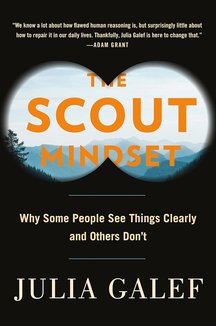
The Scout Mindset: Why Some People See Things Clearly and Others Don't
Author:
Julia Galef
"...an engaging and enlightening account from which we all can benefit."— The Wall Street Journal A better way to combat knee-jerk biases and make smarter decisions, from Julia Galef, the acclaimed expert on rational decision-making. When it comes to what we believe, humans see what they want to see.
"...an engaging and enlightening account from which we all can benefit."— The Wall Street Journal A better way to combat knee-jerk biases and make smarter decisions, from Julia Galef, the acclaimed expert on rational decision-making. When it comes to what we believe, humans see what they want to see. In other words, we have what Julia Galef calls a "soldier" mindset. From tribalism and wishful thinking, to rationalizing in our personal lives and everything in between, we are driven to defend the ideas we most want to believe—and shoot down those we don't. But if we want to get things right more often, argues Galef, we should train ourselves to have a "scout" mindset. Unlike the soldier, a scout's goal isn't to defend one side over the other. It's to go out, survey the territory, and come back with as accurate a map as possible. Regardless of what they hope to be the case, above all, the scout wants to know what's actually true. In The Scout Mindset , Galef shows that what makes scouts better at getting things right isn't that they're smarter or more knowledgeable than everyone else. It's a handful of emotional skills, habits, and ways of looking at the world—which anyone can learn. With fascinating examples ranging from how to survive being stranded in the middle of the ocean, to how Jeff Bezos avoids overconfidence, to how superforecasters outperform CIA operatives, to Reddit threads and modern partisan politics, Galef explores why our brains deceive us and what we can do to change the way we think.
Find this book on:


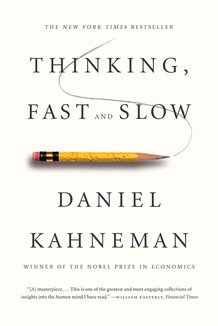
Thinking, Fast and Slow
Author:
Daniel Kahneman
*Major New York Times Bestseller *More than 2.6 million copies sold *One of The New York Times Book Review's ten best books of the year *Selected by The Wall Street Journal as one of the best nonfiction books of the year *Presidential Medal of Freedom Recipient *Daniel Kahneman's work with Amos Tversky is the subject of Michael Lewis's best-selling The Undoing Project: A Friendship That Changed Our Minds In his mega bestseller, Thinking, Fast and Slow , Daniel Kahneman, world-famous psychologist and winner of the Nobel Prize in Economics, takes us on a groundbreaking tour of the mind and explains the two systems that drive the way we think. System 1 is fast, intuitive, and emotional; System 2 is slower, more deliberative, and more logical.
*Major New York Times Bestseller *More than 2.6 million copies sold *One of The New York Times Book Review's ten best books of the year *Selected by The Wall Street Journal as one of the best nonfiction books of the year *Presidential Medal of Freedom Recipient *Daniel Kahneman's work with Amos Tversky is the subject of Michael Lewis's best-selling The Undoing Project: A Friendship That Changed Our Minds In his mega bestseller, Thinking, Fast and Slow , Daniel Kahneman, world-famous psychologist and winner of the Nobel Prize in Economics, takes us on a groundbreaking tour of the mind and explains the two systems that drive the way we think. System 1 is fast, intuitive, and emotional; System 2 is slower, more deliberative, and more logical. The impact of overconfidence on corporate strategies, the difficulties of predicting what will make us happy in the future, the profound effect of cognitive biases on everything from playing the stock market to planning our next vacation―each of these can be understood only by knowing how the two systems shape our judgments and decisions. Engaging the reader in a lively conversation about how we think, Kahneman reveals where we can and cannot trust our intuitions and how we can tap into the benefits of slow thinking. He offers practical and enlightening insights into how choices are made in both our business and our personal lives―and how we can use different techniques to guard against the mental glitches that often get us into trouble. Topping bestseller lists for almost ten years, Thinking, Fast and Slow is a contemporary classic, an essential book that has changed the lives of millions of readers.
Find this book on:
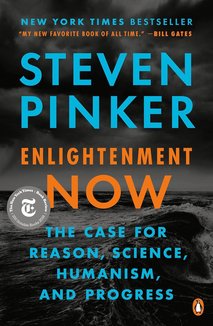
Enlightenment Now: The Case for Reason, Science, Humanism, and Progress
Author:
Steven Pinker
INSTANT NEW YORK TIMES BESTSELLER A NEW YORK TIMES NOTABLE BOOK OF 2018 ONE OF THE ECONOMIST'S BOOKS OF THE YEAR "My new favorite book of all time." --Bill Gates If you think the world is coming to an end, think again: people are living longer, healthier, freer, and happier lives, and while our problems are formidable, the solutions lie in the Enlightenment ideal of using reason and science. By the author of the new book, Rationality .
INSTANT NEW YORK TIMES BESTSELLER A NEW YORK TIMES NOTABLE BOOK OF 2018 ONE OF THE ECONOMIST'S BOOKS OF THE YEAR "My new favorite book of all time." --Bill Gates If you think the world is coming to an end, think again: people are living longer, healthier, freer, and happier lives, and while our problems are formidable, the solutions lie in the Enlightenment ideal of using reason and science. By the author of the new book, Rationality . Is the world really falling apart? Is the ideal of progress obsolete? In this elegant assessment of the human condition in the third millennium, cognitive scientist and public intellectual Steven Pinker urges us to step back from the gory headlines and prophecies of doom, which play to our psychological biases. Instead, follow the data: In seventy-five jaw-dropping graphs, Pinker shows that life, health, prosperity, safety, peace, knowledge, and happiness are on the rise, not just in the West, but worldwide. This progress is not the result of some cosmic force. It is a gift of the Enlightenment: the conviction that reason and science can enhance human flourishing. Far from being a naïve hope, the Enlightenment, we now know, has worked. But more than ever, it needs a vigorous defense. The Enlightenment project swims against currents of human nature--tribalism, authoritarianism, demonization, magical thinking--which demagogues are all too willing to exploit. Many commentators, committed to political, religious, or romantic ideologies, fight a rearguard action against it. The result is a corrosive fatalism and a willingness to wreck the precious institutions of liberal democracy and global cooperation. With intellectual depth and literary flair, Enlightenment Now makes the case for reason, science, and humanism: the ideals we need to confront our problems and continue our progress.
Find this book on:
Since its original publication in 1976, Perception and Misperception in International Politics has become a landmark book in its field, hailed by the New York Times as "the seminal statement of principles underlying political psychology." This new edition includes an extensive preface by the author reflecting on the book's lasting impact and legacy, particularly in the application of cognitive psychology to political decision making, and brings that analysis up to date by discussing the relevant psychological research over the past forty years. Jervis describes the process of perception (for example, how decision makers learn from history) and then explores common forms of misperception (such as overestimating one's influence).
Since its original publication in 1976, Perception and Misperception in International Politics has become a landmark book in its field, hailed by the New York Times as "the seminal statement of principles underlying political psychology." This new edition includes an extensive preface by the author reflecting on the book's lasting impact and legacy, particularly in the application of cognitive psychology to political decision making, and brings that analysis up to date by discussing the relevant psychological research over the past forty years. Jervis describes the process of perception (for example, how decision makers learn from history) and then explores common forms of misperception (such as overestimating one's influence). He then tests his ideas through a number of important events in international relations from nineteenth- and twentieth-century European history. Perception and Misperception in International Politics is essential for understanding international relations today.
Find this book on:
Episode overview
Can we predict the future more accurately?
It’s a question we humans have grappled with since the dawn of civilization — one that has massive implications for how we run our organizations, how we make policy decisions, and how we live our everyday lives.
It’s also the question that Philip Tetlock, a psychologist at the University of Pennsylvania and a co-author of “Superforecasting: The Art and Science of Prediction,” has dedicated his career to answering. In 2011, he recruited and trained a team of ordinary citizens to compete in a forecasting tournament sponsored by the U.S. intelligence community. Participants were asked to place numerical probabilities from 0 to 100 percent on questions like “Will North Korea launch a new multistage missile in the next year” and “Is Greece going to leave the eurozone in the next six months?” Tetlock’s group of amateur forecasters would go head-to-head against teams of academics as well as career intelligence analysts, including those from the C.I.A., who had access to classified information that Tetlock’s team didn’t have.
The results were shocking, even to Tetlock. His team won the competition by such a large margin that the government agency funding the competition decided to kick everyone else out, and just study Tetlock’s forecasters — the best of whom were dubbed “superforecasters” — to see what intelligence experts might learn from them.
So this conversation is about why some people, like Tetlock’s “superforecasters,” are so much better at predicting the future than everyone else — and about the intellectual virtues, habits of mind, and ways of thinking that the rest of us can learn to become better forecasters ourselves. It also explores Tetlock’s famous finding that the average expert is roughly as accurate as “a dart-throwing chimpanzee” at predicting future events, the inverse correlation between a person’s fame and their ability to make accurate predictions, how superforecasters approach real-life questions like whether robots will replace white-collar workers, why government bureaucracies are often resistant to adopt the tools of superforecasting and more.