
From this episode
Recommended books
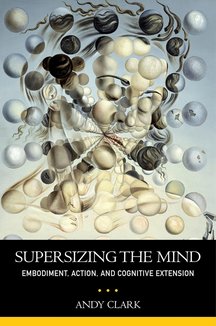
When historian Charles Weiner found pages of Nobel Prize-winning physicist Richard Feynman's notes, he saw it as a "record" of Feynman's work. Feynman himself, however, insisted that the notes were not a record but the work itself.
When historian Charles Weiner found pages of Nobel Prize-winning physicist Richard Feynman's notes, he saw it as a "record" of Feynman's work. Feynman himself, however, insisted that the notes were not a record but the work itself. In Supersizing the Mind , Andy Clark argues that our thinking doesn't happen only in our heads but that "certain forms of human cognizing include inextricable tangles of feedback, feed-forward and feed-around loops: loops that promiscuously criss-cross the boundaries of brain, body and world." The pen and paper of Feynman's thought are just such feedback loops, physical machinery that shape the flow of thought and enlarge the boundaries of mind. Drawing upon recent work in psychology, linguistics, neuroscience, artificial intelligence, robotics, human-computer systems, and beyond, Supersizing the Mind offers both a tour of the emerging cognitive landscape and a sustained argument in favor of a conception of mind that is extended rather than "brain-bound." The importance of this new perspective is profound. If our minds themselves can include aspects of our social and physical environments, then the kinds of social and physical environments we create can reconfigure our minds and our capacity for thought and reason.
Find this book on:


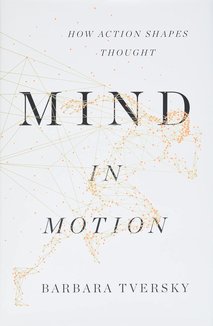
Mind in Motion: How Action Shapes Thought
Author:
Barbara Tversky
An eminent psychologist offers a major new theory of human cognition: movement, not language, is the foundation of thought When we try to think about how we think, we can't help but think of words. Indeed, some have called language the stuff of thought.
An eminent psychologist offers a major new theory of human cognition: movement, not language, is the foundation of thought When we try to think about how we think, we can't help but think of words. Indeed, some have called language the stuff of thought. But pictures are remembered far better than words, and describing faces, scenes, and events defies words. Anytime you take a shortcut or play chess or basketball or rearrange your furniture in your mind, you've done something remarkable: abstract thinking without words. In Mind in Motion , psychologist Barbara Tversky shows that spatial cognition isn't just a peripheral aspect of thought, but its very foundation, enabling us to draw meaning from our bodies and their actions in the world. Our actions in real space get turned into mental actions on thought, often spouting spontaneously from our bodies as gestures. Spatial thinking underlies creating and using maps, assembling furniture, devising football strategies, designing airports, understanding the flow of people, traffic, water, and ideas. Spatial thinking even underlies the structure and meaning of language: why we say we push ideas forward or tear them apart, why we're feeling up or have grown far apart. Like Thinking, Fast and Slow before it, Mind in Motion gives us a new way to think about how--and where--thinking takes place.
Find this book on:
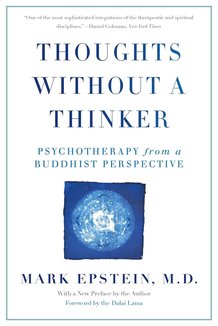
Thoughts Without A Thinker: Psychotherapy from a Buddhist Perspective
Author:
Mark Epstein
Blending the lessons of psychotherapy with Buddhist teachings, Mark Epstein offers a revolutionary understanding of what constitutes a healthy emotional life The line between psychology and spirituality has blurred, as clinicians, their patients, and religious seekers explore new perspectives on the self. A landmark contribution to the field of psychoanalysis, Thoughts Without a Thinker describes the unique psychological contributions offered by the teachings of Buddhism.
Blending the lessons of psychotherapy with Buddhist teachings, Mark Epstein offers a revolutionary understanding of what constitutes a healthy emotional life The line between psychology and spirituality has blurred, as clinicians, their patients, and religious seekers explore new perspectives on the self. A landmark contribution to the field of psychoanalysis, Thoughts Without a Thinker describes the unique psychological contributions offered by the teachings of Buddhism. Drawing upon his own experiences as a psychotherapist and meditator, New York-based psychiatrist Mark Epstein lays out the path to meditation-inspired healing, and offers a revolutionary new understanding of what constitutes a healthy emotional life.
Find this book on:
Episode overview
For decades, our society’s dominant metaphor for the mind has been a computer. A machine that operates the exact same way whether it’s in a dark room or next to a sunny window, whether it’s been working for 30 seconds or three hours, whether it’s near other computers or completely alone.
But that’s wrong. Annie Murphy Paul’s “The Extended Mind” argues, convincingly, that the human mind is contextual. It works differently in different environments, with different tools, amid different bodily states, among other minds.
Here’s the problem: Our schools, our workplaces, our society are built atop that bad metaphor. Activities and habits that we’ve been taught to associate with creativity and efficiency often stunt our thinking, and so much that we’ve been taught to dismiss — activities that look like leisure, play or rest — are crucial to thinking (and living!) well.
Paul’s book, read correctly, is a radical critique of not just how we think about thinking, but how we’ve constructed much of our society. In this conversation, we discuss how the body can pick up on patterns before the conscious mind knows what it’s seen, why forcing kids (and adults) to “sit still” makes it harder for them to think clearly, the connection between physical movement and creativity, why efficiency is often the enemy of productivity, the restorative power of exposure to the natural world, the dystopian implications of massive cognitive inequality, why open-plan offices were a terrible idea and much more.