
From this episode
Recommended books
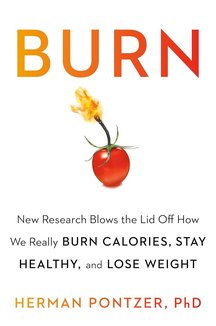
Burn: New Research Blows the Lid Off How We Really Burn Calories, Lose Weight, and Stay Healthy
Author:
Herman Pontzer PhD
One of the foremost researchers in human metabolism reveals surprising new science behind food and exercise. We burn 2,000 calories a day.
One of the foremost researchers in human metabolism reveals surprising new science behind food and exercise. We burn 2,000 calories a day. And if we exercise and cut carbs, we'll lose more weight. Right? Wrong. In this paradigm-shifting book, Herman Pontzer reveals for the first time how human metabolism really works so that we can finally manage our weight and improve our health. Pontzer's groundbreaking studies with hunter-gatherer tribes show how exercise doesn't increase our metabolism. Instead, we burn calories within a very narrow range: nearly 3,000 calories per day, no matter our activity level. This was a brilliant evolutionary strategy to survive in times of famine. Now it seems to doom us to obesity. The good news is we can lose weight, but we need to cut calories. Refuting such weight-loss hype as paleo, keto, anti-gluten, anti-grain, and even vegan, Pontzer discusses how all diets succeed or fail: For shedding pounds, a calorie is a calorie. At the same time, we must exercise to keep our body systems and signals functioning optimally, even if it won't make us thinner. Hunter-gatherers like the Hadza move about five hours a day and remain remarkably healthy into old age. But elite athletes can push the body too far, burning calories faster than their bodies can take them in. It may be that the most spectacular athletic feats are the result not just of great training, but of an astonishingly efficient digestive system. Revealing, irreverent, and always entertaining, Pontzer has written a book that will change how you eat, move, and live.
Find this book on:


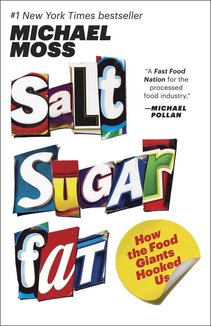
Salt Sugar Fat: How the Food Giants Hooked Us
Author:
Michael Moss
NAMED ONE OF THE BEST BOOKS OF THE YEAR BY The Atlantic • The Huffington Post • Men’s Journal • MSN (U.K.) • Kirkus Reviews • Publishers Weekly #1 NEW YORK TIMES BESTSELLER • WINNER OF THE JAMES BEARD FOUNDATION AWARD FOR WRITING AND LITERATURE Every year, the average American eats thirty-three pounds of cheese and seventy pounds of sugar. Every day, we ingest 8,500 milligrams of salt, double the recommended amount, almost none of which comes from the shakers on our table.
NAMED ONE OF THE BEST BOOKS OF THE YEAR BY The Atlantic • The Huffington Post • Men’s Journal • MSN (U.K.) • Kirkus Reviews • Publishers Weekly #1 NEW YORK TIMES BESTSELLER • WINNER OF THE JAMES BEARD FOUNDATION AWARD FOR WRITING AND LITERATURE Every year, the average American eats thirty-three pounds of cheese and seventy pounds of sugar. Every day, we ingest 8,500 milligrams of salt, double the recommended amount, almost none of which comes from the shakers on our table. It comes from processed food, an industry that hauls in $1 trillion in annual sales. In Salt Sugar Fat, Pulitzer Prize–winning investigative reporter Michael Moss shows how we ended up here. Featuring examples from Kraft, Coca-Cola, Lunchables, Frito-Lay, Nestlé, Oreos, Capri Sun, and many more, Moss’s explosive, empowering narrative is grounded in meticulous, eye-opening research. He takes us into labs where scientists calculate the “bliss point” of sugary beverages, unearths marketing techniques taken straight from tobacco company playbooks, and talks to concerned insiders who make startling confessions. Just as millions of “heavy users” are addicted to salt, sugar, and fat, so too are the companies that peddle them. You will never look at a nutrition label the same way again. Praise for Salt Sugar Fat “[Michael] Moss has written a Fast Food Nation for the processed food industry. Burrowing deep inside the big food manufacturers, he discovered how junk food is formulated to make us eat more of it and, he argues persuasively, actually to addict us.” —Michael Pollan “If you had any doubt as to the food industry’s complicity in our obesity epidemic, it will evaporate when you read this book.” — The Washington Post “Vital reading for the discerning food consumer.” — The Wall Street Journal “The chilling story of how the food giants have seduced everyone in this country . . . Michael Moss understands a vital and terrifying truth: that we are not just eating fast food when we succumb to the siren song of sugar, fat, and salt. We are fundamentally changing our lives—and the world around us.” —Alice Waters “Propulsively written [and] persuasively argued . . . an exactingly researched, deeply reported work of advocacy journalism.” — The Boston Globe “A remarkable accomplishment.” — The New York Times Book Review
Find this book on:
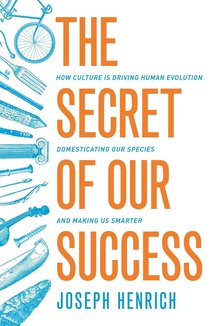
How our collective intelligence has helped us to evolve and prosper Humans are a puzzling species. On the one hand, we struggle to survive on our own in the wild, often failing to overcome even basic challenges, like obtaining food, building shelters, or avoiding predators.
How our collective intelligence has helped us to evolve and prosper Humans are a puzzling species. On the one hand, we struggle to survive on our own in the wild, often failing to overcome even basic challenges, like obtaining food, building shelters, or avoiding predators. On the other hand, human groups have produced ingenious technologies, sophisticated languages, and complex institutions that have permitted us to successfully expand into a vast range of diverse environments. What has enabled us to dominate the globe, more than any other species, while remaining virtually helpless as lone individuals? This book shows that the secret of our success lies not in our innate intelligence, but in our collective brains―on the ability of human groups to socially interconnect and learn from one another over generations. Drawing insights from lost European explorers, clever chimpanzees, mobile hunter-gatherers, neuroscientific findings, ancient bones, and the human genome, Joseph Henrich demonstrates how our collective brains have propelled our species' genetic evolution and shaped our biology. Our early capacities for learning from others produced many cultural innovations, such as fire, cooking, water containers, plant knowledge, and projectile weapons, which in turn drove the expansion of our brains and altered our physiology, anatomy, and psychology in crucial ways. Later on, some collective brains generated and recombined powerful concepts, such as the lever, wheel, screw, and writing, while also creating the institutions that continue to alter our motivations and perceptions. Henrich shows how our genetics and biology are inextricably interwoven with cultural evolution, and how culture-gene interactions launched our species on an extraordinary evolutionary trajectory. Tracking clues from our ancient past to the present, The Secret of Our Success explores how the evolution of both our cultural and social natures produce a collective intelligence that explains both our species' immense success and the origins of human uniqueness.
Find this book on:
Episode overview
Our society’s dominant narrative is that body size is a product of individual willpower. We are skinny or fat because of the choices we make: the kinds of food we buy, the amounts we eat, the exercise regimens we follow.
Research has never been kind to this thesis. It’s a folk narrative we use to punish people, not an empirical account of why residents of most rich countries are getting heavier over time. But, then, what account does fit the data?
In his 2017 book, “The Hungry Brain,” Stephan Guyenet, a neurobiologist, argues that weight gain is less about willpower than it is the product of an evolutionary mismatch between our brains, our genetics and our environments. Now a new class of weight loss drugs is raising the possibility that we can change our brains to fit this new environment.
Paired with diet and exercise, Ozempic and Wegovy caused anywhere from about a 15 percent to 18 percent loss of body weight over the course of just over a year in people classified as obese or overweight. And they do this in a way that aligns exactly with Guyenet’s research: They don’t make our bodies burn more calories, they make our brains crave less food.
So I asked Guyenet on the show to talk me through his model of weight gain, the research on these new drugs and the strange implications of living with old brains in a new world.