
From this episode
Recommended books
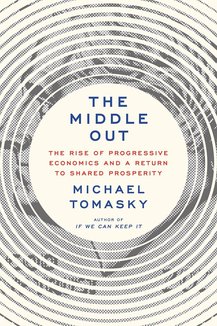
The Middle Out: The Rise of Progressive Economics and a Return to Shared Prosperity
Author:
Michael Tomasky
Political journalist Michael Tomasky tracks an exciting change among progressive economists who are overturning decades of conservative dogma and offering an alternative version of capitalism that can serve broadly shared prosperity to all. "Engaging, briskly paced ...
Political journalist Michael Tomasky tracks an exciting change among progressive economists who are overturning decades of conservative dogma and offering an alternative version of capitalism that can serve broadly shared prosperity to all. "Engaging, briskly paced ... On balance, history appears to be on Tomasky’s side." —The New York Times Book Review In the first half of the twentieth century the Keynesian brand of economics, which saw government spending as a necessary spur to economic growth, prevailed. Then in the 1970s, conservatives fought back. Once they got people to believe a few simple ideas instead—that only the free market could produce growth, that taxes and regulation stifle growth—the battle was won. The era of conservative dogma, often called neoliberal economics, had begun. It ushered in increasing inequality, a shrinking middle class, and declining public investment. For fifty years, liberals have not been able to make a dent in it. Until now. In The Middle Out , journalist Michael Tomasky narrates this history and reports on the work of today's progressive economists, who are using mountains of historical evidence to contradict neoliberal claims. Their research reveals conservative dogma to be unfounded and shows how concentrated wealth has been built on the exploitation of women, minorities, and the politically powerless. Middle-out economics, in contrast, is the belief that prosperity comes from a thriving middle class, and therefore government plays a role in supporting families and communities. This version of capitalism--more just, more equal, and in which prosperity is shared--could be the American future.
Find this book on:


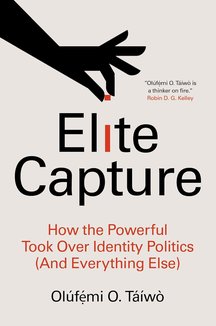
“Identity politics” is everywhere, polarizing discourse from the campaign trail to the classroom and amplifying antagonisms in the media, both online and off. But the compulsively referenced phrase bears little resemblance to the concept as first introduced by the radical Black feminist Combahee River Collective.
“Identity politics” is everywhere, polarizing discourse from the campaign trail to the classroom and amplifying antagonisms in the media, both online and off. But the compulsively referenced phrase bears little resemblance to the concept as first introduced by the radical Black feminist Combahee River Collective. While the Collective articulated a political viewpoint grounded in their own position as Black lesbians with the explicit aim of building solidarity across lines of difference, identity politics is now frequently weaponized as a means of closing ranks around ever-narrower conceptions of group interests. But the trouble, Olúfẹ́mi O. Táíwò deftly argues, is not with identity politics itself. Through a substantive engagement with the global Black radical tradition and a critical understanding of racial capitalism, Táíwò identifies the process by which a radical concept can be stripped of its political substance and liberatory potential by becoming the victim of elite capture—deployed by political, social, and economic elites in the service of their own interests. Táíwò’s crucial intervention both elucidates this complex process and helps us move beyond a binary of “class” vs. “race.” By rejecting elitist identity politics in favor of a constructive politics of radical solidarity, he advances the possibility of organizing across our differences in the urgent struggle for a better world.
Find this book on:
Episode overview
In the past few months, Joe Biden’s agenda has gone from a failed promise to real legislation.
Taken together, the CHIPS and Science Act and the Inflation Reduction Act (along with the Bipartisan Infrastructure Act) have the potential to put America on a path to decarbonization, develop some of the most advanced and crucial supply chains in the world, and build all kinds of next-generation technologies. It’s hard to overstate just how transformative these plans could be if they are carried out in the right way.
But that’s a big “if.” Because Biden’s legacy will not be written just in tax code and regulatory law. All of this legislation is about building things in the real world — from wind farms to semiconductor manufacturing plants to electric vehicle charging stations and so much more. Which means the hard work isn’t over. It’s just beginning.
Felicia Wong is the president and chief executive of the Roosevelt Institute and someone who has had an unusually clear read of the Biden administration from the beginning. Wong has been arguing that Biden wants to fundamentally reshape the productive capacity of the economy. And now he’s gotten approval of bills that have the potential to do just that. But Wong is also realistic about the obstacles in the way of realizing that project. And so the question at the center of this conversation is: What will it take to turn the Biden agenda from written legislation into lived reality?
We also discuss the death of the “care infrastructure” for helping families that was at the heart of the Build Back Better proposal, the challenges of building up the American semiconductor industry, why some progressives view these bills as “corporate welfare,” the conservative argument that government shouldn’t be “picking winners and losers,” how these bills could respond to America’s deep regional inequalities, how to address the problem of NIMBYism, what participatory budgeting and worker cooperatives can teach us about better ways to represent community voices, why we should want the government to take bigger risks even if that means more government failure, and much more