Recommended Books
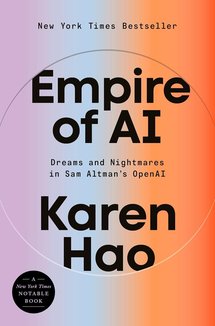
Empire of AI: Dreams and Nightmares in Sam Altman's OpenAI
Author:
Karen Hao
ISBN 13:
978-0593657508
A New York Times Notable Book • Finalist for the National Book Critics Circle Award • An Instant New York Times Bestseller • Named a Best Book of the Year by Smithsonian , Scientific American, and Elle • Porchlight 2025 Business Book Award Winner “A bestselling page-turner that has made waves not just in Silicon Valley but around the world . . . With Empire of AI, Hao is fundamentally shaping many people’s perceptions and understanding of the company at the center of the AI revolution.” —TIME Magazine , “TIME100 AI 2025” “Excellent and deeply reported.” —Tim Wu, The New York Times “Startling and intensely researched . . . an essential account of how OpenAI and ChatGPT came to be and the catastrophic places they will likely take us.” — Vulture From a brilliant longtime AI insider with intimate access to the world of Sam Altman's OpenAI from the beginning, an eye-opening account of arguably the most fateful tech arms race in history, reshaping the planet in real time, from the cockpit of the company that is driving the frenzy When AI expert and investigative journalist Karen Hao first began covering OpenAI in 2019, she thought they were the good guys. Founded as a nonprofit with safety enshrined as its core mission, the organization was meant, its leader Sam Altman told us, to act as a check against more purely mercantile, and potentially dangerous, forces. What could go wrong? Over time, Hao began to wrestle ever more deeply with that question. Increasingly, she realized that the core truth of this massively disruptive sector is that its vision of success requires an almost unprecedented amount of resources: the “compute” power of high-end chips and the processing capacity to create massive large language models, the sheer volume of data that needs to be amassed at scale, the humans “cleaning up” that data for sweatshop wages throughout the Global South, and a truly alarming spike in the usage of energy and water underlying it all. The truth is that we have entered a new and ominous age of empire: only a small handful of globally scaled companies can even enter the field of play. At the head of the pack with its ChatGPT breakthrough, how would OpenAI resist such temptations? Spoiler alert: it didn’t. Armed with Microsoft’s billions, OpenAI is setting a breakneck pace, chased by a small group of the most valuable companies in human history—toward what end, not even they can define. All this time, Hao has maintained her deep sourcing within the company and the industry, and so she was in intimate contact with the story that shocked the entire tech industry—Altman’s sudden firing and triumphant return. The behind-the-scenes story of what happened, told here in full for the first time, is revelatory of who the people controlling this technology really are. But this isn’t just the story of a single company, however fascinating it is. The g forces pressing down on the people of OpenAI are deforming the judgment of everyone else too—as such forces do. Naked power finds the ideology to cloak itself; no one thinks they’re the bad guy. But in the meantime, as Hao shows through intrepid reporting on the ground around the world, the enormous wheels of extraction grind on. By drawing on the viewpoints of Silicon Valley engineers, Kenyan data laborers, and Chilean water activists, Hao presents the fullest picture of AI and its impact we’ve seen to date, alongside a trenchant analysis of where things are headed. An astonishing eyewitness view from both up in the command capsule of the new economy and down where the real suffering happens, Empire of AI pierces the veil of the industry defining our era.


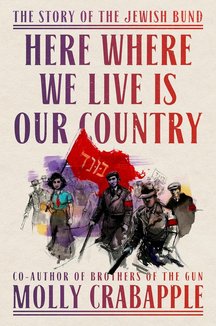
Here Where We Live Is Our Country: The Story of the Jewish Bund
Author:
Molly Crabapple
ISBN 13:
978-0593229453
The dramatic story of the Jewish Bund—a revolutionary movement from a vanished world—and its radical vision of solidarity in an age of division. “Molly Crabapple beckons readers through a portal to an irresistible, lost world, one bound together by passion, solidarity, and a burning hunger for justice.”—Naomi Klein, New York Times bestselling author of No Logo and Doppelganger In the aftermath of the Holocaust, Sam Rothbort created “memory paintings” with the hope of resurrecting the vanished world of his shtetl childhood. Decades later, his great-granddaughter, the award-winning artist Molly Crabapple, discovered these paintings and one stood out: a girl, her dress the color of sky, hurling a rock through a cottage window. Itka the Bundist, Breaking Windows . Itka is how Crabapple met the Jewish Labor Bund. Once the most influential Jewish political force in eastern Europe, the Bund was secular, socialist, and uncompromisingly anti-Zionist. The Bundists fought for dignity and equality, not in an imagined homeland in Palestine but “here where we live.” In the first popular history of the Bund, Crabapple re-creates their extraordinary world through dramatic portraits of insurgent poets and antireligious rebels, clandestine revolutionaries and lovers on the barricades. The Bundists live deeply within this violent, volatile, and somehow hopeful period, as their stories interweave with the Russian Revolution and the Holocaust. The Bund’s rise and fall raises the vital question: What can we learn from a movement that, for all its toughness, imagination, and moral clarity, was largely destroyed? Here Where We Live Is Our Country reanimates a band of idealists who broadened our global political imagination. As we once again contend with nationalism, repression, and the struggle for belonging, the Bund’s remarkable story and message—that liberation, dignity, and solidarity must begin where we stand—reaches across time as a guide to our own urgent moment.
Fire Alarm: Reading Walter Benjamin's 'On the Concept of History'
Authors:
Michael Lowy
,
Chris Turner
ISBN 13:
978-1784786410
This illuminating study of Benjamin’s final essay helps unlock the mystery of this great philosopher Revolutionary critic of the philosophy of progress, nostalgic of the past yet dreaming of the future, romantic partisan of materialism—Walter Benjamin is in every sense of the word an “unclassifiable” philosopher. His essay “On the Concept of History” was written in a state of urgency, as he attempted to escape the Gestapo in 1940, before finally committing suicide. In this scrupulous, clear and fascinating examination of this essay, Michael Löwy argues that it remains one of the most important philosophical and political writings of the twentieth century. Looking in detail at Benjamin’s celebrated but often mysterious text, and restoring the philosophical, theological and political context, Löwy highlights the complex relationship between redemption and revolution in Benjamin’s philosophy of history.