
From this episode
Recommended books
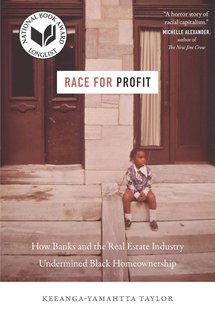
Race for Profit: How Banks and the Real Estate Industry Undermined Black Homeownership (Justice, Power, and Politics)
Author:
Keeanga-Yamahtta Taylor
LONGLISTED FOR THE 2019 NATIONAL BOOK AWARD FINALIST, 2020 PULITZER PRIZE IN HISTORY By the late 1960s and early 1970s, reeling from a wave of urban uprisings, politicians finally worked to end the practice of redlining. Reasoning that the turbulence could be calmed by turning Black city-dwellers into homeowners, they passed the Housing and Urban Development Act of 1968, and set about establishing policies to induce mortgage lenders and the real estate industry to treat Black homebuyers equally.
LONGLISTED FOR THE 2019 NATIONAL BOOK AWARD FINALIST, 2020 PULITZER PRIZE IN HISTORY By the late 1960s and early 1970s, reeling from a wave of urban uprisings, politicians finally worked to end the practice of redlining. Reasoning that the turbulence could be calmed by turning Black city-dwellers into homeowners, they passed the Housing and Urban Development Act of 1968, and set about establishing policies to induce mortgage lenders and the real estate industry to treat Black homebuyers equally. The disaster that ensued revealed that racist exclusion had not been eradicated, but rather transmuted into a new phenomenon of predatory inclusion . Race for Profit uncovers how exploitative real estate practices continued well after housing discrimination was banned. The same racist structures and individuals remained intact after redlining's end, and close relationships between regulators and the industry created incentives to ignore improprieties. Meanwhile, new policies meant to encourage low-income homeownership created new methods to exploit Black homeowners. The federal government guaranteed urban mortgages in an attempt to overcome resistance to lending to Black buyers – as if unprofitability, rather than racism, was the cause of housing segregation. Bankers, investors, and real estate agents took advantage of the perverse incentives, targeting the Black women most likely to fail to keep up their home payments and slip into foreclosure, multiplying their profits. As a result, by the end of the 1970s, the nation's first programs to encourage Black homeownership ended with tens of thousands of foreclosures in Black communities across the country. The push to uplift Black homeownership had descended into a goldmine for realtors and mortgage lenders, and a ready-made cudgel for the champions of deregulation to wield against government intervention of any kind. Narrating the story of a sea-change in housing policy and its dire impact on African Americans, Race for Profit reveals how the urban core was transformed into a new frontier of cynical extraction.
Find this book on:



Random Family: Love, Drugs, Trouble, and Coming of Age in the Bronx
Author:
Adrian Nicole LeBlanc
Selected as One of the Best Books of the 21st Century by The New York Times Set amid the havoc of the War on Drugs, this New York Times bestseller is an "astonishingly intimate" ( New York magazine) chronicle of one family’s triumphs and trials in the South Bronx of the 1990s. “Unmatched in depth and power and grace.
Selected as One of the Best Books of the 21st Century by The New York Times Set amid the havoc of the War on Drugs, this New York Times bestseller is an "astonishingly intimate" ( New York magazine) chronicle of one family’s triumphs and trials in the South Bronx of the 1990s. “Unmatched in depth and power and grace. A profound, achingly beautiful work of narrative nonfiction … The standard-bearer of embedded reportage.” —Matthew Desmond, author of Evicted In her classic bestseller, journalist Adrian Nicole LeBlanc immerses readers in the world of one family with roots in the Bronx, New York. In 1989, LeBlanc approached Jessica, a young mother whose encounter with the carceral state is about to forever change the direction of her life. This meeting redirected LeBlanc’s reporting, taking her past the perennial stories of crime and violence into the community of women and children who bear the brunt of the insidious violence of poverty. Her book bears witness to the teetering highs and devastating lows in the daily lives of Jessica, her family, and her expanding circle of friends. Set at the height of the War on Drugs, Random Family is a love story—an ode to the families that form us and the families we create for ourselves. Charting the tumultuous struggle of hope against deprivation over three generations, LeBlanc slips behind the statistics and comes back with a riveting, haunting, and distinctly American true story.
Find this book on:
Episode overview
According to the Center on Poverty and Social Policy at Columbia University, 14.3 percent of Americans — nearly 50 million people — were living in poverty in December. The scale of poverty in the U.S. dwarfs that of most of our peer countries. And it raises the question: Why does so much poverty persist in one of the richest countries in the world?
For the Princeton sociologist Matthew Desmond, the answer is simple: Poverty is a policy choice. It persists because we allow it to. And we allow it to persist because so many of us — whether we realize it or not — benefit from the exploitation of the poor.
Desmond’s 2016 book, the Pulitzer Prize winner “Evicted,” was a powerful ethnographic account of what it means to experience the depths of poverty. But his new book, “Poverty, by America,” is less about the poor than it is about the rest of us. It is about the people who are more comfortable with the perpetuation of poverty than with the changes that would be demanded for its abolition.
So this conversation is about why poverty in America persists, the choices we could make to end it and why we as a country are so stubbornly resistant to making those choices. We also discuss the heated debate over how to measure poverty in the first place, why Desmond thinks poverty is primarily a product of “exploitation,” why over $140 billion of government aid ends up never making it into the hands of the people it’s intended to help, Desmond’s view that the U. S. does “more to subsidize affluence than to alleviate poverty,” why the daily cognitive cost of poverty is as severe as losing a night of sleep, how the U. S. passed its most successful anti-poverty policy in decades and then let it expire, why Americans seem more willing to tolerate high poverty than high prices, why Desmond thinks sectoral bargaining and public housing are key pillars of any anti-poverty agenda, what it means to become a “poverty abolitionist” and more.