From this episode
Recommended books
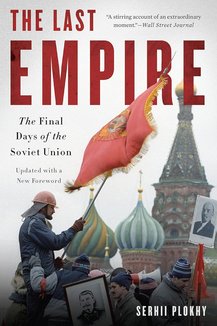
The Last Empire: The Final Days of the Soviet Union
Author:
Serhii Plokhy
The New York Times bestselling author of The Gates of Europe offers “a stirring account of an extraordinary moment” in Russian history ( Wall Street Journal ) On Christmas Day, 1991, President George H. W.
The New York Times bestselling author of The Gates of Europe offers “a stirring account of an extraordinary moment” in Russian history ( Wall Street Journal ) On Christmas Day, 1991, President George H. W. Bush addressed the nation to declare an American victory in the Cold War: earlier that day Mikhail Gorbachev had resigned as the first and last Soviet president. The enshrining of that narrative, one in which the end of the Cold War was linked to the disintegration of the Soviet Union and the triumph of democratic values over communism, took center stage in American public discourse immediately after Bush's speech and has persisted for decades -- with disastrous consequences for American standing in the world. As prize-winning historian Serhii Plokhy reveals in The Last Empire , the collapse of the Soviet Union was anything but the handiwork of the United States. Bush, in fact, was firmly committed to supporting Gorbachev as he attempted to hold together the USSR in the face of growing independence movements in its republics. Drawing on recently declassified documents and original interviews with key participants, Plokhy presents a bold new interpretation of the Soviet Union's final months, providing invaluable insight into the origins of the current Russian-Ukrainian conflict and the outset of the most dangerous crisis in East-West relations since the end of the Cold War. Winner of the Lionel Gelber Prize Winner of the Pushkin House Russian Book Prize Choice Outstanding Academic Title BBC History Magazine Best History Book of the Year
Find this book on:


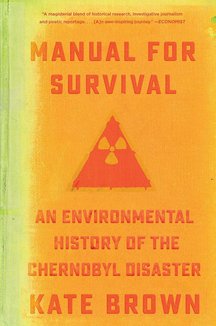
Manual for Survival: An Environmental History of the Chernobyl Disaster
Author:
Kate Brown
Winner of the Reginald Zelnik Book Prize in History Winner of the Marshall D. Shulman Book Prize Finalist for the National Book Critics Circle Award in Nonfiction Finalist for the Ryszard Kapuscinski Award for Literary Reportage "A magisterial blend of historical research, investigative journalism, and poetic reportage…[A]n awe-inspiring journey." ― Economist After the Chernobyl nuclear disaster in 1986, international aid organizations sought to help the victims but were stymied by post-Soviet political roadblocks.
Winner of the Reginald Zelnik Book Prize in History Winner of the Marshall D. Shulman Book Prize Finalist for the National Book Critics Circle Award in Nonfiction Finalist for the Ryszard Kapuscinski Award for Literary Reportage "A magisterial blend of historical research, investigative journalism, and poetic reportage…[A]n awe-inspiring journey." ― Economist After the Chernobyl nuclear disaster in 1986, international aid organizations sought to help the victims but were stymied by post-Soviet political roadblocks. Efforts to gain access to the site of catastrophic radiation damage were denied, and the residents of Chernobyl were given no answers as their lives hung in the balance. Drawing on a decade of archival research and on-the-ground interviews in Ukraine, Russia, and Belarus, Kate Brown unveils the full breadth of the devastation and the whitewash that followed. Her findings make clear the irreversible impact of man-made radioactivity on every living thing; and hauntingly, they force us to confront the untold legacy of decades of weapons-testing and other catastrophic nuclear incidents.
Find this book on:
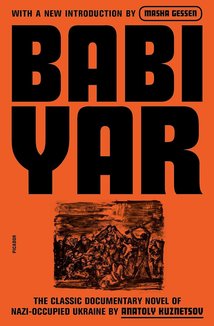
Babi Yar
Author:
Anatoly Kuznetsov
"[A] masterpiece . .
"[A] masterpiece . . . Babi Yar [is] every bit the peer of the canonical works of witness [such as] Anne Frank's diary . . . Wiesel's Night . . . Solzhenityn's Gulag Archipelago . " ―George Packer, The Atlantic An internationally acclaimed documentary novel that describes the fateful collision of Russia, Ukraine, and Nazi Germany, and one of the largest mass executions of the Holocaust, with a new introduction by Masha Gessen. “I wonder if we shall ever understand that the most precious thing in this world is a man’s life and his freedom? Or is there still more barbarism ahead? With these questions I think I shall bring this book to an end. I wish you peace. And freedom.” At the age of twelve, Anatoly Kuznetsov experienced the Nazi invasion of Ukraine, and soon began keeping a diary of the brutal occupation of Kiev that followed. Years later, he combined those notebooks with other survivors’ memories to create a classic work of documentary witness in the form of a novel. When Babi Yar was first published in a Soviet magazine in 1966, it became a literary sensation, not least for its powerful and unprecedented narratives of the Nazi massacre of the city’s Jews, and later Roma, prisoners of war, and other victims, at the Babi Yar ravine―one of the largest mass killings of the Holocaust. After Kuznetsov defected to Great Britain in 1969, he republished the book in a new edition that included extensive passages censored by the Soviets, along with his later reflections. In its fully realized form, Babi Yar is a classic of Holocaust and World War II testimony. With sustained immediacy, it relates a scrappy but principled boy’s day-to-day fight to survive and provide for his family. He dodges bullets and avoids transport to Germany, befriends black market horse dealers and pre-revolutionary aristocrats, wonders at the pomp of the Nazi’s opera performances, overhears his mother and grandparents debate the merits of German versus Soviet rule, collects grenades, digs hiding places, and confronts the moral dilemmas of assisting neighbors or looting stores―all the while hearing the constant hum of bullets at the Babi Yar ravine nearby. In a bravura feat of reporting, he tells the story of what happened at Babi Yar―from the deceptive roundup of the city’s Jews and execution of the national soccer team, to the memories of the site’s few survivors and the story of a daring escape. The book’s once-censored passages explore the Soviet effort to hide the realities of the massacre and other facts about wartime that the regime did not want discussed. In the manner of Elie Wiesel’s Night or The Diary of Anne Frank , here is a book that tells some of the most uncomfortable truths of the past century―and the most essential.
Find this book on:
Episode overview
For Western audiences, the past few weeks have been a torrent of information about what’s happening in Russia and Ukraine. Daily updates of Russian military advances. Horrifying videos of buildings exploding and innocent civilians being killed. Announcements of increasingly severe economic sanctions and major corporate pullouts. Charts showing the collapse of the ruble. Story after story about the hardships facing the Russian economy.
Most Russians, however, are living in an alternate reality. This week, the Russian government made it a crime for journalists to spread what it considers false information about the “special military operation” in Ukraine — information that would include calling the war a war. As a result, many Western news organizations, including The Times, have pulled their employees out of Russia. The Kremlin has made it nearly impossible for people in Russia to access independent or international news sources. Russian state media coverage of the conflict has been, in the words of my guest today, “bland and bloodless.”
That raises some important questions: What do ordinary Russians know about the war being waged by their government? How are they interpreting the collapse of their currency and impending financial crisis? What are they being told to believe? And is the propaganda machine working?
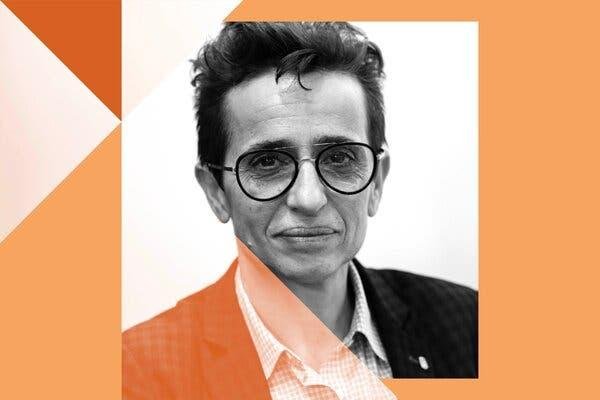
Masha Gessen is a staff writer at The New Yorker and the author of many books on Russian history, politics and culture, including “The Man Without a Face: The Unlikely Rise of Vladimir Putin” and the National Book Award-winning “The Future Is History: How Totalitarianism Reclaimed Russia.” And, perhaps most important, Gessen has been on the ground in Russia in recent weeks trying to understand how ordinary Russians are seeing and interpreting the world around them.
This is a conversation that starts in Moscow, as Gessen describes what it was like to be there during the first days of the invasion. We talk about the eerie sense of normalcy in the city as the ruble crashed and the odd sense of calm in Pushkin Square as policemen in combat gear dragged protesters into a police bus. We then take a wider view on how Russians responded to economic sanctions in the past, how totalitarian societies make it impossible for people to form opinions, where Putin sees himself in a lineage of “brutal, expansionist dictators” like Ivan the Terrible and Joseph Stalin, why Putin governs Russia as if it were a 19th-century empire, what we learn when we listen closely to Putin’s speeches and how this latest act of aggression is likely to play out.