From this episode
Recommended books
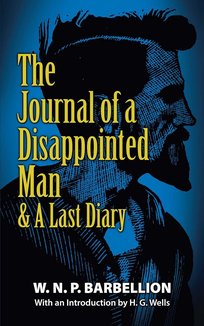
The Journal of a Disappointed Man: & A Last Diary
Author:
W.N.P. Barbellion
Published shortly before the author's death in 1919, The Journal of a Disappointed Man presents a remarkable memoir that addresses struggles with poverty, inadequate education, and the creeping paralysis of multiple sclerosis. Yet author W.
Published shortly before the author's death in 1919, The Journal of a Disappointed Man presents a remarkable memoir that addresses struggles with poverty, inadequate education, and the creeping paralysis of multiple sclerosis. Yet author W. N. P. Barbellion manages to write with uplifting eloquence and passion of his love for family, natural history, music, and literature. Told with a thoroughly modern voice, the unjustly overlooked Journal is reprinted here with its posthumous successor, A Last Diary. This edition features a thoughtful Introduction by H. G. Wells, who writes of the book's "exquisite beauty." W. N. P. Barbellion (1889–1919), whose real name was Bruce Frederick Cummings, was a naturalist who worked in the Entomology Department of London's Natural History Museum. Upon attempting to enlist in the British Army during World War I, he was diagnosed with multiple sclerosis. The discovery of his disease intensified the tenor of his journal-keeping, and his frank and articulate reflections on coping with a fatal illness remain a powerful testament to his life and struggles.
Find this book on:


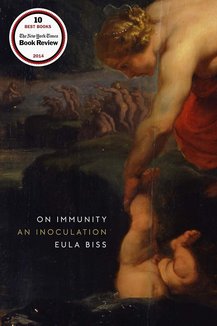
On Immunity: An Inoculation
Author:
Eula Biss
“ On Immunity is a book I’ve recommended too many times to count―a searching, empathetic, ultimately unassailable argument, not just for vaccination but for thoroughly acknowledging our interdependence, and for all that becomes necessary and possible once we do. Written before COVID, it nonetheless speaks directly to the concerns of the pandemic era―to the fact that we are dangerous as well as vulnerable, to the way collective well-being and individual self-interest are configured at odds to one another when they are fundamentally intertwined.”―Jia Tolentino In this bold, fascinating book, Eula Biss addresses our fear of the government, the medical establishment, and what may be in our children's air, food, mattresses, medicines, and vaccines.
“ On Immunity is a book I’ve recommended too many times to count―a searching, empathetic, ultimately unassailable argument, not just for vaccination but for thoroughly acknowledging our interdependence, and for all that becomes necessary and possible once we do. Written before COVID, it nonetheless speaks directly to the concerns of the pandemic era―to the fact that we are dangerous as well as vulnerable, to the way collective well-being and individual self-interest are configured at odds to one another when they are fundamentally intertwined.”―Jia Tolentino In this bold, fascinating book, Eula Biss addresses our fear of the government, the medical establishment, and what may be in our children's air, food, mattresses, medicines, and vaccines. Reflecting on her own experience as a new mother, she suggests that we cannot immunize our children, or ourselves, against the world. As she explores the metaphors surrounding immunity, Biss extends her conversations with other mothers to meditations on the myth of Achilles, Voltaire's Candide , Bram Stoker's Dracula , Rachel Carson's Silent Spring , Susan Sontag's AIDS and Its Metaphors , and beyond. On Immunity is an inoculation against our fear and a moving account of how we are all interconnected-our bodies and our fates.
Find this book on:
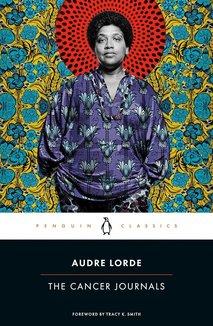
The Cancer Journals
Authors:
Audre Lorde,
Tracy K. Smith
Moving between journal entry, memoir, and exposition, Audre Lorde fuses the personal and political as she reflects on her experience coping with breast cancer and a radical mastectomy. A Penguin Classic First published over forty years ago, The Cancer Journals is a startling, powerful account of Audre Lorde's experience with breast cancer and mastectomy.
Moving between journal entry, memoir, and exposition, Audre Lorde fuses the personal and political as she reflects on her experience coping with breast cancer and a radical mastectomy. A Penguin Classic First published over forty years ago, The Cancer Journals is a startling, powerful account of Audre Lorde's experience with breast cancer and mastectomy. Long before narratives explored the silences around illness and women's pain, Lorde questioned the rules of conformity for women's body images and supported the need to confront physical loss not hidden by prosthesis. Living as a "black, lesbian, mother, warrior, poet," Lorde heals and re-envisions herself on her own terms and offers her voice, grief, resistance, and courage to those dealing with their own diagnosis. Poetic and profoundly feminist, Lorde's testament gives visibility and strength to women with cancer to define themselves, and to transform their silence into language and action.
Find this book on:
Episode overview
One of the most frightening, least understood aspects of the coronavirus pandemic is what’s come to be known as “long Covid.” Stories abound of young, healthy adults who experienced mild or asymptomatic coronavirus infections and recovered fairly quickly, only to experience an onset of debilitating symptoms weeks or even months later. One major study of almost two million Covid patients in the United States found that nearly a quarter sought medical treatment for new conditions one month or more after their initial infection.
Scientists still don’t fully understand what’s causing long Covid or how to best treat it. But in that sense, long Covid isn’t all that novel. Today, millions of Americans suffer from chronic illnesses set off by the body’s response to infections. Many of these conditions routinely go undiagnosed or are misdiagnosed. And even those who find their conditions identified correctly often struggle to find treatments that work for them.
“To have a poorly understood disease,” writes Meghan O’Rourke, “is to be brought up against every flaw in the U.S. health care system; to collide with the structural problems of a late-capitalist society that values productivity more than health; and to confront the philosophical problem of conveying an experience that lacks an accepted framework.”
O’Rourke, an award-winning journalist and poet and the editor of The Yale Review, has spent more than a decade of her life struggling with chronic illness, a journey she documents in her forthcoming book, “The Invisible Kingdom: Reimagining Chronic Illness.” In it, O’Rourke uses her experience to illuminate the facets of American society that often remain invisible to the rest of us: the blind spots in our scientific and medical paradigms, the shortcomings of our individualistic ethos, the way economic inequalities show up in our bodies, our culture’s tendency to pathologize suffering.
So this conversation begins with long Covid and the debates surrounding it, which O’Rourke has done excellent reporting and writing on. But it is also about what it’s like to experience America’s hidden chronic illness epidemic firsthand, and what that epidemic reveals about the society that too often pretends it doesn’t exist.