
From this episode
Recommended books
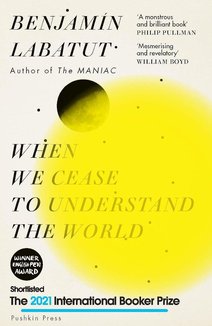
When We Cease to Understand the World
Authors:
Benjamin Labatut,
Adrian Nathan West,
Labatut Benjamin
SHORTLISTED FOR THE 2021 INTERNATIONAL BOOKER PRIZE A GUARDIAN FICTION BOOK OF THE YEAR 'A monstrous and brilliant book' Philip Pullman 'Wholly mesmerising and revelatory... Completely fascinating' William Boyd Sometimes discovery brings destruction When We Cease to Understand the World shows us great minds striking out into dangerous, uncharted terrain.
SHORTLISTED FOR THE 2021 INTERNATIONAL BOOKER PRIZE A GUARDIAN FICTION BOOK OF THE YEAR 'A monstrous and brilliant book' Philip Pullman 'Wholly mesmerising and revelatory... Completely fascinating' William Boyd Sometimes discovery brings destruction When We Cease to Understand the World shows us great minds striking out into dangerous, uncharted terrain. Fritz Haber, Alexander Grothendieck, Werner Heisenberg, Erwin Schrödinger: these are among the luminaries into whose troubled minds we are thrust as they grapple with the most profound questions of existence. They have strokes of unparalleled genius, they alienate friends and lovers, they descend into isolated states of madness. Some of their discoveries revolutionise our world for the better; others pave the way to chaos and unimaginable suffering. The lines are never clear. With breakneck pace and wondrous detail, Benjamín Labatut uses the imaginative resources of fiction to break open the stories of scientists and mathematicians who expanded our notions of the possible.
Find this book on:


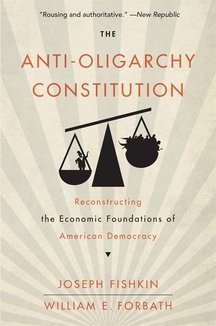
The Anti-Oligarchy Constitution: Reconstructing the Economic Foundations of American Democracy
Authors:
Joseph Fishkin,
William E. Forbath
“Eminently readable, and anybody who cares about the future of American democracy in these perilous times can only hope that it will be widely read and carefully considered.” ―James Pope, Washington Post “Fishkin and Forbath’s accessible work serves as both history lesson and political playbook, offering the Left an underutilized―and perhaps counterintuitive―tool in the present-day fight against social and economic injustice: the Constitution.” ―Benjamin Morse, Jacobin “Aims to recover the Constitution’s pivotal role in shaping claims of justice and equality…in engaging, imaginative prose that makes even the present court’s capture by the ideological right a compelling platform for a revived social-democratic constitutional politics.” ― New Republic Oligarchy is a threat to the American republic. When too much economic and political power is concentrated in too few hands, we risk losing the “republican form of government” the Constitution requires.
“Eminently readable, and anybody who cares about the future of American democracy in these perilous times can only hope that it will be widely read and carefully considered.” ―James Pope, Washington Post “Fishkin and Forbath’s accessible work serves as both history lesson and political playbook, offering the Left an underutilized―and perhaps counterintuitive―tool in the present-day fight against social and economic injustice: the Constitution.” ―Benjamin Morse, Jacobin “Aims to recover the Constitution’s pivotal role in shaping claims of justice and equality…in engaging, imaginative prose that makes even the present court’s capture by the ideological right a compelling platform for a revived social-democratic constitutional politics.” ― New Republic Oligarchy is a threat to the American republic. When too much economic and political power is concentrated in too few hands, we risk losing the “republican form of government” the Constitution requires. Today, courts enforce the Constitution as if it had almost nothing to say about this threat. But as this revolutionary retelling of constitutional history shows, a commitment to prevent oligarchy once stood at the center of a robust tradition in American political and constitutional thought. Joseph Fishkin and William Forbath demonstrate that reformers, legislators, and even judges working in this “democracy-of-opportunity” tradition understood that the Constitution imposes a duty on legislatures to thwart oligarchy and promote a broad distribution of wealth and political power. These ideas led Jacksonians to fight special economic privileges for the few, Populists to try to break up monopoly power, and Progressives to battle for the constitutional right to form a union. But today, as we enter a new Gilded Age, this tradition in progressive American economic and political thought lies dormant. The Anti-Oligarchy Constitution begins the work of recovering it and exploring its profound implications for our deeply unequal society and badly damaged democracy.
Find this book on:
The Second Creation: Fixing the American Constitution in the Founding Era
Author:
Jonathan Gienapp
A stunning revision of our founding document’s evolving history that forces us to confront anew the question that animated the founders so long ago: What is our Constitution? Americans widely believe that the United States Constitution was created when it was drafted in 1787 and ratified in 1788.
A stunning revision of our founding document’s evolving history that forces us to confront anew the question that animated the founders so long ago: What is our Constitution? Americans widely believe that the United States Constitution was created when it was drafted in 1787 and ratified in 1788. But in a shrewd rereading of the Founding era, Jonathan Gienapp upends this long-held assumption, recovering the unknown story of American constitutional creation in the decade after its adoption―a story with explosive implications for current debates over constitutional originalism and interpretation. When the Constitution first appeared, it was shrouded in uncertainty. Not only was its meaning unclear, but so too was its essential nature. Was the American Constitution a written text, or something else? Was it a legal text? Was it finished or unfinished? What rules would guide its interpretation? Who would adjudicate competing readings? As political leaders put the Constitution to work, none of these questions had answers. Through vigorous debates they confronted the document’s uncertainty, and―over time―how these leaders imagined the Constitution radically changed. They had begun trying to fix, or resolve, an imperfect document, but they ended up fixing, or cementing, a very particular notion of the Constitution as a distinctively textual and historical artifact circumscribed in space and time. This means that some of the Constitution’s most definitive characteristics, ones which are often treated as innate, were only added later and were thus contingent and optional.
Find this book on:
Episode overview
For decades now, the conservative legal movement has been on a mission to remake this nation’s laws from the bench. And it’s working. On Friday we released an episode with the legal scholar Kate Shaw that walked through case after case showing how conservative Supreme Court majorities have lurched this country’s laws to the right on guns, voting, gerrymandering, regulatory authority, unions, campaign finance and more in the past 20 years. And if the Dobbs majority is any indication, this rightward shift is just getting started.
But this conservative legal revolution is only half of the story. The other half is just as important: the collapse of liberal constitutional thinking. Liberals have “lost anything that would animate a positive theory of what the Constitution should be,” says the legal scholar Larry Kramer. “And so they’ve been left with a kind of potpourri of leftover things from the periods when liberals were ascendant in the ’60s and ’70s.”
Kramer is a former dean of Stanford Law School, the current president of the William and Flora Hewlett Foundation and the author of“The People Themselves: Popular Constitutionalism and Judicial Review.” And according to him, it hasn’t always been this way. For most of American history, politicians, from Jefferson to Lincoln to Franklin Roosevelt, believed that constitutional interpretation was inextricable from politics. And they put forward distinct visions of what the Constitution meant and the kind of country it was written to build. But then, in response to the progressive victories of the Warren court, liberals began to embrace the doctrine of judicial supremacy: the view that the final authority on the Constitution rests with the courts. This has resulted in both the conservative legal victories of the past few decades and liberals’ muddled, weak response.
So this is a conversation about the collapse of liberal constitutional politics: why it happened, what we can learn from it and what a renewed, progressive vision of the Constitution could look like. We also discuss why the founders weren’t actually originalists at all, whether liberal constitutional thinking has been captured by the legal profession, what a liberal alternative to originalism could consist of, why changing the size of the court (despite its controversies) has been an important tool for staving off constitutional crisis, the case for an “anti-oligarchy Constitution,” the merits of imposing supermajority requirements on court decisions and nominations, why Kramer views Roosevelt’s infamous court-packing effort as a major success and more.