
From this episode
Recommended books
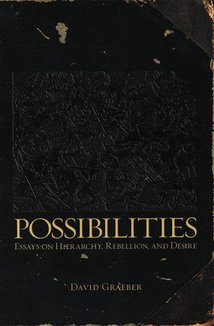
Possibilities: Essays on Hierarchy, Rebellion, and Desire
Author:
David Graeber
If anthropology consists of making the apparently wild thought of others logically compelling in their own cultural settings and intellectually revealing of the human condition, then David Graeber is the consummate anthropologist. Not only does he accomplish this profound feat, he redoubles it by the critical tasknow more urgent than everof making the possibilities of other people’s worlds the basis for understanding our own.” Marshall Sahlins, University of Chicago Graeber’s ideas are rich and wide-ranging; he pushes us to expand the boundaries of what we admit to be possible, or even thinkable.”Steven Shaviro, Wayne State University In this new collection, David Graeber revisits questions raised in his popular book, Fragments of an Anarchist Anthropology .
If anthropology consists of making the apparently wild thought of others logically compelling in their own cultural settings and intellectually revealing of the human condition, then David Graeber is the consummate anthropologist. Not only does he accomplish this profound feat, he redoubles it by the critical tasknow more urgent than everof making the possibilities of other people’s worlds the basis for understanding our own.” Marshall Sahlins, University of Chicago Graeber’s ideas are rich and wide-ranging; he pushes us to expand the boundaries of what we admit to be possible, or even thinkable.”Steven Shaviro, Wayne State University In this new collection, David Graeber revisits questions raised in his popular book, Fragments of an Anarchist Anthropology . Written in an unpretentious style that uses accessible and entertaining language to convey complex theoretical ideas, these twelve essays cover a lot of ground, including the origins of capitalism, the history of European table manners, love potions in rural Madagascar, and the phenomenology of giant puppets at street protests. But they’re linked by a clear purpose: to explore the nature of social power and the forms that resistance to it have taken, or might take in the future. Anarchism is currently undergoing a worldwide revival, in many ways replacing Marxism as the theoretical and moral center of new revolutionary social movements. It has, however, left little mark on the academy. While anarchists and other visionaries have turned to anthropology for ideas and inspiration, anthropologists are reluctant to enter into serious dialogue. David Graeber is not. These essays, spanning almost twenty years, show how scholarly concerns can be of use to radical social movements, and how the perspectives of such movements shed new light on debates within the academy. David Graeber has written for Harper’s Magazine , New Left Review , and numerous scholarly journals. He is the author or editor of four books and currently lives in New York City. In Oakland, California on March 24, 2015 a fire destroyed the AK Press warehouse along with several other businesses. Please consider visiting the AK Press website to learn more about the fundraiser to help them and their neighbors.
Find this book on:


Winner of the 2019 National Book Critics Circle Award in Criticism Winner of the PEN/John Kenneth Galbraith Award for Nonfiction Winner of the 2020 Judy Grahn Award for Lesbian Nonfiction Finalist for the Lambda Literary Award for Lesbian Memoir/Biography Named one of the Best Books of the 21st Century by the New York Times Book Review "Exhilarating…A rich resurrection of a forgotten history." ―Parul Sehgal, New York Times Beautifully written and deeply researched, Wayward Lives, Beautiful Experiments examines the revolution of black intimate life that unfolded in Philadelphia and New York at the beginning of the twentieth century. In wrestling with the question of what a free life is, many young black women created forms of intimacy and kinship indifferent to the dictates of respectability and outside the bounds of law.
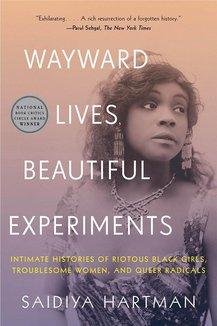
Winner of the 2019 National Book Critics Circle Award in Criticism Winner of the PEN/John Kenneth Galbraith Award for Nonfiction Winner of the 2020 Judy Grahn Award for Lesbian Nonfiction Finalist for the Lambda Literary Award for Lesbian Memoir/Biography Named one of the Best Books of the 21st Century by the New York Times Book Review "Exhilarating…A rich resurrection of a forgotten history." ―Parul Sehgal, New York Times Beautifully written and deeply researched, Wayward Lives, Beautiful Experiments examines the revolution of black intimate life that unfolded in Philadelphia and New York at the beginning of the twentieth century. In wrestling with the question of what a free life is, many young black women created forms of intimacy and kinship indifferent to the dictates of respectability and outside the bounds of law. They cleaved to and cast off lovers, exchanged sex to subsist, and revised the meaning of marriage. Longing and desire fueled their experiments in how to live. They refused to labor like slaves or to accept degrading conditions of work. Here, for the first time, these women are credited with shaping a cultural movement that transformed the urban landscape. Through a melding of history and literary imagination, Wayward Lives, Beautiful Experiments recovers these women’s radical aspirations and insurgent desires. 67 black and white illustrations
Find this book on:

The Force of Nonviolence: An Ethico-Political Bind
Author:
Judith Butler
“The most creative and courageous social theorist working today” examines the ethical binds that emerge within the force field of violence (Cornel West). “ .
“The most creative and courageous social theorist working today” examines the ethical binds that emerge within the force field of violence (Cornel West). “ . . . nonviolence is often seen as passive and resolutely individual. Butler’s philosophical inquiry argues that it is in fact a shrewd and even aggressive collective political tactic.” — New York Times Judith Butler shows how an ethic of nonviolence must be connected to a broader political struggle for social equality. While many think of nonviolence as passive or individualist, Butler argues nonviolence is an ethical position found in the midst of the political field. She champions an ‘aggressive’ nonviolence, which accepts hostility as part of our psychic constitution—but values ambivalence as a way of checking the conversion of aggression into violence. Some challengers say a politics of nonviolence is subjective: What qualifies as violence versus nonviolence? This distinction is often mobilized in the service of ratifying the state’s monopoly on violence. Considering nonviolence as an ethical problem within a political philosophy requires two things: a critique of individualism and an understanding of the psychosocial dimensions of violence. Butler draws upon Foucault, Fanon, Freud, and Benjamin to consider how the interdiction against violence fails to include lives regarded as ‘ungrievable’. By considering how “racial phantasms” inform justifications of state and administrative violence, Butler tracks how violence is often attributed to those who are most severely exposed to its lethal effects. Ultimately, the struggle for nonviolence is found in modes of resistance and social movements that separate aggression from its destructive aims to affirm the living potentials of radical egalitarian politics.
Find this book on:
Episode overview
Maggie Nelson is a poet, critic and cultural theorist whose work includes the award-winning 2016 book “The Argonauts.” Her newest work, “On Freedom,” pierces right into the heart of America’s founding idea: What if there’s no such thing as freedom, at least not freedom as a state of enduring liberation?
And more than that: What if we don’t want to be free? Perhaps that’s the great lie in the American dream: We’re taught to want freedom, but many of us recoil from its touch.
Nelson describes herself as a “disobedient thinker,” someone who enjoys looking at “the difficulty of difficult things,” and this conversation bears that out. We talk about when and whether freedom is hard to bear, the difference between a state of liberation and the daily practice of freedom, the hard conversations sexual liberation demands, what it means to live in koans, my problems with the “The Giving Tree,” Nelson’s disagreements with the left, the difficulty of maintaining your own experience of art in an age when the entire internet wants to tell you how to feel about everything, and more.