
From this episode
Recommended books
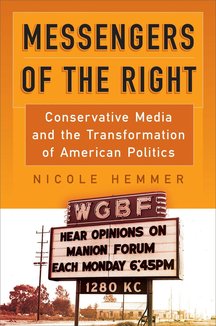
From Rush Limbaugh and Sean Hannity to Glenn Beck and Matt Drudge, Americans are accustomed to thinking of right-wing media as integral to contemporary conservatism. But today's well-known personalities make up the second generation of broadcasting and publishing activists.
From Rush Limbaugh and Sean Hannity to Glenn Beck and Matt Drudge, Americans are accustomed to thinking of right-wing media as integral to contemporary conservatism. But today's well-known personalities make up the second generation of broadcasting and publishing activists. Messengers of the Right tells the story of the little-known first generation. Beginning in the late 1940s, activists working in media emerged as leaders of the American conservative movement. They not only started an array of enterprises—publishing houses, radio programs, magazines, book clubs, television shows—they also built the movement. They coordinated rallies, founded organizations, ran political campaigns, and mobilized voters. While these media activists disagreed profoundly on tactics and strategy, they shared a belief that political change stemmed not just from ideas but from spreading those ideas through openly ideological communications channels. In Messengers of the Right , Nicole Hemmer explains how conservative media became the institutional and organizational nexus of the conservative movement, transforming audiences into activists and activists into a reliable voting base. Hemmer also explores how the idea of liberal media bias emerged, why conservatives have been more successful at media activism than liberals, and how the right remade both the Republican Party and American news media. Messengers of the Right follows broadcaster Clarence Manion, book publisher Henry Regnery, and magazine publisher William Rusher as they evolved from frustrated outsiders in search of a platform into leaders of one of the most significant and successful political movements of the twentieth century.
Find this book on:

The Boys on the Bus
Authors:
Timothy Crouse,
Hunter S. Thompson
Cheap booze. Flying fleshpots.
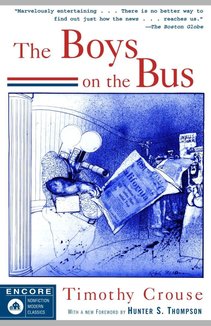
Cheap booze. Flying fleshpots. Lack of sleep. Endless spin. Lying pols. Just a few of the snares lying in wait for the reporters who covered the 1972 presidential election. Traveling with the press pack from the June primaries to the big night in November, Rolling Stone reporter Timothy Crouse hopscotched the country with both the Nixon and McGovern campaigns and witnessed the birth of modern campaign journalism. The Boys on the Bus is the raucous story of how American news got to be what it is today. With its verve, wit, and psychological acumen, it is a classic of American reporting.
Find this book on:


Making News: A Study in the Construction of Reality
Authors:
Barbara W. Tuchman,
Gaye Tuchman
From Simon & Schuster, Making News is Gaye Tuchman's exploration into the study in the construction of reality. The Professor of Sociology at Queens College and City University of New York, Tuchman's latest work is one to cherish.As described by Todd Gitlin of Contemporary Sociology , Making News is "simply the most comprehensive book on the social construction of news by an American sociologist to date."
From Simon & Schuster, Making News is Gaye Tuchman's exploration into the study in the construction of reality. The Professor of Sociology at Queens College and City University of New York, Tuchman's latest work is one to cherish.As described by Todd Gitlin of Contemporary Sociology , Making News is "simply the most comprehensive book on the social construction of news by an American sociologist to date."
Find this book on:
For ten years, Herbert J. Gans spent considerable time in four major television and magazine newsrooms, observing and talking to the journalists who choose the national news stories that inform America about itself.
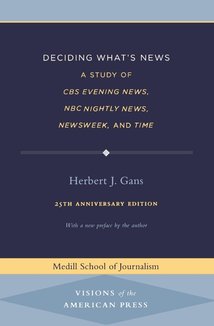
For ten years, Herbert J. Gans spent considerable time in four major television and magazine newsrooms, observing and talking to the journalists who choose the national news stories that inform America about itself. Writing during the golden age of journalism, Gans included such headline events as the War on Poverty, the Vietnam War and the protests against it, urban ghetto disorders, the assassinations of Martin Luther King, Jr. and Robert F. Kennedy, and Watergate. He was interested in the values, professional standards, and the external pressures that shaped journalists' judgments. Deciding What's News has become a classic. A new preface outlines the major changes that have taken place in the news media since Gans first wrote the book, but it also suggests that the basics of news judgment and the structures of news organizations have changed little. Gans's book is still the most comprehensive sociological account of some of the country's most prominent national news media. The book received the 1979 Theatre Library Association Award and the 1980 Book Award of the National Association of Educational Broadcasters. This is the first work to be published under the Medill School of Journalism's "Visions of the American Press" imprint, a new journalism history series featuring both original volumes and reprints of important classics.
Find this book on:
Episode overview
“Making it harder to vote, and harder to understand what the party is really about — these are two parts of the same project” for the Republican Party, Jay Rosen writes. “The conflict with honest journalism is structural. To be its dwindling self, the G.O.P. has to also be at war with the press, unless of course the press folds under pressure.”
Rosen is a professor of journalism at N.Y.U., author of the blog “PressThink,” and one of America’s sharpest contemporary media critics. And his argument is a simple one: The media’s implicit model of American politics — of two coequal parties with competing governing philosophies — is fundamentally broken. Today, the most important axis of political conflict is not between left and right, but between pro- and anti-democracy forces.
The way Rosen sees it, the American mainstream press must make a choice: Will it double down on its commitment to detached, nonpartisan neutrality? Or will it choose instead to boldly and aggressively defend truth and democracy?
These days, Rosen’s view seems almost common-sensical. But he’s been critiquing “both sides” journalism — and the model of politics underlying it — for years now, long before such arguments came into vogue. As a result, he’s done some of the most original thinking about what an alternative model of journalism would look like, and wrestled with the inevitable political, social and economic tensions that come with it.
So this conversation is about what pro-democracy journalism could look like in practice and the thorny questions that this approach to coverage raises. But it also touches on the drawbacks of the press’s focus on Senators Joe Manchin and Kyrsten Sinema; how journalists should cover Donald Trump and Tucker Carlson; why Rosen believes “moderate” and “centrist” are “two of the most ideology-soaked terms” in political journalism; the consequences of an economy where political news has to compete for attention with Netflix, Xbox and TikTok; and why Substack and podcasting may hold one of the keys to restoring trust in the media.