
From this episode
Recommended books
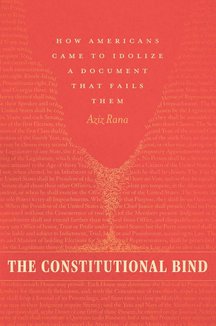
An eye-opening account of how Americans came to revere the Constitution and what this reverence has meant domestically and around the world. Some Americans today worry that the Federal Constitution is ill-equipped to respond to mounting democratic threats and may even exacerbate the worst features of American politics.
An eye-opening account of how Americans came to revere the Constitution and what this reverence has meant domestically and around the world. Some Americans today worry that the Federal Constitution is ill-equipped to respond to mounting democratic threats and may even exacerbate the worst features of American politics. Yet for as long as anyone can remember, the Constitution has occupied a quasi-mythical status in American political culture, which ties ideals of liberty and equality to assumptions about the inherent goodness of the text’s design. The Constitutional Bind explores how a flawed document came to be so glorified and how this has impacted American life. In a pathbreaking retelling of the American experience, Aziz Rana shows that today’s reverential constitutional culture is a distinctively twentieth-century phenomenon. Rana connects this widespread idolization to another relatively recent development: the rise of US global dominance. Ultimately, such veneration has had far-reaching consequences: despite offering a unifying language of reform, it has also unleashed an interventionist national security state abroad while undermining the possibility of deeper change at home. Revealing how the current constitutional order was forged over the twentieth century, The Constitutional Bind also sheds light on an array of movement activists—in Black, Indigenous, feminist, labor, and immigrant politics—who struggled to imagine different constitutional horizons. As time passed, these voices of opposition were excised from memory. Today, they offer essential insights.
Find this book on:



Eichmann in Jerusalem: A Report on the Banality of Evil (Penguin Classics)
Authors:
Hannah Arendt,
Amos Elon
The controversial journalistic analysis of the mentality that fostered the Holocaust, from the author of The Origins of Totalitarianism Sparking a flurry of heated debate, Hannah Arendt’s authoritative and stunning report on the trial of German Nazi leader Adolf Eichmann first appeared as a series of articles in The New Yorker in 1963. This revised edition includes material that came to light after the trial, as well as Arendt’s postscript directly addressing the controversy that arose over her account.
The controversial journalistic analysis of the mentality that fostered the Holocaust, from the author of The Origins of Totalitarianism Sparking a flurry of heated debate, Hannah Arendt’s authoritative and stunning report on the trial of German Nazi leader Adolf Eichmann first appeared as a series of articles in The New Yorker in 1963. This revised edition includes material that came to light after the trial, as well as Arendt’s postscript directly addressing the controversy that arose over her account. A major journalistic triumph by an intellectual of singular influence, Eichmann in Jerusalem is as shocking as it is informative—an unflinching look at one of the most unsettling (and unsettled) issues of the twentieth century.
Find this book on:
Political Liberalism (Columbia Classics in Philosophy)
Author:
John Rawls
This book continues and revises the ideas of justice as fairness that John Rawls presented in A Theory of Justice but changes its philosophical interpretation in a fundamental way. That previous work assumed what Rawls calls a "well-ordered society," one that is stable and relatively homogenous in its basic moral beliefs and in which there is broad agreement about what constitutes the good life.
This book continues and revises the ideas of justice as fairness that John Rawls presented in A Theory of Justice but changes its philosophical interpretation in a fundamental way. That previous work assumed what Rawls calls a "well-ordered society," one that is stable and relatively homogenous in its basic moral beliefs and in which there is broad agreement about what constitutes the good life. Yet in modern democratic society a plurality of incompatible and irreconcilable doctrines―religious, philosophical, and moral―coexist within the framework of democratic institutions. Recognizing this as a permanent condition of democracy, Rawls asks how a stable and just society of free and equal citizens can live in concord when divided by reasonable but incompatible doctrines? This edition includes the essay "The Idea of Public Reason Revisited," which outlines Rawls' plans to revise Political Liberalism, which were cut short by his death. "An extraordinary well-reasoned commentary on A Theory of Justice ...a decisive turn towards political philosophy." ― Times Literary Supplement
Find this book on:
A World after Liberalism: Five Thinkers Who Inspired the Radical Right
Author:
Matthew Rose
A bracing account of liberalism’s most radical critics introducing one of the most controversial movements of the twentieth century “Powerful. .
A bracing account of liberalism’s most radical critics introducing one of the most controversial movements of the twentieth century “Powerful. . . . Bracing. . . . Part of the book’s eerie relevance comes from the role Russia plays throughout.”—Ezra Klein, New York Times “One of the best books I’ve read this year. . . . Its importance at this critical moment in our history cannot be overstated.”—Rod Dreher, American Conservative In this eye-opening book, Matthew Rose introduces us to one of the most controversial intellectual movements of the twentieth century, the “radical right,” and discusses its adherents’ different attempts to imagine political societies after the death or decline of liberalism. Rose shows how such thinkers are animated by religious aspirations and anxieties that are ultimately in tension with Christian teachings and the secular values those teachings birthed in modernity.
Find this book on:
Melting Point: Family, Memory, and the Search for a Promised Land
Author:
Rachel Cockerell
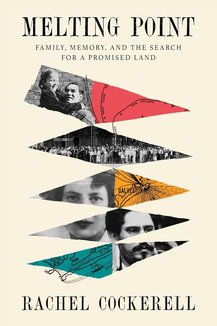
Longlisted for the 2024 Baillie Gifford Prize for Non-Fiction A New York Times Most Anticipated Book "Fabulous . .
Longlisted for the 2024 Baillie Gifford Prize for Non-Fiction A New York Times Most Anticipated Book "Fabulous . . . One gets a thrilling sense of history unfolding in real time." ―Matthew Reisz, The Guardian This dazzling, innovative family memoir tells the story of a long-lost plan to create a Jewish state in Texas. On June 7, 1907, a ship packed with Russian Jews sets sail not to Jerusalem or New York, as many on board have dreamed, but to Texas. The man who persuades the passengers to go is David Jochelmann, Rachel Cockerell’s great-grandfather. The journey marks the beginning of the Galveston Movement, a forgotten moment in history when ten thousand Jews fled to Texas in the leadup to World War I. The charismatic leader of the movement is Jochelmann’s closest friend, Israel Zangwill, whose novels have made him famous across Europe and America. As Eastern Europe becomes infected by antisemitic violence, Zangwill embarks on a desperate search for a temporary homeland―from Australia to Canada, Angola to Antarctica―before reluctantly settling on Galveston. He fears the Jewish people will be absorbed into the great American melting pot, but there is no other hope. In a highly inventive style, Cockerell captures history as it unfolds, weaving together letters, diaries, memoirs, newspaper articles, and interviews into a vivid account. Melting Point follows Zangwill and the Jochelmann family through two world wars, to London, New York, and Jerusalem―as their lives intertwine with some of the most memorable figures of the twentieth century, and each chooses whether to cling to their history or melt into their new surroundings. It is a story that asks what it means to belong, and what can be salvaged from the past.
Find this book on:
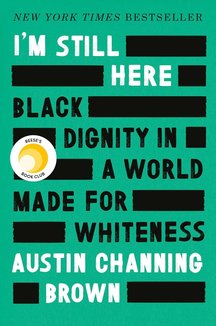
I'm Still Here: Reese's Book Club: Black Dignity in a World Made for Whiteness
Author:
Austin Channing Brown
NEW YORK TIMES BESTSELLER • REESE’S BOOK CLUB PICK • From a leading voice on racial justice, an eye-opening account of growing up Black, Christian, and female that exposes how white America’s love affair with “diversity” so often falls short of its ideals. “Austin Channing Brown introduces herself as a master memoirist.
NEW YORK TIMES BESTSELLER • REESE’S BOOK CLUB PICK • From a leading voice on racial justice, an eye-opening account of growing up Black, Christian, and female that exposes how white America’s love affair with “diversity” so often falls short of its ideals. “Austin Channing Brown introduces herself as a master memoirist. This book will break open hearts and minds.”—Glennon Doyle, #1 New York Times bestselling author of Untamed Austin Channing Brown’s first encounter with a racialized America came at age seven, when she discovered her parents named her Austin to deceive future employers into thinking she was a white man. Growing up in majority-white schools and churches, Austin writes, “I had to learn what it means to love blackness,” a journey that led to a lifetime spent navigating America’s racial divide as a writer, speaker, and expert helping organizations practice genuine inclusion. In a time when nearly every institution (schools, churches, universities, businesses) claims to value diversity in its mission statement, Austin writes in breathtaking detail about her journey to self-worth and the pitfalls that kill our attempts at racial justice. Her stories bear witness to the complexity of America’s social fabric—from Black Cleveland neighborhoods to private schools in the middle-class suburbs, from prison walls to the boardrooms at majority-white organizations. For readers who have engaged with America’s legacy on race through the writing of Ta-Nehisi Coates and Michael Eric Dyson, I’m Still Here is an illuminating look at how white, middle-class, Evangelicalism has participated in an era of rising racial hostility, inviting the reader to confront apathy, recognize God’s ongoing work in the world, and discover how blackness—if we let it—can save us all.
Find this book on:
Episode overview
Is Donald Trump eroding American democracy and consolidating power for himself? Or is he trying to do that and failing? Is this what sliding toward authoritarianism looks like? Or is this what a functioning democracy looks like? And how can you tell the difference?
Two articles came out recently that offer very different perspectives on these questions. In Vox, Zack Beauchamp wrote a piece called “Trump Is Losing,” which argues that Trump’s efforts to cow his enemies and consolidate power are not organized or strategic enough to make a serious dent in our democratic system. In The New Yorker, Andrew Marantz published a piece that he reported in Hungary, about how life in a modern authoritarian regime doesn’t look and feel like you might expect: “You can live through the big one, it turns out, and still go on acting as if — still go on feeling as if — the big one is not yet here,” he writes.
So I invited both Beauchamp and Marantz on the show to debate these big questions: What timeline are we on? What signs are they looking at? If we’ve crossed the line into authoritarianism, how would we know? Is Trump losing? Or is it possible he’s already won?
This episode contains strong language.