
From this episode
Recommended books
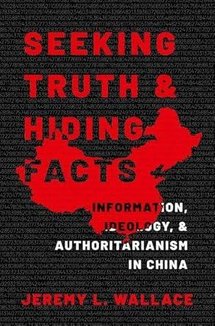
Seeking Truth and Hiding Facts: Information, Ideology, and Authoritarianism in China
Author:
Jeremy L. Wallace
A unique analysis of the numbers that came to define Chinese politics and how this quantification evolved over time. For decades, a few numbers came to define Chinese politics-until those numbers did not count what mattered and what they counted did not measure up.
A unique analysis of the numbers that came to define Chinese politics and how this quantification evolved over time. For decades, a few numbers came to define Chinese politics-until those numbers did not count what mattered and what they counted did not measure up. Seeking Truth and Hiding Facts argues that the Chinese government adopted a system of limited, quantified vision in order to survive the disasters unleashed by Mao Zedong's ideological leadership. Jeremy Wallace explains how that system worked and analyzes how the problems that accumulated in its blind spots led Xi Jinping to take drastic action. Xi's neopolitical turn--aggressive anti-corruption campaigns, reassertion of party authority, and personalization of power--is an attempt fix the problems of the prior system, as well as a hedge against an inability to do so. The book argues that while of course dictators stay in power through coercion and cooptation, they also do so by convincing their populations and themselves of their right to rule. Quantification is one tool in this persuasive arsenal, but it comes with its own perils.
Find this book on:


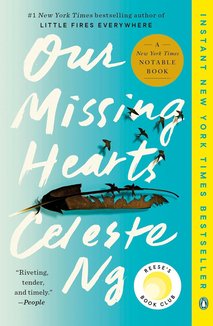
Our Missing Hearts: Reese's Book Club (A Novel)
Author:
Celeste Ng
An instant New York Times bestseller • A New York Times Notable Book • Named a Best Book of 2022 by People, TIME Magazine, The Washington Post, USA Today , NPR, Los Angeles Times , and Oprah Daily, and more • A Reese's Book Club Pick • New York Times Paperback Row Selection From the #1 bestselling author of Little Fires Everywhere , comes the inspiring new novel about a mother’s unshakeable love. “Riveting, tender, and timely.” — People, Book of the Week "Remarkable .
An instant New York Times bestseller • A New York Times Notable Book • Named a Best Book of 2022 by People, TIME Magazine, The Washington Post, USA Today , NPR, Los Angeles Times , and Oprah Daily, and more • A Reese's Book Club Pick • New York Times Paperback Row Selection From the #1 bestselling author of Little Fires Everywhere , comes the inspiring new novel about a mother’s unshakeable love. “Riveting, tender, and timely.” — People, Book of the Week "Remarkable . . . An unflinching yet life-affirming drama about the power of art and love to push back in dangerous times." — Oprah Daily “Thought-provoking, heart-wrenching . . . I was so invested in the future of this mother and son.” —Reese Witherspoon (Reese’s Book Club Pick) Twelve-year-old Bird Gardner lives a quiet existence with his loving father, a former linguist who now shelves books in a university library. His mother, Margaret, a Chinese American poet, left without a trace when he was nine years old. He doesn’t know what happened to her—only that her books have been banned—and he resents that she cared more about her work than about him. Then one day Bird receives a mysterious letter containing only a cryptic drawing, and soon he is pulled into a quest to find her. His journey will take him back to the many folktales she poured into his head as a child, through the ranks of an underground network of heroic librarians, and finally to New York City, where he will learn the truth about what happened to his mother and what the future holds for them both. Our Missing Hearts is an old story made new, of the ways supposedly civilized communities can ignore the most searing injustice. It’s about the lessons and legacies we pass on to our children and the power of art to create change.
Find this book on:
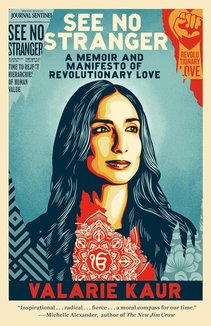
#1 LOS ANGELES TIMES BESTSELLER • FINALIST FOR THE DAYTON LITERARY PEACE PRIZE • An urgent manifesto and a dramatic memoir of awakening, this is the story of revolutionary love. “In a world stricken with fear and turmoil, Valarie Kaur shows us how to summon our deepest wisdom.”—Elizabeth Gilbert, author of Eat Pray Love How do we love in a time of rage?
#1 LOS ANGELES TIMES BESTSELLER • FINALIST FOR THE DAYTON LITERARY PEACE PRIZE • An urgent manifesto and a dramatic memoir of awakening, this is the story of revolutionary love. “In a world stricken with fear and turmoil, Valarie Kaur shows us how to summon our deepest wisdom.”—Elizabeth Gilbert, author of Eat Pray Love How do we love in a time of rage? How do we fix a broken world while not breaking ourselves? Valarie Kaur—renowned Sikh activist, filmmaker, and civil rights lawyer—describes revolutionary love as the call of our time, a radical, joyful practice that extends in three directions: to others, to our opponents, and to ourselves. It enjoins us to see no stranger but instead look at others and say: You are part of me I do not yet know. Starting from that place of wonder, the world begins to change: It is a practice that can transform a relationship, a community, a culture, even a nation. Kaur takes readers through her own riveting journey—as a brown girl growing up in California farmland finding her place in the world; as a young adult galvanized by the murders of Sikhs after 9/11; as a law student fighting injustices in American prisons and on Guantánamo Bay; as an activist working with communities recovering from xenophobic attacks; and as a woman trying to heal from her own experiences with police violence and sexual assault. Drawing from the wisdom of sages, scientists, and activists, Kaur reclaims love as an active, public, and revolutionary force that creates new possibilities for ourselves, our communities, and our world. See No Stranger helps us imagine new ways of being with each other—and with ourselves—so that together we can begin to build the world we want to see.
Find this book on:

A sweeping account of the rise and evolution of liberal internationalism in the modern era, selected as a Best Book of 2021 by Foreign Affairs “A thoughtful and profound defence of liberal internationalism—both as a political philosophy and as a guide to future actions.”—Gideon Rachman, Financial Times “The crowning achievement of [Ikenberry’s] decades-long work explaining and defending the liberal international order.”—Michael Hirsch, Foreign Policy For two hundred years, the grand project of liberal internationalism has been to build a world order that is open, loosely rules-based, and oriented toward progressive ideas. Today this project is in crisis, threatened from the outside by illiberal challengers and from the inside by nationalist-populist movements.
A sweeping account of the rise and evolution of liberal internationalism in the modern era, selected as a Best Book of 2021 by Foreign Affairs “A thoughtful and profound defence of liberal internationalism—both as a political philosophy and as a guide to future actions.”—Gideon Rachman, Financial Times “The crowning achievement of [Ikenberry’s] decades-long work explaining and defending the liberal international order.”—Michael Hirsch, Foreign Policy For two hundred years, the grand project of liberal internationalism has been to build a world order that is open, loosely rules-based, and oriented toward progressive ideas. Today this project is in crisis, threatened from the outside by illiberal challengers and from the inside by nationalist-populist movements. This timely book offers the first full account of liberal internationalism’s long journey from its nineteenth-century roots to today’s fractured political moment. Creating an international “space” for liberal democracy, preserving rights and protections within and between countries, and balancing conflicting values such as liberty and equality, openness and social solidarity, and sovereignty and interdependence—these are the guiding aims that have propelled liberal internationalism through the upheavals of the past two centuries. G. John Ikenberry argues that in a twenty-first century marked by rising economic and security interdependence, liberal internationalism—reformed and reimagined—remains the most viable project to protect liberal democracy.
Find this book on:
Episode overview
There are few issues on which the dominant consensus in Washington has changed as rapidly in recent years as it has on China. Donald Trump made taking on China a core pillar of his campaign and presidency. And while Joe Biden has toned down the harsh anti-China rhetoric of his predecessor, many of his administration’s policies have gone even further than Trump’s did.
In October the Biden administration unveiled sweeping controls on advanced chip exports to China — a move that former Trump officials have described as a sharp break from where their administration’s policies were. And the Biden administration doesn’t intend on stopping there: It plans to roll out further controls that target China’s biotech and clean energy sectors.
Meanwhile, Biden has repeatedly voiced such strong declarations of American military support for Taiwan that his own administration has had to walk them back. And, in Congress, China policy is one of the few areas Democrats and Republicans seem willing to work together — almost always in the direction of getting tougher on Beijing.
Jessica Chen Weiss is a political scientist and China scholar at Cornell. From August 2021 to last July, she was a senior adviser in the Biden State Department. And she emerged from that experience as one of the most outspoken critics of Washington’s more hawkish turn regarding China. “The more combative approach, on both sides, has produced a mirroring dynamic,” Weiss wrote in a 2022 essay called “The China Trap.” She worries that Beijing and Washington are misreading each other’s ambitions, resulting in a “downward spiral” of mutual aggression that will leave both sides — and the world more broadly — less prosperous and secure.
So I asked Weiss to come on the show to help me understand the state of U.S.-China relations and why she thinks it’s headed in the wrong direction.