From this episode
Recommended books
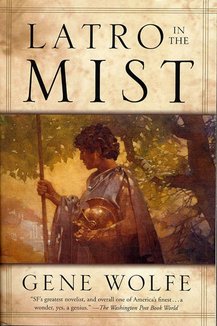
Latro in the Mist: Soldier of the Mist and Soldier of Areté
Author:
Gene Wolfe
A distinguished compilation of two classic fantasy novels, Soldier of the Mist and Soldier of Areté , in one volume This omnibus of two acclaimed novels is the story of Latro, a Roman mercenary who while fighting in Greece received a head injury that deprived him of his short-term memory but gave him in return the ability to see and converse with the supernatural creatures and the gods and goddesses, who invisibly inhabit the ancient landscape. Latro forgets everything when he sleeps.
A distinguished compilation of two classic fantasy novels, Soldier of the Mist and Soldier of Areté , in one volume This omnibus of two acclaimed novels is the story of Latro, a Roman mercenary who while fighting in Greece received a head injury that deprived him of his short-term memory but gave him in return the ability to see and converse with the supernatural creatures and the gods and goddesses, who invisibly inhabit the ancient landscape. Latro forgets everything when he sleeps. Writing down his experiences every day and reading his journal anew each morning gives him a poignantly tenuous hold on himself, but his story's hold on readers is powerful indeed, and many consider these Wolfe's best books.
Find this book on:


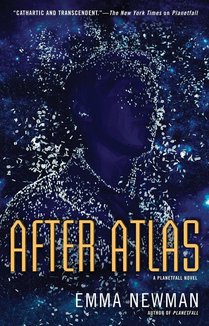
After Atlas (A Planetfall Novel)
Author:
Emma Newman
Acclaimed author Emma Newman returns to the captivating universe she created in Planetfall with a stunning science fiction mystery where one man’s murder is much more than it seems—an Arthur C. Clarke Award Nominee.
Acclaimed author Emma Newman returns to the captivating universe she created in Planetfall with a stunning science fiction mystery where one man’s murder is much more than it seems—an Arthur C. Clarke Award Nominee. Gov-corp detective Carlos Moreno was only a baby when Atlas left Earth to seek truth among the stars. But in that moment, the course of Carlos’s entire life changed. Atlas is what took his mother away; what made his father lose hope; what led Alejandro Casales, leader of the religious cult known as the Circle, to his door. And now, on the eve of the fortieth anniversary of Atlas ’s departure, it’s got something to do why Casales was found dead in his hotel room—and why Carlos is the man in charge of the investigation. To figure out who killed one of the most powerful men on Earth, Carlos is supposed to put aside his personal history. But the deeper he delves into the case, the more he realizes that escaping the past is not so easy. There’s more to Casales’s death than meets the eye, and something much more sinister to the legacy of Atlas than anyone realizes...
Find this book on:
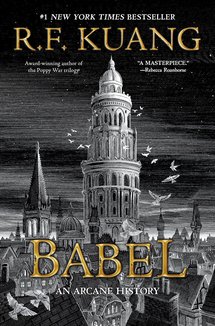
Instant #1 New York Times Bestseller from the author of The Poppy War “Absolutely phenomenal. One of the most brilliant, razor-sharp books I've had the pleasure of reading that isn't just an alternative fantastical history, but an interrogative one; one that grabs colonial history and the Industrial Revolution, turns it over, and shakes it out.” -- Shannon Chakraborty, bestselling author of The City of Brass From award-winning author R.
Instant #1 New York Times Bestseller from the author of The Poppy War “Absolutely phenomenal. One of the most brilliant, razor-sharp books I've had the pleasure of reading that isn't just an alternative fantastical history, but an interrogative one; one that grabs colonial history and the Industrial Revolution, turns it over, and shakes it out.” -- Shannon Chakraborty, bestselling author of The City of Brass From award-winning author R. F. Kuang comes Babel , a thematic response to The Secret History and a tonal retort to Jonathan Strange & Mr. Norrell that grapples with student revolutions, colonial resistance, and the use of language and translation as the dominating tool of the British empire. Traduttore, traditore : An act of translation is always an act of betrayal. 1828. Robin Swift, orphaned by cholera in Canton, is brought to London by the mysterious Professor Lovell. There, he trains for years in Latin, Ancient Greek, and Chinese, all in preparation for the day he’ll enroll in Oxford University’s prestigious Royal Institute of Translation—also known as Babel. Babel is the world's center for translation and, more importantly, magic. Silver working—the art of manifesting the meaning lost in translation using enchanted silver bars—has made the British unparalleled in power, as its knowledge serves the Empire’s quest for colonization. For Robin, Oxford is a utopia dedicated to the pursuit of knowledge. But knowledge obeys power, and as a Chinese boy raised in Britain, Robin realizes serving Babel means betraying his motherland. As his studies progress, Robin finds himself caught between Babel and the shadowy Hermes Society, an organization dedicated to stopping imperial expansion. When Britain pursues an unjust war with China over silver and opium, Robin must decide… Can powerful institutions be changed from within, or does revolution always require violence?
Find this book on:
Episode overview
Adrian Tchaikovsky’s “Children of Time” is about an advanced civilization built by sentient spiders. A sequel, “Children of Ruin,” is about a society run by superintelligent octopuses. I love these books. They’re remarkably serious about their premises, and by the end, it’s human civilization and our limited sensorium that come to seem strange.
But Tchaikovsky’s latest book, “Children of Memory,” ostensibly about crows, read as something very different to me: the best fictional representation I’ve read of what it is like to interact with, and perhaps even be, an artificial intelligence system like ChatGPT. It was a very strange read at this moment. And it made possible an episode I’ve been wanting to do for months.
Long before we have to face the question of whether A.I. is sentient, we will have to face the question of whether it is creative, and that will turn into the question of whether we, truly, are creative. And so Tchaikovsky and I talk about whether there’s a meaningful difference between human creativity and A.I. problem solving, why he believes this is a “profoundly scary time” to be a writer or a designer, what an explosion of A.I.-produced content would mean for human society and the human spirit, whether the advancement of A.I. could exhaust avenues for human originality and much more.