
From this episode
Recommended books
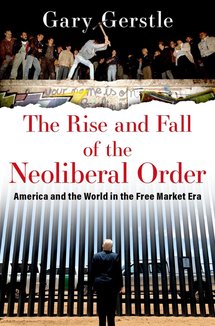
The most sweeping account of how neoliberalism came to dominate American politics for nearly a half century before crashing against the forces of Trumpism on the right and a new progressivism on the left. The epochal shift toward neoliberalism--a web of related policies that, broadly speaking, reduced the footprint of government in society and reassigned economic power to private market forces--that began in the United States and Great Britain in the late 1970s fundamentally changed the world.
The most sweeping account of how neoliberalism came to dominate American politics for nearly a half century before crashing against the forces of Trumpism on the right and a new progressivism on the left. The epochal shift toward neoliberalism--a web of related policies that, broadly speaking, reduced the footprint of government in society and reassigned economic power to private market forces--that began in the United States and Great Britain in the late 1970s fundamentally changed the world. Today, the word "neoliberal" is often used to condemn a broad swath of policies, from prizing free market principles over people to advancing privatization programs in developing nations around the world. To be sure, neoliberalism has contributed to a number of alarming trends, not least of which has been a massive growth in income inequality. Yet as the eminent historian Gary Gerstle argues in The Rise and Fall of the Neoliberal Order , these indictments fail to reckon with the full contours of what neoliberalism was and why its worldview had such persuasive hold on both the right and the left for three decades. As he shows, the neoliberal order that emerged in America in the 1970s fused ideas of deregulation with personal freedoms, open borders with cosmopolitanism, and globalization with the promise of increased prosperity for all. Along with tracing how this worldview emerged in America and grew to dominate the world, Gerstle explores the previously unrecognized extent to which its triumph was facilitated by the collapse of the Soviet Union and its communist allies. He is also the first to chart the story of the neoliberal order's fall, originating in the failed reconstruction of Iraq and Great Recession of the Bush years and culminating in the rise of Trump and a reinvigorated Bernie Sanders-led American left in the 2010s. An indispensable and sweeping re-interpretation of the last fifty years, this book illuminates how the ideology of neoliberalism became so infused in the daily life of an era, while probing what remains of that ideology and its political programs as America enters an uncertain future.
Find this book on:

Free Market: The History of an Idea
Author:
Jacob Soll
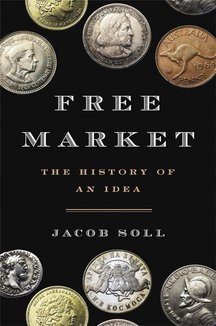
From a MacArthur “Genius,” an intellectual history of the free market, from ancient Rome to the twenty-first century After two government bailouts of the US economy in less than twenty years, free market ideology is due for serious reappraisal. In Free Market, Jacob Soll details how we got to this current crisis, and how we can find our way out by looking to earlier iterations of free market thought.
From a MacArthur “Genius,” an intellectual history of the free market, from ancient Rome to the twenty-first century After two government bailouts of the US economy in less than twenty years, free market ideology is due for serious reappraisal. In Free Market, Jacob Soll details how we got to this current crisis, and how we can find our way out by looking to earlier iterations of free market thought. Contrary to popular narratives, early market theorists believed that states had an important role in building and maintaining free markets. But in the eighteenth century, thinkers insisted on free markets without state intervention, leading to a tradition of ideological brittleness. That tradition only calcified in the centuries that followed. Tracing the intellectual evolution of the free market from Cicero to Milton Friedman, Soll argues that we need to go back to the origins of free market ideology in order to truly understand it—and to develop new economic concepts to face today’s challenges.
Find this book on:

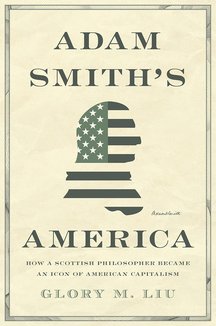
The unlikely story of how Americans canonized Adam Smith as the patron saint of free markets Originally published in 1776, Adam Smith’s The Wealth of Nations was lauded by America’s founders as a landmark work of Enlightenment thinking about national wealth, statecraft, and moral virtue. Today, Smith is one of the most influential icons of economic thought in America.
The unlikely story of how Americans canonized Adam Smith as the patron saint of free markets Originally published in 1776, Adam Smith’s The Wealth of Nations was lauded by America’s founders as a landmark work of Enlightenment thinking about national wealth, statecraft, and moral virtue. Today, Smith is one of the most influential icons of economic thought in America. Glory Liu traces how generations of Americans have read, reinterpreted, and weaponized Smith’s ideas, revealing how his popular image as a champion of American-style capitalism and free markets is a historical invention. Drawing on a trove of illuminating archival materials, Liu tells the story of how an unassuming Scottish philosopher captured the American imagination and played a leading role in shaping American economic and political ideas. She shows how Smith became known as the father of political economy in the nineteenth century and was firmly associated with free trade, and how, in the aftermath of the Great Depression, the Chicago School of Economics transformed him into the preeminent theorist of self-interest and the miracle of free markets. Liu explores how a new generation of political theorists and public intellectuals has sought to recover Smith’s original intentions and restore his reputation as a moral philosopher. Charting the enduring fascination that this humble philosopher from Scotland has held for American readers over more than two centuries, Adam Smith’s America shows how Smith continues to be a vehicle for articulating perennial moral and political anxieties about modern capitalism.
Find this book on:
Episode overview
“One can usually pretend that there is a logic to the distribution of wealth — that behind a person’s prosperity lies some rational basis, whether it is that person’s hard work, skill and farsightedness or some ancestor’s,” writes J. Bradford DeLong. “Inflation — even moderate inflation — strips the mask.”
DeLong is an economic historian at the University of California, Berkeley, a former deputy assistant secretary of the Treasury and the author of “Slouching Towards Utopia” — a new book about the wave of economic growth that transformed the world in the 20th century. In it, he argues, among other things, that inflation isn’t just economically damaging; it’s one of the most destabilizing, destructive forces in all of politics. Left unchecked, it has the power to swing elections, erode the foundations of core social institutions and usher in wholesale changes in political and economic regimes.
[You can listen to this episode of “The Ezra Klein Show” on Apple, Spotify, Amazon Music, Google or wherever you get your podcasts.]
That’s exactly what happened the last time inflation was this high. In DeLong’s telling, the inflation crisis of the 1970s was weaponized to discredit the reigning New Deal economic order and helped give rise to the small government, pro-market political turn of the 1980s — the consequences of which we are living with today. So I wanted to have DeLong on the show to walk me through that story and some of the questions it raises: Why is inflation is so uniquely politically destructive? What are the right — and wrong — lessons to take from the experience of the 1970s? What kinds of political transformations could today’s inflation could bring about?
We also discuss why inflation spiraled out of control in the 1970s (and whether it could have been stopped sooner), the efficacy of price controls as a way of taming inflation, why DeLong believes it’s a mistake to take the 1970s comparisons too literally, how unchecked inflation can decimate social trust, how economic thinking became obsessed with “moochers” and “slackers” in the 1980s and ’90s, whether the 2007-08 financial crisis brought an end to the neoliberal era, what DeLong would say to his younger self serving in the early Clinton administration and more.