
From this episode
Recommended books
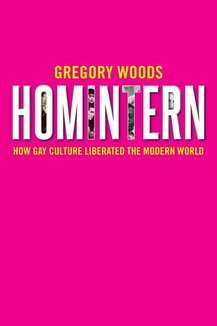
Homintern: How Gay Culture Liberated the Modern World
Author:
Gregory Woods
A landmark account of gay and lesbian creative networks and the seismic changes they brought to twentieth-century culture In a hugely ambitious study which crosses continents, languages, and almost a century, Gregory Woods identifies the ways in which homosexuality has helped shape Western culture. Extending from the trials of Oscar Wilde to the gay liberation era, this book examines a period in which increased visibility made acceptance of homosexuality one of the measures of modernity.
A landmark account of gay and lesbian creative networks and the seismic changes they brought to twentieth-century culture In a hugely ambitious study which crosses continents, languages, and almost a century, Gregory Woods identifies the ways in which homosexuality has helped shape Western culture. Extending from the trials of Oscar Wilde to the gay liberation era, this book examines a period in which increased visibility made acceptance of homosexuality one of the measures of modernity. Woods shines a revealing light on the diverse, informal networks of gay people in the arts and other creative fields. Uneasily called “the Homintern” (an echo of Lenin’s “Comintern”) by those suspicious of an international homosexual conspiracy, such networks connected gay writers, actors, artists, musicians, dancers, filmmakers, politicians, and spies. While providing some defense against dominant heterosexual exclusion, the grouping brought solidarity, celebrated talent, and, in doing so, invigorated the majority culture. Woods introduces an enormous cast of gifted and extraordinary characters, most of them operating with surprising openness; but also explores such issues as artistic influence, the coping strategies of minorities, the hypocrisies of conservatism, and the effects of positive and negative discrimination. Traveling from Harlem in the 1910s to 1920s Paris, 1930s Berlin, 1950s New York and beyond, this sharply observed, warm-spirited book presents a surpassing portrait of twentieth-century gay culture and the men and women who both redefined themselves and changed history.
Find this book on:



Caliban and the Witch: Women, the Body and Primitive Accumulation
Author:
Silvia Federici
Literary Nonfiction. CALIBAN AND THE WITCH is a history of the body in the transition to capitalism.
Literary Nonfiction. CALIBAN AND THE WITCH is a history of the body in the transition to capitalism. Moving from the peasant revolts of the late Middle Ages to the witch-hunts and the rise of mechanical philosophy, Federici investigates the capitalist rationalization of social reproduction. She shows how the battle against the rebel body and the conflict between body and mind are essential conditions for the development of labor power and self-ownership, two central principles of modern social organization. "It is both a passionate work of memory recovered and a hammer of humanity's agenda."—Peter Linebaugh, author of The London Hanged
Find this book on:

Can the Monster Speak?: Report to an Academy of Psychoanalysts (Semiotext(e) / Intervention Series)
Authors:
Paul B. Preciado,
Frank Wynne
Paul Preciado's controversial 2019 lecture at the École de la Cause Freudienne annual conference, published in a definitive translation for the first time. In November 2019, Paul Preciado was invited to speak in front of 3,500 psychoanalysts at the École de la Cause Freudienne's annual conference in Paris.
Paul Preciado's controversial 2019 lecture at the École de la Cause Freudienne annual conference, published in a definitive translation for the first time. In November 2019, Paul Preciado was invited to speak in front of 3,500 psychoanalysts at the École de la Cause Freudienne's annual conference in Paris. Standing in front of the profession for whom he is a "mentally ill person" suffering from "gender dysphoria," Preciado draws inspiration in his lecture from Kafka's "Report to an Academy," in which a monkey tells an assembly of scientists that human subjectivity is a cage comparable to one made of metal bars. Speaking from his own "mutant" cage, Preciado does not so much criticize the homophobia and transphobia of the founders of psychoanalysis as demonstrate the discipline's complicity with the ideology of sexual difference dating back to the colonial era--an ideology which is today rendered obsolete by technological advances allowing us to alter our bodies and procreate differently. Preciado calls for a radical transformation of psychological and psychoanalytic discourse and practices, arguing for a new epistemology capable of allowing for a multiplicity of living bodies without reducing the body to its sole heterosexual reproductive capability, and without legitimizing hetero-patriarchal and colonial violence. Causing a veritable outcry among the assembly, Preciado was heckled and booed and unable to finish. The lecture, filmed on smartphones, was published online, where fragments were transcribed, translated, and published with no regard for exactitude. With this volume, Can the Monster Speak? is published in a definitive translation for the first time.
Find this book on:
Episode overview
In the 2023 legislative session alone, Republican state legislators have introduced more than a hundred bills seeking to restrict transgender people’s freedoms, rights and health care access. To put that in perspective, in the 2018 legislative session, fewer than 20 such bills restricting transgender rights were proposed.
Over the weekend, at the Conservative Political Action Conference, the commentator Michael Knowles said that “transgenderism must be eradicated from public life entirely.” These bills have many different aims and often conflicting rationales, but taken together, they reveal the Republican Party’s ambitions to do nothing less than what Knowles suggested.
So what are these policies intended to do to the people they target? And why are there so many of them now?
Gillian Branstetter is a communications strategist at the American Civil Liberties Union’s Women’s Rights Project and L.G.B.T.Q. and H.I.V. Project. She’s been tracking and studying this wave of legislation, and she guides me through it here. We discuss the attempt by Gov. Greg Abbott of Texas to classify some forms of gender-affirming care as child abuse, why the Republican Party has united around anti-trans policy, how North Carolina’s unsuccessful “bathroom bill” in 2016 transformed the modern right, what gender-affirming care actually is, how Ron DeSantis is trying to build his brand atop this fight, where one might find grounds for hope in trans politics today and much more.