Recommended Books
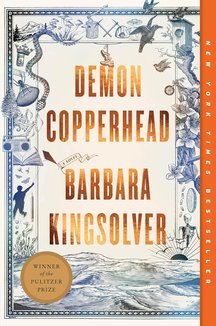
Demon Copperhead: A Pulitzer Prize Winner
Author:
Barbara Kingsolver
ISBN 13:
978-0063251984
WINNER OF THE PULITZER PRIZE • WINNER OF THE WOMEN'S PRIZE FOR FICTION New York Times Readers’ Pick: Top 100 Books of the 21 st Century • An Oprah’s Book Club Selection • An Instant New York Times Bestseller • An Instant Wall Street Journal Bestseller • A #1 Washington Post Bestseller • A New York Times "Ten Best Books of the Year" "Demon is a voice for the ages—akin to Huck Finn or Holden Caulfield—only even more resilient.” —Beth Macy, author of Dopesick "May be the best novel of [the year]. . . . Equal parts hilarious and heartbreaking, this is the story of an irrepressible boy nobody wants, but readers will love.” — Ron Charles, Washington Post From the acclaimed author of The Poisonwood Bible and The Bean Trees and the recipient of the National Book Foundation's Medal for Distinguished Contribution to American Letters , a brilliant novel that enthralls, compels, and captures the heart as it evokes a young hero’s unforgettable journey to maturity Set in the mountains of southern Appalachia, Demon Copperhead is the story of a boy born to a teenaged single mother in a single-wide trailer, with no assets beyond his dead father’s good looks and copper-colored hair, a caustic wit, and a fierce talent for survival. Relayed in his own unsparing voice, Demon braves the modern perils of foster care, child labor, derelict schools, athletic success, addiction, disastrous loves, and crushing losses. Through all of it, he reckons with his own invisibility in a popular culture where even the superheroes have abandoned rural people in favor of cities. Many generations ago, Charles Dickens wrote David Copperfield from his experience as a survivor of institutional poverty and its damages to children in his society. Those problems have yet to be solved in ours. Dickens is not a prerequisite for readers of this novel, but he provided its inspiration. In transposing a Victorian epic novel to the contemporary American South, Barbara Kingsolver enlists Dickens’ anger and compassion, and above all, his faith in the transformative powers of a good story. Demon Copperhead speaks for a new generation of lost boys, and all those born into beautiful, cursed places they can’t imagine leaving behind.



America in the World: A History of U.S. Diplomacy and Foreign Policy
Author:
Robert B. Zoellick
ISBN 13:
978-1538712375
America has a long history of diplomacy–ranging from Benjamin Franklin, Alexander Hamilton, and Thomas Jefferson to Henry Kissinger, Ronald Reagan, and James Baker–now is your chance to see the impact these Americans have had on the world. Recounting the actors and events of U.S. foreign policy, Zoellick identifies five traditions that have emerged from America's encounters with the world: the importance of North America; the special roles trading, transnational, and technological relations play in defining ties with others; changing attitudes toward alliances and ways of ordering connections among states; the need for public support, especially through Congress; and the belief that American policy should serve a larger purpose. These traditions frame a closing review of post-Cold War presidencies, which Zoellick foresees serving as guideposts for the future. Both a sweeping work of history and an insightful guide to U.S. diplomacy past and present, America in the World serves as an informative companion and practical adviser to readers seeking to understand the strategic and immediate challenges of U.S. foreign policy during an era of transformation.
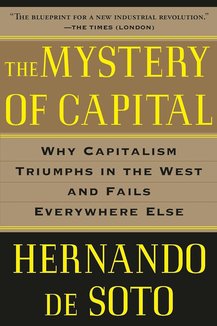
The Mystery of Capital: Why Capitalism Triumphs in the West and Fails Everywhere Else
Author:
Hernando De Soto
ISBN 13:
978-0465016150
A renowned economist argues for the importance of property rights in "the most intelligent book yet written about the current challenge of establishing capitalism in the developing world" ( Economist ) "The hour of capitalism's greatest triumph," writes Hernando de Soto, "is, in the eyes of four-fifths of humanity, its hour of crisis." In The Mystery of Capital , the world-famous Peruvian economist takes up one of the most pressing questions the world faces today: Why do some countries succeed at capitalism while others fail? In strong opposition to the popular view that success is determined by cultural differences, de Soto finds that it actually has everything to do with the legal structure of property and property rights. Every developed nation in the world at one time went through the transformation from predominantly extralegal property arrangements, such as squatting on large estates, to a formal, unified legal property system. In the West we've forgotten that creating this system is what allowed people everywhere to leverage property into wealth. This persuasive book revolutionized our understanding of capital and points the way to a major transformation of the world economy.

The Peacemaker: Ronald Reagan, the Cold War, and the World on the Brink
Author:
William Inboden
ISBN 13:
978-1524745899
Winner of the Society of Presidential Descendants Book Award and the Age of Reagan Conference Book Prize One of the Wall Street Journal ’s best political books of 2022 A masterful account of how Ronald Reagan and his national security team confronted the Soviets, reduced the nuclear threat, won the Cold War, and supported the spread of freedom around the world. “Remarkable… a great read.”—Robert Gates • “Mesmerizing… hard to put down.”—Paul Kennedy • “Full of fresh information… will shape all future studies of the role the United States played in ending the Cold War.”—John Lewis Gaddis • “A major contribution to our understanding of the Reagan presidency and the twilight of the Cold War era.”—David Kennedy With decades of hindsight, the peaceful end of the Cold War seems a foregone conclusion. But in the early 1980s, most experts believed the Soviet Union was strong, stable, and would last into the next century. Ronald Reagan entered the White House with no certainty of what would happen next, only an overriding faith in democracy and an abiding belief that Soviet communism—and the threat of nuclear war—must end. The Peacemaker reveals how Reagan’s White House waged the Cold War while managing multiple crises around the globe. From the emergence of global terrorism, wars in the Middle East, the rise of Japan, and the awakening of China to proxy conflicts in Latin America, Africa, and Asia, Reagan’s team oversaw the worldwide expansion of democracy, globalization, free trade, and the information revolution. Yet no issue was greater than the Cold War standoff with the Soviet Union. As president, Reagan remade the four-decades-old policy of containment and challenged the Soviets in an arms race and ideological contest that pushed them toward economic and political collapse, all while extending an olive branch of diplomacy as he sought a peaceful end to the conflict. Reagan’s revolving team included Secretaries of State Al Haig and George Shultz; Secretaries of Defense Caspar Weinberger and Frank Carlucci; National Security Advisors Bill Clark, John Poindexter, and Bud McFarlane; Chief of Staff James Baker; CIA Director Bill Casey; and United Nations Ambassador Jeane Kirkpatrick. Talented and devoted to their president, they were often at odds with one another as rivalries and backstabbing led to missteps and crises. But over the course of the presidency, Reagan and his team still developed the strategies that brought about the Cold War’s peaceful conclusion and remade the world. Based on thousands of pages of newly-declassified documents and interviews with senior Reagan officials, The Peacemaker brims with fresh insights into one of America’s most consequential presidents. Along the way, it shows how the pivotal decade of the 1980s shaped the world today.