
From this episode
Recommended books
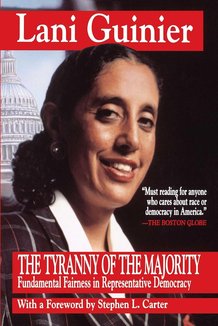
Tyranny of the Majority : Fundamental Fairness in Representative Democracy
Author:
Lani Guinier
At last...the public hearing she was denied...These essays reveal keen powers of analysis applied to some of the most obdurate problems that bedevil electoral politics. Anyone who cares about the mechanisms of democracy should be engaged by her tough-minded explorations.
At last...the public hearing she was denied...These essays reveal keen powers of analysis applied to some of the most obdurate problems that bedevil electoral politics. Anyone who cares about the mechanisms of democracy should be engaged by her tough-minded explorations. It doesn't matter where you think you stand: it's all here, to argue or agree with. -- Henry Louis Gates, Jr. Lani Guinier's fascinating book is a prophetic intervention into a public conversation we desperately need to rejuvenate. There is no doubt that her powerful voice will produce good consequences for our nation and world. -- Cornel West, Author of Race Matters Intriguing and desperately needed... -- The San Francisco Chronicle
Find this book on:

American Politics: The Promise of Disharmony
Author:
Samuel P. Huntington
This stunningly persuasive book examines the persistent, radical gap between the promise of American ideals and the performance of American politics. Samuel P.
This stunningly persuasive book examines the persistent, radical gap between the promise of American ideals and the performance of American politics. Samuel P. Huntington shows how Americans, throughout their history as a nation, have been united by the democratic creed of liberty, equality, and hostility to authority. At the same time he reveals how, inevitably, these ideals have been perennially frustrated through the institutions and hierarchies required to carry on the essential functions of governing a democratic society. From this antagonism between the ideals of democracy and the realities of power have risen four great political upheavals in American history. Every third generation, Huntington argues, Americans have tried to reconstruct their institutions to make them more truly reflect deeply rooted national ideals. Moving from the clenched fists and mass demonstrations of the 1960s, to the moral outrage of the Progressive and Jacksonian Eras, back to the creative ideological fervor of the American Revolution, he incisively analyzes the dissenters’ objectives. All, he pungently writes, sought to remove the fundamental disharmony between the reality of government in America and the ideals on which the American nation was founded. Huntington predicts that the tension between ideals and institutions is likely to increase in this country in the future. And he reminds us that the fate of liberty and democracy abroad is intrinsically linked to the strength of our power in world affairs. This brilliant and controversial analysis deserves to rank alongside the works of Tocqueville, Bryce, and Hofstadter and will become a classic commentary on the meaning of America.
Find this book on:
The Recognitions (New York Review Books Classics)
Authors:
William H. Gass,
William Gaddis,
Tom McCarthy
A postmodern masterpiece about fraud and forgery by one of the most distinctive, accomplished novelists of the last century. The Recognitions is a sweeping depiction of a world in which everything that anyone recognizes as beautiful or true or good emerges as anything but: our world.
A postmodern masterpiece about fraud and forgery by one of the most distinctive, accomplished novelists of the last century. The Recognitions is a sweeping depiction of a world in which everything that anyone recognizes as beautiful or true or good emerges as anything but: our world. The book is a masquerade, moving from New England to New York to Madrid, from the art world to the underworld, but it centers on the story of Wyatt Gwyon, the son of a New England minister, who forsakes religion to devote himself to painting, only to despair of his inspiration. In expiation, he will paint nothing but flawless copies of his revered old masters—copies, however, that find their way into the hands of a sinister financial wizard by the name of Recktall Brown, who of course sells them as the real thing. Dismissed uncomprehendingly by reviewers on publication in 1955 and ignored by the literary world for decades after, The Recognitions is now established as one of the great American novels, immensely ambitious and entirely unique, a book of wild, Boschian inspiration and outrageous comedy that is also profoundly serious and sad.
Find this book on:
Episode overview
We have entered a world of maximum gerrymandering warfare. Any guardrails that once existed, from the Constitution or the courts, have been bulldozed over the last decade – most recently in the Supreme Court decision that gutted the Voting Rights Act and made it harder for minorities to challenge racially discriminatory voting maps.
Red and blue states alike have been aggressively trying to redraw their congressional maps in response to all these developments. And there is no sign that will end in 2028; legislatures will just continue trying to tweak their lines to squeeze out advantage for whatever party is in power. And competitive districts in this country – already an endangered species – now teeter on extinction.
That is, unless something dramatic changes.
Lee Drutman is a senior fellow in the political reform program at New America. He’s one of the most persistent and thoughtful advocates of selecting House members through proportional representation – a system used in many other countries that would make gerrymandering much more difficult. He’s the author of the 2020 book “Breaking the Two-Party Doom Loop: The Case for Multiparty Democracy in America” and writes the newsletter Undercurrent Events.