From this episode
Recommended books
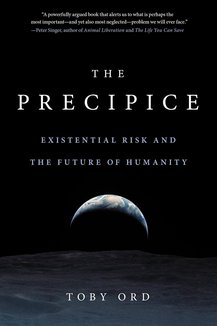
Precipice
Author:
Toby Ord
This urgent and eye-opening book makes the case that protecting humanity's future is the central challenge of our time. If all goes well, human history is just beginning.
This urgent and eye-opening book makes the case that protecting humanity's future is the central challenge of our time. If all goes well, human history is just beginning. Our species could survive for billions of years - enough time to end disease, poverty, and injustice, and to flourish in ways unimaginable today. But this vast future is at risk. With the advent of nuclear weapons, humanity entered a new age, where we face existential catastrophes - those from which we could never come back. Since then, these dangers have only multiplied, from climate change to engineered pathogens and artificial intelligence. If we do not act fast to reach a place of safety, it will soon be too late. Drawing on over a decade of research, The Precipice explores the cutting-edge science behind the risks we face. It puts them in the context of the greater story of humanity: showing how ending these risks is among the most pressing moral issues of our time. And it points the way forward, to the actions and strategies that can safeguard humanity. An Oxford philosopher committed to putting ideas into action, Toby Ord has advised the US National Intelligence Council, the UK Prime Minister's Office, and the World Bank on the biggest questions facing humanity. In The Precipice , he offers a startling reassessment of human history, the future we are failing to protect, and the steps we must take to ensure that our generation is not the last. "A book that seems made for the present moment." — N ew Yorker
Find this book on:


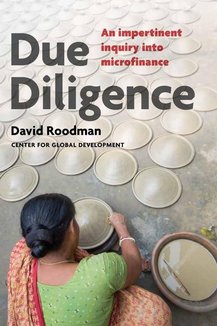
Due Diligence: An Impertinent Inquiry into Microfinance
Author:
David Roodman
The idea that small loans can help poor families build businesses and exit poverty has blossomed into a global movement. The concept has captured the public imagination, drawn in billions of dollars, reached millions of customers, and garnered a Nobel Prize.
The idea that small loans can help poor families build businesses and exit poverty has blossomed into a global movement. The concept has captured the public imagination, drawn in billions of dollars, reached millions of customers, and garnered a Nobel Prize. Radical in its suggestion that the poor are creditworthy and conservative in its insistence on individual accountability, the idea has expanded beyond credit into savings, insurance, and money transfers, earning the name microfinance. But is it the boon so many think it is? Readers of David Roodman's openbook blog will immediately recognize his thorough, straightforward, and trenchant analysis. Due Diligence , written entirely in public with input from readers, probes the truth about microfinance to guide governments, foundations, investors, and private citizens who support financial services for poor people. In particular, it explains the need to deemphasize microcredit in favor of other financial services for the poor.
Find this book on:
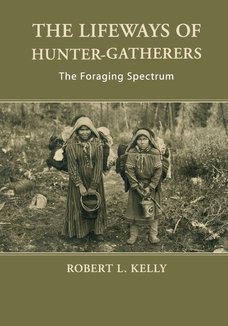
The Lifeways of Hunter-Gatherers: The Foraging Spectrum
Author:
Robert L. Kelly
In this book, Robert L. Kelly challenges the preconceptions that hunter-gatherers were Paleolithic relics living in a raw state of nature, instead crafting a position that emphasizes their diversity, and downplays attempts to model the original foraging lifeway or to use foragers to depict human nature stripped to its core.
In this book, Robert L. Kelly challenges the preconceptions that hunter-gatherers were Paleolithic relics living in a raw state of nature, instead crafting a position that emphasizes their diversity, and downplays attempts to model the original foraging lifeway or to use foragers to depict human nature stripped to its core. Kelly reviews the anthropological literature for variation among living foragers in terms of diet, mobility, sharing, land tenure, technology, exchange, male–female relations, division of labor, marriage, descent, and political organization. Using the paradigm of human behavioral ecology, he analyzes the diversity in these areas and seeks to explain rather than explain away variability, and argues for an approach to prehistory that uses archaeological data to test theory rather than one that uses ethnographic analogy to reconstruct the past.
Find this book on:
Episode overview
Do we actually know how much good our charitable donations do?
This is the question that jump-started Holden Karnofsky’s current career. He was working at a hedge fund and wanted to figure out how to give his money away with the certainty that it would save as many lives as possible. But he couldn’t find a service that would help him do that, so he and his co-worker Elie Hassenfeld decided to quit their jobs to build one. The result was GiveWell, a nonprofit that measures the effectiveness of different charities and recommends the ones it is most confident can save lives with the least cost. Things like providing bed nets to prevent malaria and treatments to deworm schoolchildren in low-income countries.
But in recent years, Karnofsky has taken a different approach. He is currently the co-C.E.O. of Open Philanthropy, which operates under the same basic principle — how can we do the most good possible? — but with a very different theory of how to do so. Open Phil’s areas of funding range from farm animal welfare campaigns and criminal justice reform to pandemic preparedness and A.I. safety. And Karnofsky has recently written a series of blog posts centered around the idea that, ethically speaking, we’re living through the most important century in human history: The decisions we make in the coming decades about transformational technologies will determine the fate of trillions of future humans.
In all of this, Karnofsky represents the twin poles of a movement that’s come to deeply influence my thinking: effective altruism. The hallmark of that approach is following fundamental questions about how to do good through to their conclusions, no matter how simple or fantastical the answers. And so this is a conversation, at a meta-level, about how to think like an effective altruist. Along the way, we discuss everything from climate change to animal welfare to evaluating charities to artificial intelligence to the hard limits of economic growth to trying to view the world as if you were a billion years old.
You probably won’t agree with every prediction in here, but that is, in a way, the point: We live in a weird world that’s only getting weirder, and we need to be able to entertain both the obvious and the outlandish implications. What Karnofksy’s career reveals is how hard that is to actually do.