
From this episode
Recommended books
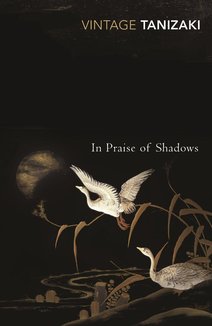
In Praise of Shadows
Author:
Jun'ichiro Tanizaki
An intimate reflection on Japanese art and architecture from one of the country's greatest novelists. This is an enchanting essay on aesthetics by one of the greatest Japanese novelists.
An intimate reflection on Japanese art and architecture from one of the country's greatest novelists. This is an enchanting essay on aesthetics by one of the greatest Japanese novelists. Tanizaki's eye ranges over architecture, jade, food, toilets, and combines an acute sense of the use of space in buildings, as well as perfect descriptions of lacquerware under candlelight and women in the darkness of the house of pleasure. The result is a classic description of the collision between the shadows of traditional Japanese interiors and the dazzling light of the modern age. 'Elegant...a delight to read' Independent on Sunday
Find this book on:


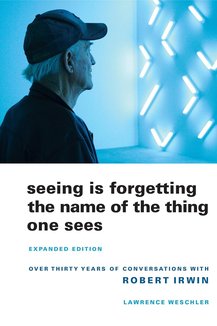
Seeing Is Forgetting the Name of the Thing One Sees: Expanded Edition
Author:
Lawrence Weschler
When this book first appeared in 1982, it introduced readers to Robert Irwin, the Los Angeles artist "who one day got hooked on his own curiosity and decided to live it." Now expanded to include six additional chapters and twenty-four pages of color plates, Seeing Is Forgetting the Name of the Thing One Sees chronicles three decades of conversation between Lawrence Weschler and light and space master Irwin. It surveys many of Irwin's site-conditioned projects―in particular the Central Gardens at the Getty Museum (the subject of an epic battle with the site's principal architect, Richard Meier) and the design that transformed an abandoned Hudson Valley factory into Dia's new Beacon campus―enhancing what many had already considered the best book ever on an artist.
When this book first appeared in 1982, it introduced readers to Robert Irwin, the Los Angeles artist "who one day got hooked on his own curiosity and decided to live it." Now expanded to include six additional chapters and twenty-four pages of color plates, Seeing Is Forgetting the Name of the Thing One Sees chronicles three decades of conversation between Lawrence Weschler and light and space master Irwin. It surveys many of Irwin's site-conditioned projects―in particular the Central Gardens at the Getty Museum (the subject of an epic battle with the site's principal architect, Richard Meier) and the design that transformed an abandoned Hudson Valley factory into Dia's new Beacon campus―enhancing what many had already considered the best book ever on an artist.
Find this book on:
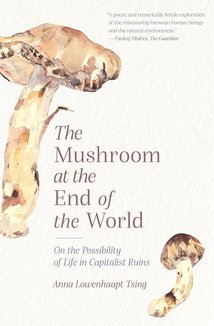
The Mushroom at the End of the World: On the Possibility of Life in Capitalist Ruins
Author:
Anna Lowenhaupt Tsing
"A poetic and remarkably fertile exploration of the relationship between human beings and the natural environment."—Pankaj Mishra, The Guardian "I'm very grateful to have this book."—Ursula K. Le Guin The acclaimed and award-winning book about what a rare mushroom can teach us about sustaining life on a fragile planet A Flavorwire and Times Higher Education Book of the Year Matsutake is the most valuable mushroom in the world—and a weed that grows in human-disturbed forests across the northern hemisphere.
"A poetic and remarkably fertile exploration of the relationship between human beings and the natural environment."—Pankaj Mishra, The Guardian "I'm very grateful to have this book."—Ursula K. Le Guin The acclaimed and award-winning book about what a rare mushroom can teach us about sustaining life on a fragile planet A Flavorwire and Times Higher Education Book of the Year Matsutake is the most valuable mushroom in the world—and a weed that grows in human-disturbed forests across the northern hemisphere. Through its ability to nurture trees, matsutake helps forests to grow in daunting places. It is also an edible delicacy in Japan, where it sometimes commands astronomical prices. In all its contradictions, matsutake offers insights into areas far beyond just mushrooms and addresses a crucial question: what manages to live in the ruins we have made? A tale of diversity within our damaged landscapes, The Mushroom at the End of the World follows one of the strangest commodity chains of our times to explore the unexpected corners of capitalism. Here, we witness the varied and peculiar worlds of matsutake commerce: the worlds of Japanese gourmets, capitalist traders, Hmong jungle fighters, industrial forests, Yi Chinese goat herders, Finnish nature guides, and more. These companions also lead us into fungal ecologies and forest histories to better understand the promise of cohabitation in a time of massive human destruction. By investigating one of the world's most sought-after fungi, The Mushroom at the End of the World presents an original examination into the relation between capitalist destruction and collaborative survival within multispecies landscapes, the prerequisite for continuing life on earth.
Find this book on:
Episode overview
Being on the internet just doesn’t feel as fun anymore. As more of our digital life is driven by algorithms, it’s become a lot easier to find movies or TV shows or music that fits our preferences pretty well. But it feels harder to find things that are strange and surprising — the kinds of culture that help you, as an individual, develop your own sense of taste.
This can be a fuzzy thing to talk about. But Kyle Chayka, a staff writer at The New Yorker, has written a whole book on it, the forthcoming “Filterworld: How Algorithms Flattened Culture.” We talk about how today’s internet encourages everything to look more the same and is even dulling our ability to know what we like. And we discuss what we can do to strengthen our sense of personal taste in order to live a richer, more beautiful life.