
From this episode
Recommended books
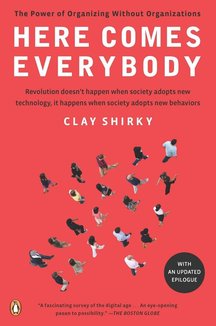
Here Comes Everybody: The Power of Organizing Without Organizations
Author:
Clay Shirky
“A fascinating survey of the digital age . .
“A fascinating survey of the digital age . . . An eye-opening paean to possibility.” — The Boston Globe “Mr. Shirky writes cleanly and convincingly about the intersection of technological innovation and social change.” — New York Observer An extraordinary exploration of how technology can empower social and political organizers For the first time in history, the tools for cooperating on a global scale are not solely in the hands of governments or institutions. The spread of the internet and mobile phones are changing how people come together and get things done—and sparking a revolution that, as Clay Shirky shows, is changing what we do, how we do it, and even who we are. Here, we encounter a whoman who loses her phone and recruits an army of volunteers to get it back from the person who stole it. A dissatisfied airline passenger who spawns a national movement by taking her case to the web. And a handful of kids in Belarus who create a political protest that the state is powerless to stop. Here Comes Everybody is a revelatory examination of how the wildfirelike spread of new forms of social interaction enabled by technology is changing the way humans form groups and exist within them. A revolution in social organization has commenced, and Clay Shirky is its brilliant chronicler.
Find this book on:



The Profiteers: Bechtel and the Men Who Built the World
Author:
Sally Denton
From the bestselling coauthor of The Money and the Power , the “compelling corporate history” ( The National Book Review ) and inside story of the Bechtel family and the empire they’ve controlled since the construction of the Hoover Dam. The tale of the Bechtel family dynasty is a classic American business story.
From the bestselling coauthor of The Money and the Power , the “compelling corporate history” ( The National Book Review ) and inside story of the Bechtel family and the empire they’ve controlled since the construction of the Hoover Dam. The tale of the Bechtel family dynasty is a classic American business story. It begins with Warren A. “Dad” Bechtel, who led a consortium that constructed the Hoover Dam. They would go on to “build the world,” from the construction of airports in Hong Kong and Doha, to pipelines and tunnels in Alaska and Europe, to mining and energy operations around the globe. In their century-long quest, five generations of Bechtel men have harnessed and distributed much of the planet’s natural resources, including solar geothermal power. Bechtel is now one of the largest privately held corporations in the world. The Bechtel Group has eclipsed its few rivals, with developments in emerging and third world nations that include secret military installations and defense projects; underground bunkers in Kuwait, Iraq, and Afghanistan; oil pipelines and entire cities in the Middle East; palaces for Arab rulers, such as the Saudi Royal Family; and chemical plants for Arab dictators. Like all stories of empire building, the rise of Bechtel—one of the first mega companies to emerge in the American West—presents a complex and riveting narrative. Veiled in obsessive secrecy, Bechtel has had closer ties to the US government than any other private corporation in modern memory. “Riveting and revealing” ( Kirkus Reviews ), The Profiteers is one of the biggest business and political stories of our time.
Find this book on:

Jim Ravel's theatrical pickpocketing
Author:
Paul Butler
Whether you perform magic close-up, in clubs or on stage, from the simplest card tricks to the largest illusions, the secrets in this book can increase your commerciality one hundredfold. Knowledge of even the simplest pickpocketing skills can change a good trick into a great trick or a working act into a featured act.
Whether you perform magic close-up, in clubs or on stage, from the simplest card tricks to the largest illusions, the secrets in this book can increase your commerciality one hundredfold. Knowledge of even the simplest pickpocketing skills can change a good trick into a great trick or a working act into a featured act. If you are looking for audience response, you need look no further than the genuine shock on the face of an innocent volunteer learning that he has just been relieved of his valuables! "But, I'm a magician", you say. This book was written by a magician, for magicians. Jim Ravel (who spent half of his career as a magician and the other half as a stage pickpocket) knows both fields inside out. Like magic, pickpocketing requires certain skills, but there are also secrets that make seemingly impossible steals simple. Theatrical Pickpocketing contains the applied psychology, step-by-step moves, logical ideas and complete routines necessary to steal watches, wallets, belts, suspenders, cufflinks, neckties and shirts right off a spectator's back. So whether you want to change careers or simply add a couple of screamingly funny moments to your present act, Theatrical Pickpocketing is must reading for every working magician (or anyone who would like to be). Hardbound; 137 pages; over 80 illustrations.
Find this book on:
Episode overview
For most of us, seeing an advertisement pop up while we’re scrolling on Instagram or reading an article or watching a video is the most banal experience possible. But in the background of those experiences is a $500 billion marketplace where our attention is being bought, packaged and sold at split-second speeds virtually every minute of every day. Online advertising is the economic engine of the internet, and that engine is fueled by our attention.
Tim Hwang is the former global public policy lead for A.I. and machine learning at Google and the author of the book “Subprime Attention Crisis: Advertising and the Time Bomb at the Heart of the Internet.” Hwang’s central argument is that everything about the internet — from the emphasis data collection to the use of the “like” button to the fact that services like Google Search and Facebook are free — flows from its core business model. But that business model is also in crisis. The internet is degrading the very resource — our collective attention — on which its financial survival depends. The resulting “subprime attention crisis” threatens upend the internet as we know it.
So this conversation is about the economic logic that undergirds our entire experience of the internet, and how that logic is constantly warping, manipulating and shaping the most important resource we have — our attention. But it’s also about whether a very different kind of internet — build on a very different economic logic — is possible.