
From this episode
Recommended books
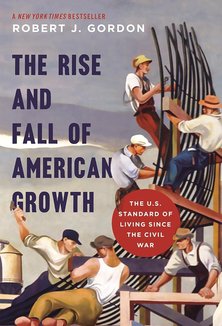
How America's high standard of living came to be and why future growth is under threat In the century after the Civil War, an economic revolution improved the American standard of living in ways previously unimaginable. Electric lighting, indoor plumbing, motor vehicles, air travel, and television transformed households and workplaces.
How America's high standard of living came to be and why future growth is under threat In the century after the Civil War, an economic revolution improved the American standard of living in ways previously unimaginable. Electric lighting, indoor plumbing, motor vehicles, air travel, and television transformed households and workplaces. But has that era of unprecedented growth come to an end? Weaving together a vivid narrative, historical anecdotes, and economic analysis, The Rise and Fall of American Growth challenges the view that economic growth will continue unabated, and demonstrates that the life-altering scale of innovations between 1870 and 1970 cannot be repeated. Gordon contends that the nation's productivity growth will be further held back by the headwinds of rising inequality, stagnating education, an aging population, and the rising debt of college students and the federal government, and that we must find new solutions. A critical voice in the most pressing debates of our time, The Rise and Fall of American Growth is at once a tribute to a century of radical change and a harbinger of tougher times to come.
Find this book on:


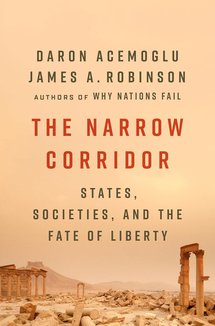
The Narrow Corridor: States, Societies, and the Fate of Liberty
Authors:
Daron Acemoglu,
James A. Robinson
From the authors of the international bestseller Why Nations Fail , a crucial new big-picture framework that answers the question of how liberty flourishes in some states but falls to authoritarianism or anarchy in others--and explains how it can continue to thrive despite new threats. In Why Nations Fail , Daron Acemoglu and James A.
From the authors of the international bestseller Why Nations Fail , a crucial new big-picture framework that answers the question of how liberty flourishes in some states but falls to authoritarianism or anarchy in others--and explains how it can continue to thrive despite new threats. In Why Nations Fail , Daron Acemoglu and James A. Robinson argued that countries rise and fall based not on culture, geography, or chance, but on the power of their institutions. In their new book, they build a new theory about liberty and how to achieve it, drawing a wealth of evidence from both current affairs and disparate threads of world history. Liberty is hardly the "natural" order of things. In most places and at most times, the strong have dominated the weak and human freedom has been quashed by force or by customs and norms. Either states have been too weak to protect individuals from these threats, or states have been too strong for people to protect themselves from despotism. Liberty emerges only when a delicate and precarious balance is struck between state and society. There is a Western myth that political liberty is a durable construct, arrived at by a process of "enlightenment." This static view is a fantasy, the authors argue. In reality, the corridor to liberty is narrow and stays open only via a fundamental and incessant struggle between state and society: The authors look to the American Civil Rights Movement, Europe’s early and recent history, the Zapotec civilization circa 500 BCE, and Lagos’s efforts to uproot corruption and institute government accountability to illustrate what it takes to get and stay in the corridor. But they also examine Chinese imperial history, colonialism in the Pacific, India’s caste system, Saudi Arabia’s suffocating cage of norms, and the “Paper Leviathan” of many Latin American and African nations to show how countries can drift away from it, and explain the feedback loops that make liberty harder to achieve. Today we are in the midst of a time of wrenching destabilization. We need liberty more than ever, and yet the corridor to liberty is becoming narrower and more treacherous. The danger on the horizon is not "just" the loss of our political freedom, however grim that is in itself; it is also the disintegration of the prosperity and safety that critically depend on liberty. The opposite of the corridor of liberty is the road to ruin.
Find this book on:
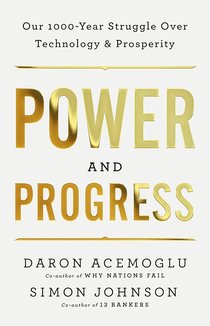
Power and Progress: Our Thousand-Year Struggle Over Technology and Prosperity
Authors:
Daron Acemoglu,
Simon Johnson
The bestselling co-author of Why Nations Fail and the bestselling co-author of 13 Bankers deliver a bold reinterpretation of economics and history that will fundamentally change how you see the world A thousand years of history and contemporary evidence make one thing clear: progress depends on the choices we make about technology. New ways of organizing production and communication can either serve the narrow interests of an elite or become the foundation for widespread prosperity.
The bestselling co-author of Why Nations Fail and the bestselling co-author of 13 Bankers deliver a bold reinterpretation of economics and history that will fundamentally change how you see the world A thousand years of history and contemporary evidence make one thing clear: progress depends on the choices we make about technology. New ways of organizing production and communication can either serve the narrow interests of an elite or become the foundation for widespread prosperity. The wealth generated by technological improvements in agriculture during the European Middle Ages was captured by the nobility and used to build grand cathedrals, while peasants remained on the edge of starvation. The first hundred years of industrialization in England delivered stagnant incomes for working people. And throughout the world today, digital technologies and artificial intelligence undermine jobs and democracy through excessive automation, massive data collection, and intrusive surveillance. It doesn’t have to be this way. Power and Progress demonstrates the path of technology was once—and may again—be brought under control. Cutting-edge technological advances can become empowering and democratizing tools, but not if all major decisions remain in the hands of a few hubristic tech leaders. With their bold reinterpretation of economics and history, Daron Acemoglu and Simon Johnson fundamentally change how we see the world, providing the vision needed to redirect innovation so it again benefits most people.
Find this book on:
Episode overview
The world economy has experienced many shocks over the past few years: A pandemic. Russia’s invasion of Ukraine. Skyrocketing inflation. These are the stories that have dominated headlines — and for good reason.
But they’ve also overshadowed a set of deeper, more fundamental shifts — the rise of China as an economic superpower, the fracturing of trade relations, the realities of the climate crisis — that are transforming the global economic order and prompting ambitious policy responses from leaders across the world.
Martin Wolf is the chief economics commentator at The Financial Times, a former senior economist at the World Bank and the author, most recently, of “The Crisis of Democratic Capitalism. Across his writings, Wolf has developed some of the clearest frameworks for thinking about how the global economy is changing and some of the sharpest critiques of how policymakers are responding to those changes.
We discuss how China’s meteoric economic rise has shaken the foundations of the global economy, why globalization has remained far more resilient than so many predicted, why Wolf is skeptical that President Biden’s industrial policy agenda will succeed, the debate between “onshoring” and “friendshoring” that is dividing the Democratic Party, why a recession in the United States is looking far less likely than it did six months ago, the virtues and vices of Biden’s “foreign policy for the middle class,” why China’s recent economic troubles could signal a more foundational decline, why the U.S. economy has remained so much more stronger than most economists anticipated, and more.
This episode is guest-hosted by Rogé Karma, the senior editor for “The Ezra Klein Show.” Rogé has been with the show since July 2019, when it was based at Vox. He works closely with Ezra on everything related to the show, from editing to interview prep to guest selection. At Vox, he also wrote and conducted interviews on topics ranging from policing and racial justice to democracy reform and the coronavirus pandemic.