From this episode
Recommended books
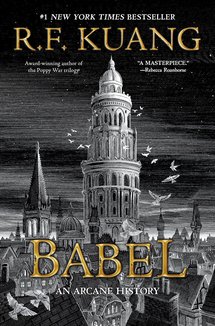
Instant #1 New York Times Bestseller from the author of The Poppy War “Absolutely phenomenal. One of the most brilliant, razor-sharp books I've had the pleasure of reading that isn't just an alternative fantastical history, but an interrogative one; one that grabs colonial history and the Industrial Revolution, turns it over, and shakes it out.” -- Shannon Chakraborty, bestselling author of The City of Brass From award-winning author R.
Instant #1 New York Times Bestseller from the author of The Poppy War “Absolutely phenomenal. One of the most brilliant, razor-sharp books I've had the pleasure of reading that isn't just an alternative fantastical history, but an interrogative one; one that grabs colonial history and the Industrial Revolution, turns it over, and shakes it out.” -- Shannon Chakraborty, bestselling author of The City of Brass From award-winning author R. F. Kuang comes Babel , a thematic response to The Secret History and a tonal retort to Jonathan Strange & Mr. Norrell that grapples with student revolutions, colonial resistance, and the use of language and translation as the dominating tool of the British empire. Traduttore, traditore : An act of translation is always an act of betrayal. 1828. Robin Swift, orphaned by cholera in Canton, is brought to London by the mysterious Professor Lovell. There, he trains for years in Latin, Ancient Greek, and Chinese, all in preparation for the day he’ll enroll in Oxford University’s prestigious Royal Institute of Translation—also known as Babel. Babel is the world's center for translation and, more importantly, magic. Silver working—the art of manifesting the meaning lost in translation using enchanted silver bars—has made the British unparalleled in power, as its knowledge serves the Empire’s quest for colonization. For Robin, Oxford is a utopia dedicated to the pursuit of knowledge. But knowledge obeys power, and as a Chinese boy raised in Britain, Robin realizes serving Babel means betraying his motherland. As his studies progress, Robin finds himself caught between Babel and the shadowy Hermes Society, an organization dedicated to stopping imperial expansion. When Britain pursues an unjust war with China over silver and opium, Robin must decide… Can powerful institutions be changed from within, or does revolution always require violence?
Find this book on:


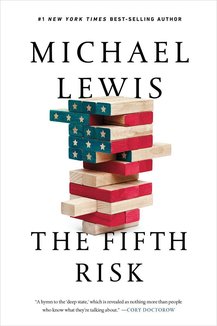
The Fifth Risk: Undoing Democracy
Author:
Michael Lewis
The New York Times Bestseller, with a new afterword "[Michael Lewis’s] most ambitious and important book." ―Joe Klein, New York Times Michael Lewis’s brilliant narrative of the Trump administration’s botched presidential transition takes us into the engine rooms of a government under attack by its leaders through willful ignorance and greed. The government manages a vast array of critical services that keep us safe and underpin our lives from ensuring the safety of our food and drugs and predicting extreme weather events to tracking and locating black market uranium before the terrorists do.
The New York Times Bestseller, with a new afterword "[Michael Lewis’s] most ambitious and important book." ―Joe Klein, New York Times Michael Lewis’s brilliant narrative of the Trump administration’s botched presidential transition takes us into the engine rooms of a government under attack by its leaders through willful ignorance and greed. The government manages a vast array of critical services that keep us safe and underpin our lives from ensuring the safety of our food and drugs and predicting extreme weather events to tracking and locating black market uranium before the terrorists do. The Fifth Risk masterfully and vividly unspools the consequences if the people given control over our government have no idea how it works.
Find this book on:
Episode overview
In my columns and on this show over the past few years, I’ve argued that to achieve the goals liberals hold most dear, we need a liberalism that builds. A liberalism that builds everything from multifamily housing and mass transit systems to transmission lines and solar farms. And we need a liberalism that can build it all quickly, cheaply and effectively. But even in the places where liberals have governing power, they are often failing to do exactly that. Why?
Nicholas Bagley is a law professor at the University of Michigan, the former chief legal counsel to Gov. Gretchen Whitmer and the author of a fascinating paper called “The Procedure Fetish.” In it, Bagley argues that liberals — liberal lawyers in particular — have helped hobble the very government they now need to act swiftly and decisively. It’s easy to see how conservatives have strategically used a thicket of procedures and paperwork to slow down government, but what Bagley shows is that liberals too have been complicit in that project — to the detriment of many of the very causes they hope to advance.
So this is a conversation about what I’ve come to think of as the divided soul of American liberalism — one that simultaneously demands big government action while also constantly acting to restrain it. We also discuss the importance of the administrative state, what liberals often fail to understand about government legitimacy, how corporate interests end up “capturing” government agencies, why Bagley thinks that American politics broadly and the Democratic Party in particular have a “lawyer problem,” how government paralysis helps fuel the rise of right-wing populists like Donald Trump, what it will take to restore Americans’ trust in government, the problems with the public interest legal movement, how progressives are getting in the way of their own decarbonization agenda and more.