From this episode
Recommended books
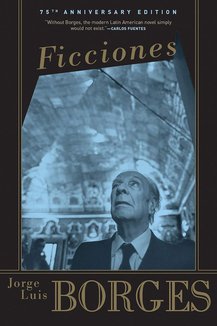
Ficciones
Authors:
Jorge Luis Borges,
Anthony Kerrigan
The seventeen pieces in Ficciones demonstrate the gargantuan powers of imagination, intelligence, and style of one of the greatest writers of this or any other century. Borges sends us on a journey into a compelling, bizarre, and profoundly resonant realm; we enter the fearful sphere of Pascal’s abyss, the surreal and literal labyrinth of books, and the iconography of eternal return.
The seventeen pieces in Ficciones demonstrate the gargantuan powers of imagination, intelligence, and style of one of the greatest writers of this or any other century. Borges sends us on a journey into a compelling, bizarre, and profoundly resonant realm; we enter the fearful sphere of Pascal’s abyss, the surreal and literal labyrinth of books, and the iconography of eternal return. More playful and approachable than the fictions themselves are Borges’s Prologues, brief elucidations that offer the uninitiated a passageway into the whirlwind of Borges’s genius and mirror the precision and potency of his intellect and inventiveness, his piercing irony, his skepticism, and his obsession with fantasy. To enter the worlds in Ficciones is to enter the mind of Jorge Luis Borges, wherein lies Heaven, Hell, and everything in between.
Find this book on:


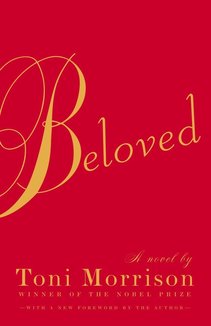
Beloved: Pulitzer Prize Winner
Author:
Toni Morrison
PULITZER PRIZE WINNER • NEW YORK TIMES BESTSELLER • A spellbinding novel that transforms history into a story as powerful as Exodus and as intimate as a lullaby. With a new afterword by the author.
PULITZER PRIZE WINNER • NEW YORK TIMES BESTSELLER • A spellbinding novel that transforms history into a story as powerful as Exodus and as intimate as a lullaby. With a new afterword by the author. This "brutally powerful, mesmerizing story” ( People) is an unflinchingly look into the abyss of slavery, from the acclaimed Nobel Prize winner. Sethe was born a slave and escaped to Ohio, but eighteen years later she is still not free. Sethe has too many memories of Sweet Home, the beautiful farm where so many hideous things happened. And Sethe’s new home is haunted by the ghost of her baby, who died nameless and whose tombstone is engraved with a single word: Beloved. “A masterwork.... Wonderful.... I can’t imagine American literature without it.” —John Leonard, Los Angeles Times
Find this book on:
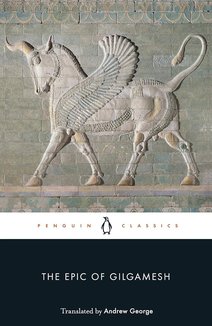
The Epic of Gilgamesh (Penguin Classics)
Author:
Andrew George
Andrew George's "masterly new translation" ( The Times ) of the world's first truly great work of literature A Penguin Classic Miraculously preserved on clay tablets dating back as much as four thousand years, the poem of Gilgamesh, king of Uruk, is the world's oldest epic, predating Homer by many centuries. The story tells of Gilgamesh's adventures with the wild man Enkidu, and of his arduous journey to the ends of the earth in quest of the Babylonian Noah and the secret of immortality.
Andrew George's "masterly new translation" ( The Times ) of the world's first truly great work of literature A Penguin Classic Miraculously preserved on clay tablets dating back as much as four thousand years, the poem of Gilgamesh, king of Uruk, is the world's oldest epic, predating Homer by many centuries. The story tells of Gilgamesh's adventures with the wild man Enkidu, and of his arduous journey to the ends of the earth in quest of the Babylonian Noah and the secret of immortality. Alongside its themes of family, friendship and the duties of kings, the Epic of Gilgamesh is, above all, about mankind's eternal struggle with the fear of death. The Babylonian version has been known for over a century, but linguists are still deciphering new fragments in Akkadian and Sumerian. Andrew George's award-winning translation has been revised to include many new discoveries of text, and reissued in 2019. It brilliantly combines these into a fluent narrative and will long rank as the definitive English Gilgamesh. For more than seventy years, Penguin has been the leading publisher of classic literature in the English-speaking world. With more than 1,700 titles, Penguin Classics represents a global bookshelf of the best works throughout history and across genres and disciplines. Readers trust the series to provide authoritative texts enhanced by introductions and notes by distinguished scholars and contemporary authors, as well as up-to-date translations by award-winning translators.
Find this book on:
Episode overview
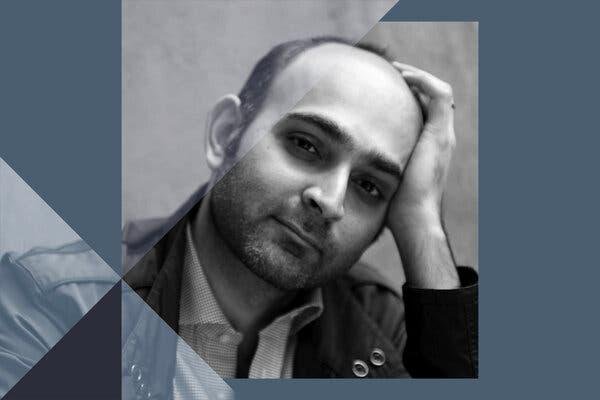
In his latest work, “The Last White Man,” the award-winning writer Mohsin Hamid imagines a world that is very like our own, with one major exception: On various days, white people wake up to discover that their skin is no longer white. It’s a heavy premise, but one of Hamid’s unique talents as a novelist is his ability to take on the most difficult of topics — racism, migration, loss — with a remarkably light touch.
“How do you begin to have these conversations in a way that allows everybody a way in?” Hamid asks at one point in our conversation. “How do you talk about these things in a way that’s open to everyone?” What sets Hamid apart is his capacity to do just that — both in his fiction and in our conversation. We discuss:
How Hamid experienced what it was like to lose his whiteness after 9/11
What happens to a society when suddenly we can’t sort ourselves by race
The origins of modern humans’ fear of death — and how to overcome it
Why Hamid thinks future humans will look back at the idea of borders with moral horror
Why Hamid believes that pessimistic realism is a “deeply conservative” worldview
Hamid’s process for imagining optimistic futures
Why Hamid believes that the very notion of the self is a fiction
Why we turn to activities like sex, drugs and meditation when we get overwhelmed
How America’s policies toward immigrants and refugees should challenge our “heroic” sense of national identity
What Toni Morrison taught Hamid about how to read and write
And more.