
From this episode
Recommended books
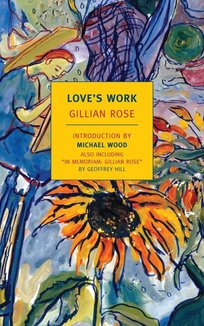
Love's Work
Authors:
Gillian Rose,
Michael Wood
Love’s Work is at once a memoir and a work of philosophy. Written by the English philosopher Gillian Rose as she was dying of cancer, it is a book about both the fallibility and the endurance of love, love that becomes real and lasting through an ongoing reckoning with its own limitations.
Love’s Work is at once a memoir and a work of philosophy. Written by the English philosopher Gillian Rose as she was dying of cancer, it is a book about both the fallibility and the endurance of love, love that becomes real and lasting through an ongoing reckoning with its own limitations. Rose looks back on her childhood, the complications of her parents’ divorce and her dyslexia, and her deep and divided feelings about what it means to be Jewish. She tells the stories of several friends also laboring under the sentence of death. From the sometimes conflicting vantage points of her own and her friends’ tales, she seeks to work out (seeks, because the work can never be complete—to be alive means to be incomplete) a distinctive outlook on life, one that will do justice to our yearning both for autonomy and for connection to others. With droll self-knowledge (“I am highly qualified in unhappy love affairs,” Rose writes, “My earliest unhappy love affair was with Roy Rogers”) and with unsettling wisdom (“To live, to love, is to be failed”), Rose has written a beautiful, tender, tough, and intricately wrought survival kit packed with necessary but unanswerable questions.
Find this book on:


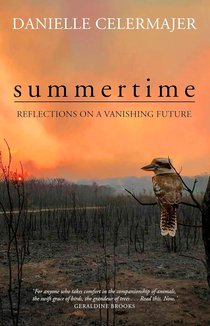
Summertime: Reflections on a vanishing future
Author:
Danielle Celermajer
A different kind of nature writing, for a different kind of landscape. I went and sat alone where Jimmy has been lying.
A different kind of nature writing, for a different kind of landscape. I went and sat alone where Jimmy has been lying. It is way down in the bush. The light is soft, the air and the earth are cool, and the smell is of leaves and the river. I cannot presume to know what he is doing when he lies here, but it seems that he is taking himself back to an ecology not wrought by the terror of the fires, not fuelled by our violence on the earth. He is letting another earth heal him. Philosopher Danielle Celermajer’ s story of Jimmy the pig caught the world’ s attention during the Black Summer of 2019 -20. Gathered here is that story and others written in the shadow of the bushfires that ravaged Australia. In the midst of the death and grief of animals, humans, trees and ecologies Celermajer asks us to look around – really look around – to become present to all beings who are living and dying through the loss of our shared home. At once a howl in the forest and an elegy for a country’ s soul, these meditations are lyrical, tender and profound.
Find this book on:
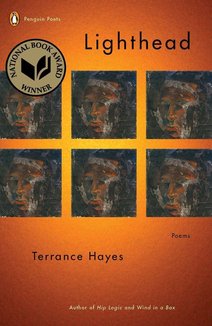
Lighthead: Poems (National Book Award Winner) (Penguin Poets)
Author:
Terrance Hayes
Winner of the 2010 National Book Award for Poetry Watch for the new collection of poetry from Terrance Hayes, American Sonnets for My Past and Future Assassin , coming in June of 2018 In his fourth collection, Terrance Hayes investigates how we construct experience. With one foot firmly grounded in the everyday and the other hovering in the air, his poems braid dream and reality into a poetry that is both dark and buoyant.
Winner of the 2010 National Book Award for Poetry Watch for the new collection of poetry from Terrance Hayes, American Sonnets for My Past and Future Assassin , coming in June of 2018 In his fourth collection, Terrance Hayes investigates how we construct experience. With one foot firmly grounded in the everyday and the other hovering in the air, his poems braid dream and reality into a poetry that is both dark and buoyant. Cultural icons as diverse as Fela Kuti, Harriet Tubman, and Wallace Stevens appear with meditations on desire and history. We see Hayes testing the line between story and song in a series of stunning poems inspired by the Pecha Kucha, a Japanese presentation format. This innovative collection presents the light- headedness of a mind trying to pull against gravity and time. Fueled by an imagination that enlightens, delights, and ignites, Lighthead leaves us illuminated and scorched.
Find this book on:
Episode overview
One of the oldest human ideas is that we are somehow different from animals, somehow superior to them. That’s a mistake, argues the environmental philosopher Melanie Challenger. “Many of the things we most value — our relationships, the romantic sensations of attraction and love, pregnancy and childbirth, the pleasures of springtime, of eating a meal — are physical, largely unconscious and demonstrably animal,” she writes in her book “How to Be Animal: A New History of What It Means to Be Human.” The consequences of resisting our fellowship with other species, she argues, have been devastating to them and to the planet.
Challenger’s arguments are fascinating in their own right, but they also have a particular resonance at this moment of tremendous technological advancement. Humans have long defined ourselves by our cognitive intelligence, yet the machines we’re building are rapidly surpassing our minds. What does it mean to be human in a world where we are no longer superior by the standards we’ve created? Have we set ourselves up for a specieswide existential crisis? And how can embracing our status as animals help us navigate this bizarre future?