
From this episode
Recommended books
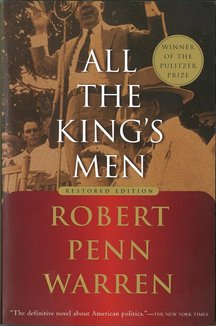
All the King's Men
Authors:
Robert Penn Warren,
Noel Polk
WINNER OF THE PULITZER PRIZE The fully restored original text of the classic, ever-relevant story of a backcountry lawyer whose idealism is overcome by his lust for power—American literature's definitive political novel. All the King's Men traces the rise of fall of demagogue Willie Talos, a fiction Southern policitian who resembles the real-life Huey Long of Louisiana.
WINNER OF THE PULITZER PRIZE The fully restored original text of the classic, ever-relevant story of a backcountry lawyer whose idealism is overcome by his lust for power—American literature's definitive political novel. All the King's Men traces the rise of fall of demagogue Willie Talos, a fiction Southern policitian who resembles the real-life Huey Long of Louisiana. Talos begins his career as an idealistic man of the people, but he soon becomes corrupted by success and the lust for power. Now Warren's masterpiece has been fully restored and reintroduced by literary scholar Noel Polk, textual editor of the works of William Faulkner. Polk presents the novel as it was originally written, revealing even greater energy, excitement, and complexity.
Find this book on:


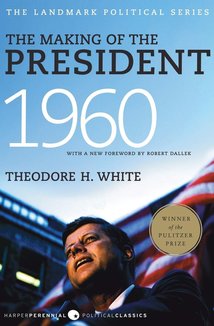
The Making of the President 1960 (Harper Perennial Political Classics)
Author:
Theodore H. White
A Harper Perennial Political Classic, The Making of the President 1960 is the groundbreaking national bestseller and Pulitzer Prize-winning account of the 1960 presidential campaign and the election of John F. Kennedy.
A Harper Perennial Political Classic, The Making of the President 1960 is the groundbreaking national bestseller and Pulitzer Prize-winning account of the 1960 presidential campaign and the election of John F. Kennedy. The Making of the President: 1960 revolutionized the way modern presidential campaigns are reported. Reporting from within the campaign for the first time on record, White’s extensive research and access to all parties involved set the bar for campaign coverage and remains unparalleled. White conveyed, in magnificent detail and with exquisite pacing, the high-stakes drama; he painted the unforgettable, even mythic, story of JFK versus Nixon; and most of all, he imbued the nation’s presidential election process with a grandeur that later political writers have rarely matched.
Find this book on:
Quiet Revolution: Struggle for the Democratic Party and the Shaping of Post-Reform Politics
Author:
Byron E. Shafer
This is the story of a revolution without fanfare, a hidden struggle for party reform that produced a new era in national politics. From this struggle emerged the greatest deliberately planned and centrally imposed change in the mechanics of delegate selection, and hence presidential nomination, in all of American history.
This is the story of a revolution without fanfare, a hidden struggle for party reform that produced a new era in national politics. From this struggle emerged the greatest deliberately planned and centrally imposed change in the mechanics of delegate selection, and hence presidential nomination, in all of American history. The success of this revolution heralded the arrival of new political coalitions that would alter the very character of presidential politics, from campaign organization to grass-roots participation. The battle for reform raged within the Democratic party from 1968 to 1972, although it would quickly affect the Republican party as well. It was intense, intricate―and nearly invisible. Yet its chronicle is essential background for political practitioners, professional commentators, and interested citizens alike. And it is the basis for understanding the subsequent course of national politics and the current shape of presidential politics. Quiet Revolution provides the first definitive account of this struggle for reform, an account that is at once modern political history and an illuminating analysis of contemporary American politics. Based on candid interviews with numerous key participants and on extensive archival material, this compelling narrative offers the fascination of political maneuvers closely observed, the drama of momentous events unfolding, and the challenge of a new politics newly interpreted.
Find this book on:
Episode overview
Last week on the show, I argued that the Democrats should pick their nominee at the Democratic National Convention in August.
It’s an idea that sounds novel but is really old-fashioned. This is how most presidential nominees have been picked in American history. All the machinery to do it is still there; we just stopped using it. But Democrats may need a Plan B this year. And the first step is recognizing they have one.
Elaine Kamarck literally wrote the book on how we choose presidential candidates. It’s called “Primary Politics: Everything You Need to Know About How America Nominates Its Presidential Candidates.” She’s a senior fellow in governance studies and the founding director of the Center for Effective Public Management at the Brookings Institution. But her background here isn’t just theory. It’s practice. She has worked on four presidential campaigns and 10 nominating conventions for both Democrats and Republicans. She’s also on the convention’s rules committee and has been a superdelegate at five Democratic conventions.
It’s a fascinating conversation, even if you don’t think Democrats should attempt to select their nominee at the convention. The history here is rich, and it is, if nothing else, a reminder that the way we choose candidates now is not the way we have always done it and not the way we must always do it.