From this episode
Recommended books
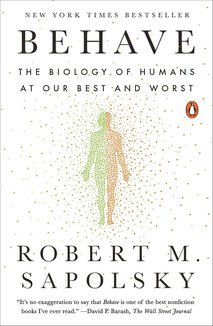
Behave: The Biology of Humans at Our Best and Worst
Author:
Robert M. Sapolsky
New York Times bestseller • Winner of the Los Angeles Times Book Prize • One of the Washington Post 's 10 Best Books of the Year “It’s no exaggeration to say that Behave is one of the best nonfiction books I’ve ever read.” —David P. Barash, The Wall Street Journal "It has my vote for science book of the year.” —Parul Sehgal, The New York Times "Immensely readable, often hilarious...Hands-down one of the best books I’ve read in years.
New York Times bestseller • Winner of the Los Angeles Times Book Prize • One of the Washington Post 's 10 Best Books of the Year “It’s no exaggeration to say that Behave is one of the best nonfiction books I’ve ever read.” —David P. Barash, The Wall Street Journal "It has my vote for science book of the year.” —Parul Sehgal, The New York Times "Immensely readable, often hilarious...Hands-down one of the best books I’ve read in years. I loved it." —Dina Temple-Raston, The Washington Post From the bestselling author of A Primate's Memoir and Determined: A Science of Life Without Free Will comes a landmark, genre-defining examination of human behavior and an answer to the question: Why do we do the things we do? Behave is one of the most dazzling tours d’horizon of the science of human behavior ever attempted. Moving across a range of disciplines, Sapolsky—a neuroscientist and primatologist—uncovers the hidden story of our actions. Undertaking some of our thorniest questions relating to tribalism and xenophobia, hierarchy and competition, and war and peace, Behave is a towering achievement—a majestic synthesis of cutting-edge research and a heroic exploration of why we ultimately do the things we do . . . for good and for ill.
Find this book on:


A New York Times Notable Book • Inspiration for PBS's American Experience film The Poison Squad “A detailed, highly readable history of food and drink regulation in the United States.” — Wall Street Journal “Riveting. .
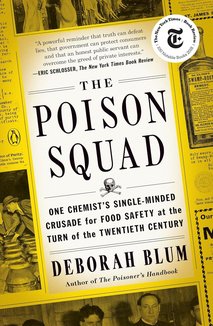
A New York Times Notable Book • Inspiration for PBS's American Experience film The Poison Squad “A detailed, highly readable history of food and drink regulation in the United States.” — Wall Street Journal “Riveting. . . . [A] timely tale about how scientists and citizens can work together on meaningful consumer protections.” — Science From Pulitzer Prize winner and New York Times bestselling author Deborah Blum, the dramatic true story of how food was made safe in the United States and the heroes, led by the inimitable Dr. Harvey Washington Wiley, who fought for change By the end of nineteenth century, food was dangerous. Lethal, even. "Milk" might contain formaldehyde, most often used to embalm corpses. Decaying meat was preserved with both salicylic acid, a pharmaceutical chemical, and borax, a compound first identified as a cleaning product. This was not by accident; food manufacturers had rushed to embrace the rise of industrial chemistry, and were knowingly selling harmful products. Unchecked by government regulation, basic safety, or even labelling requirements, they put profit before the health of their customers. By some estimates, in New York City alone, thousands of children were killed by "embalmed milk" every year. Citizens--activists, journalists, scientists, and women's groups--began agitating for change. But even as protective measures were enacted in Europe, American corporations blocked even modest regulations. Then, in 1883, Dr. Harvey Washington Wiley, a chemistry professor from Purdue University, was named chief chemist of the agriculture department, and the agency began methodically investigating food and drink fraud, even conducting shocking human tests on groups of young men who came to be known as, "The Poison Squad." Over the next thirty years, a titanic struggle took place, with the courageous and fascinating Dr. Wiley campaigning indefatigably for food safety and consumer protection. Together with a gallant cast, including the muckraking reporter Upton Sinclair, whose fiction revealed the horrific truth about the Chicago stockyards; Fannie Farmer, then the most famous cookbook author in the country; and Henry J. Heinz, one of the few food producers who actively advocated for pure food, Dr. Wiley changed history. When the landmark 1906 Food and Drug Act was finally passed, it was known across the land, as "Dr. Wiley's Law." Blum brings to life this timeless and hugely satisfying "David and Goliath" tale with righteous verve and style, driving home the moral imperative of confronting corporate greed and government corruption with a bracing clarity, which speaks resoundingly to the enormous social and political challenges we face today.
Find this book on:
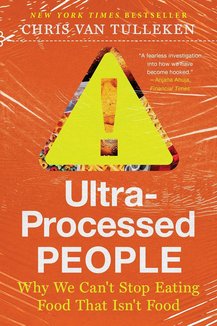
Ultra-Processed People: Why We Can't Stop Eating Food That Isn't Food
Author:
Chris van Tulleken
New York Times Bestseller Longlisted for the Baillie Gifford Prize Shortlisted for the Waterstones Book of the Year “A fearless investigation into how we have become hooked.” ― Financial Times A manifesto to change how you eat and how you think about the human body. It’s not you, it’s the food.
New York Times Bestseller Longlisted for the Baillie Gifford Prize Shortlisted for the Waterstones Book of the Year “A fearless investigation into how we have become hooked.” ― Financial Times A manifesto to change how you eat and how you think about the human body. It’s not you, it’s the food. We have entered a new age of eating. For the first time in human history, most of our calories come from an entirely novel set of substances called Ultra-Processed Food. There’s a long, formal scientific definition, but it can be boiled down to this: if it’s wrapped in plastic and has at least one ingredient that you wouldn’t find in your kitchen, it’s UPF. These products are specifically engineered to behave as addictive substances, driving excess consumption. They are now linked to the leading cause of early death globally and the number one cause of environmental destruction. Yet almost all our staple foods are ultra-processed. UPF is our food culture and for many people it is the only available and affordable food. In this book, Chris van Tulleken, father, scientist, doctor, and award-winning BBC broadcaster, marshals the latest evidence to show how governments, scientists, and doctors have allowed transnational food companies to create a pandemic of diet-related disease. The solutions don’t lie in willpower, personal responsibility, or exercise. You’ll find no diet plan in this book―but join Chris as he undertakes a powerful self-experiment that made headlines around the world: under the supervision of colleagues at University College London he spent a month eating a diet of 80 percent UPF, typical for many children and adults in the United States. While his body became the subject of scientific scrutiny, he spoke to the world’s leading experts from academia, agriculture, and―most important―the food industry itself. But more than teaching him about the experience of the food, the diet switched off Chris’s own addiction to UPF. In a fast-paced and eye-opening narrative he explores the origins, science, and economics of UPF to reveal its catastrophic impact on our bodies and the planet. And he proposes real solutions for doctors, for policy makers, and for all of us who have to eat. A book that won’t only upend the way you shop and eat, Ultra-Processed People will open your eyes to the need for action on a global scale.
Find this book on:
Episode overview
Here’s a shocking number: One out of eight American adults is taking a GLP-1, like Ozempic or Zepbound, according to a KFF poll.
GLP-1s are the biggest pharmaceutical story since antidepressants. But there’s still so much we don’t know.
“We’re only at the beginning of what’s been called this Ozempic era,” the journalist Julia Belluz told me. “I think we’re really just at the beginning of discovering the benefits and the harms of these drugs.” These discoveries begin in the research but are also expanding into how we think about our punishing beauty standards and the blurry lines between illness and wellness.
Belluz is a contributing Opinion writer and the author, with Kevin Hall, of “Food Intelligence.” She’s one of the best health and science reporters I know and has been reporting on GLP-1s for years.
In this conversation, Belluz takes me through what we know — and don’t know — about GLP-1s, their unexpected uses, how they are clashing with a culture obsessed with thinness and looksmaxxing, and whether everyone should be on them.