
From this episode
Recommended books
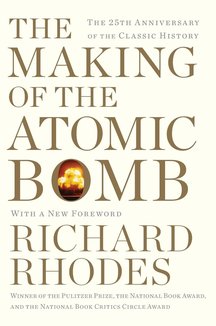
The Making of the Atomic Bomb: 25th Anniversary Edition
Author:
Richard Rhodes
**Winner of the Pulitzer Prize, the National Book Award, and the National Book Critics Circle Award** The definitive history of nuclear weapons— from the turn-of-the-century discovery of nuclear energy to J. Robert Oppenheimer and the Manhattan Project—this epic work details the science, the people, and the sociopolitical realities that led to the development of the atomic bomb.
**Winner of the Pulitzer Prize, the National Book Award, and the National Book Critics Circle Award** The definitive history of nuclear weapons— from the turn-of-the-century discovery of nuclear energy to J. Robert Oppenheimer and the Manhattan Project—this epic work details the science, the people, and the sociopolitical realities that led to the development of the atomic bomb. This sweeping account begins in the 19th century, with the discovery of nuclear fission, and continues to World War Two and the Americans’ race to beat Hitler’s Nazis. That competition launched the Manhattan Project and the nearly overnight construction of a vast military-industrial complex that culminated in the fateful dropping of the first bombs on Hiroshima and Nagasaki. Reading like a character-driven suspense novel, the book introduces the players in this saga of physics, politics, and human psychology—from FDR and Einstein to the visionary scientists who pioneered quantum theory and the application of thermonuclear fission, including Planck, Szilard, Bohr, Oppenheimer, Fermi, Teller, Meitner, von Neumann, and Lawrence. From nuclear power’s earliest foreshadowing in the work of H.G. Wells to the bright glare of Trinity at Alamogordo and the arms race of the Cold War, this dread invention forever changed the course of human history, and The Making of The Atomic Bom b provides a panoramic backdrop for that story. Richard Rhodes’s ability to craft compelling biographical portraits is matched only by his rigorous scholarship. Told in rich human, political, and scientific detail that any reader can follow, The Making of the Atomic Bomb is a thought-provoking and masterful work.
Find this book on:


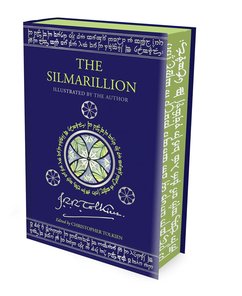
The Silmarillion: Illustrated by J.R.R. Tolkien (Tolkien Editions) (Tolkien Illustrated Editions)
Author:
J. R. R. Tolkien
For the first time ever, a very special edition of the forerunner to The Lord of the Rings , illustrated throughout in color by J.R.R. Tolkien himself and with the complete text printed in two colors.
For the first time ever, a very special edition of the forerunner to The Lord of the Rings , illustrated throughout in color by J.R.R. Tolkien himself and with the complete text printed in two colors. The Silmarillion fills in the background which lies behind the more popular work, and gives the earlier history of Middle-earth, introducing some of the key characters. The Silmarilli were three perfect jewels, fashioned by Fëanor, most gifted of the Elves, and within them was imprisoned the last Light of the Two Trees of Valinor. But the first Dark Lord, Morgoth, stole the jewels and set them within his iron crown, guarded in the impenetrable fortress of Angband in the north of Middle-earth. The Silmarillion is the history of the rebellion of Fëanor and his kindred against the gods, their exile from Valinor and return to Middle-earth, and their war, hopeless despite all the heroism, against the great Enemy. It is the ancient drama to which the characters in The Lord of the Rings look back, and in whose events some of them such as Elrond and Galadriel took part. The book also includes several shorter works: the Ainulindalë , a myth of the Creation, and the Valaquenta , in which the nature and powers of each of the gods is described. The Akallabêth recounts the downfall of the great island kingdom of Númenor at the end of the Second Age, and Of the Rings of Power tells of the great events at the end of the Third Age, as narrated in The Lord of the Rings. Tolkien could not publish The Silmarillion in his lifetime, as it grew with him, so he would leave it to his son, Christopher Tolkien, to edit the work from many manuscripts and bring his father’s great vision to publishable form, so completing the literary achievement of a lifetime. This special edition presents anew this seminal first step towards mapping out the posthumous publishing of Middle-earth, and the beginning of an illustrious forty years and more than twenty books celebrating his father’s legacy. This definitive new edition includes, by way of an introduction, a letter written by Tolkien in 1951 which provides a brilliant exposition of the earlier Ages, and for the first time in its history is presented with Tolkien’s own paintings and drawings, which reveal the breathtaking grandeur and beauty of his vision of the First Age of Middle-earth.
Find this book on:
Episode overview
OpenAI last week released its most powerful language model yet: GPT-4, which vastly outperforms its predecessor, GPT-3.5, on a variety of tasks.
GPT-4 can pass the bar exam in the 90th percentile, while the previous model struggled around in the 10th percentile. GPT-4 scored in the 88th percentile on the LSAT, up from GPT-3.5’s 40th percentile. And on the advanced sommelier theory test, GPT-4 performed better than 77 percent of test-takers. (It’s predecessor hovered around 46 percent.) These are stunning results — not just what the model can do, but the rapid pace of progress. And Open AI’s ChatGPT and other chat bots are just one example of what recent A.I. systems can achieve.
Kelsey Piper is a senior writer at Vox, where she’s been ahead of the curve covering advanced A.I., its world-changing possibilities, and the people creating it. Her work is informed by her deep knowledge of the handful of companies that arguably have the most influence over the future of A.I.
We discuss whether artificial intelligence has coherent “goals” — and whether that matters; whether the disasters ahead in A.I. will be small enough to learn from or “truly catastrophic”; the challenge of building “social technology” fast enough to withstand malicious uses of A.I.; whether we should focus on slowing down A.I. progress — and the specific oversight and regulation that could help us do it; why Piper is more optimistic this year that regulators can be “on the ball’ with A.I.; how competition between the U.S. and China shapes A.I. policy; and more.
This episode contains strong language.