From this episode
Recommended books
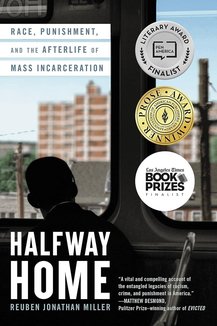
Halfway Home: Race, Punishment, and the Afterlife of Mass Incarceration
Author:
Reuben Jonathan Miller
A "persuasive and essential" (Matthew Desmond) work that will forever change how we look at life after prison in America through Miller's "stunning, and deeply painful reckoning with our nation's carceral system" (Heather Ann Thompson). Each year, more than half a million Americans are released from prison and join a population of twenty million people who live with a felony record.
A "persuasive and essential" (Matthew Desmond) work that will forever change how we look at life after prison in America through Miller's "stunning, and deeply painful reckoning with our nation's carceral system" (Heather Ann Thompson). Each year, more than half a million Americans are released from prison and join a population of twenty million people who live with a felony record. Reuben Miller, a chaplain at the Cook County Jail in Chicago and now a sociologist studying mass incarceration, spent years alongside prisoners, ex-prisoners, their friends, and their families to understand the lifelong burden that even a single arrest can entail. What his work revealed is a simple, if overlooked truth: life after incarceration is its own form of prison. The idea that one can serve their debt and return to life as a full-fledge member of society is one of America's most nefarious myths. Recently released individuals are faced with jobs that are off-limits, apartments that cannot be occupied and votes that cannot be cast. As The Color of Law exposed about our understanding of housing segregation, Halfway Home shows that the American justice system was not created to rehabilitate. Parole is structured to keep classes of Americans impoverished, unstable, and disenfranchised long after they've paid their debt to society. Informed by Miller's experience as the son and brother of incarcerated men, captures the stories of the men, women, and communities fighting against a system that is designed for them to fail. It is a poignant and eye-opening call to arms that reveals how laws, rules, and regulations extract a tangible cost not only from those working to rebuild their lives, but also our democracy. As Miller searchingly explores, America must acknowledge and value the lives of its formerly imprisoned citizens. PEN America 2022 John Kenneth Galbraith Award for Nonfiction Finalist Winner of the 2022 PROSE Award for Excellence in Social Sciences 2022 PROSE Awards Finalist 2022 PROSE Awards Category Winner for Cultural Anthropology and Sociology An NPR Selected 2021 Books We Love As heard on NPR’s Fresh Air
Find this book on:


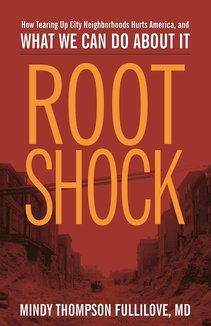
Root Shock: How Tearing Up City Neighborhoods Hurts America, And What We Can Do About It
Authors:
Mindy Thompson Fullilove,
Carlos F. Peterson,
Mary Travis Bassett
Root Shock examines 3 different U.S. cities to unmask the crippling results of decades-old disinvestment in communities of color and the urban renewal practices that ultimately destroyed these neighborhoods for the advantage of developers and the elite.
Root Shock examines 3 different U.S. cities to unmask the crippling results of decades-old disinvestment in communities of color and the urban renewal practices that ultimately destroyed these neighborhoods for the advantage of developers and the elite. Like a sequel to the prescient warnings of urbanist Jane Jacobs, Dr. Mindy Thompson Fullilove reveals the disturbing effects of decades of insensitive urban renewal projects on communities of color. For those whose homes and neighborhoods were bulldozed, the urban modernization projects that swept America starting in 1949 were nothing short of an assault. Vibrant city blocks - places rich in culture - were torn apart by freeways and other invasive development, devastating the lives of poor residents. Fullilove passionately describes the profound traumatic stress- the "root shock"that results when a neighborhood is demolished. She estimates that federal and state urban renewal programs, spearheaded by business and real estate interests, destroyed 1,600 African American districts in cities across the United States. But urban renewal didn't just disrupt black communities: it ruined their economic health and social cohesion, stripping displaced residents of their sense of place as well. It also left big gashes in the centers of cities that are only now slowly being repaired. Focusing on the Hill District of Pittsburgh, the Central Ward in Newark, and the small Virginia city of Roanoke, Dr. Fullilove argues powerfully against policies of displacement. Understanding the damage caused by root shock is crucial to coping with its human toll and helping cities become whole. Mindy Thompson Fullilove, MD, is a research psychiatrist at New York State Psychiatric Institute and professor of clinical psychiatry and public health at Columbia University. She is the author of five books, including Urban Alchemy.
Find this book on:
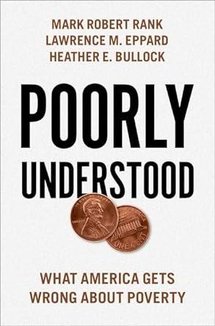
Poorly Understood: What America Gets Wrong About Poverty
Authors:
Mark Robert Rank,
Lawrence M. Eppard,
Heather E. Bullock
What if the idealized image of American society—a land of opportunity that will reward hard work with economic success—is completely wrong? Few topics have as many myths, stereotypes, and misperceptions surrounding them as that of poverty in America.
What if the idealized image of American society—a land of opportunity that will reward hard work with economic success—is completely wrong? Few topics have as many myths, stereotypes, and misperceptions surrounding them as that of poverty in America. The poor have been badly misunderstood since the beginnings of the country, with the rhetoric only ratcheting up in recent times. Our current era of fake news, alternative facts, and media partisanship has led to a breeding ground for all types of myths and misinformation to gain traction and legitimacy. Poorly Understood is the first book to systematically address and confront many of the most widespread myths pertaining to poverty. Mark Robert Rank, Lawrence M. Eppard, and Heather E. Bullock powerfully demonstrate that the realities of poverty are much different than the myths; indeed in many ways they are more disturbing. The idealized image of American society is one of abundant opportunities, with hard work being rewarded by economic prosperity. But what if this picture is wrong? What if poverty is an experience that touches the majority of Americans? What if hard work does not necessarily lead to economic well-being? What if the reasons for poverty are largely beyond the control of individuals? And if all of the evidence necessary to disprove these myths has been readily available for years, why do they remain so stubbornly pervasive? These are much more disturbing realities to consider because they call into question the very core of America's identity. Armed with the latest research, Poorly Understood not only challenges the myths of poverty and inequality, but it explains why these myths continue to exist, providing an innovative blueprint for how the nation can move forward to effectively alleviate American poverty.
Find this book on:
Episode overview
There has been a bit of panic lately over employers who say not enough people want to apply for open jobs. Are we facing a labor shortage? Have stimulus checks and expanded unemployment insurance payments created an economy full of people who don’t want to work — and who are holding back the economic recovery? That’s one theory, anyway. But it’s leading to real policy change: 25 Republican governors have cut off expanded unemployment benefits early.
You can also tell a different story: The continuing threat of the coronavirus and the ongoing traumas and child care disruptions mean lots of workers don’t feel safe taking jobs in poorly ventilated spaces. Others may be using their stimulus checks and unemployment benefits to let them find a better job than they had before the pandemic, insisting on better pay and conditions. And if so — isn’t that a policy success?
This is a moment when an implicit but ugly fact of our economy has been thrown into unusual relief: Our economy relies on poverty — or at least the threat of it — to force people to take bad jobs at low wages. This gets couched in paeans to the virtues of work, but the truth is more instrumental. The country likes cheap goods and plentiful services, and it can’t get them without a lot of people taking jobs that higher-income Americans would never, ever consider. When we begin to see glimmers of worker power in the economy, a lot of powerful people freak out, all at once.
Jamila Michener is an associate professor of government at Cornell University and a co-director of Cornell’s Center for Health Equity. She does remarkable research on the intersection of race, poverty and public policy and speaks about all of it with uncommon humanity. We discuss the role of poverty in the economy, cultural narratives around work and deservingness, why the less-well-off masses don’t band together politically, how social programs disempower and humiliate the very people they’re ostensibly supposed to help, why it would be so hard to sell a universal basic income, whether the Biden administration’s economic agenda represents a sharp break from those of past administrations and much more.