From this episode
Recommended books
The Hollow Parties: The Many Pasts and Disordered Present of American Party Politics (Princeton Studies in American Politics)
Authors:
Daniel Schlozman,
Sam Rosenfeld
A major history from the Founding to our embittered present that “explains the void” ( Politico ) at the center of America’s political parties Featured on The Ezra Klein Show and The Weekly Show with Jon Stewart America’s political parties are hollow shells of what they could be, locked in a polarized struggle for power and unrooted as civic organizations. The Hollow Parties takes readers from the rise of mass party politics in the Jacksonian era through the years of Barack Obama and Donald Trump.
A major history from the Founding to our embittered present that “explains the void” ( Politico ) at the center of America’s political parties Featured on The Ezra Klein Show and The Weekly Show with Jon Stewart America’s political parties are hollow shells of what they could be, locked in a polarized struggle for power and unrooted as civic organizations. The Hollow Parties takes readers from the rise of mass party politics in the Jacksonian era through the years of Barack Obama and Donald Trump. Today’s parties, at once overbearing and ineffectual, have emerged from the interplay of multiple party traditions that reach back to the Founding. Daniel Schlozman and Sam Rosenfeld paint unforgettable portraits of figures such as Martin Van Buren, whose pioneering Democrats invented the machinery of the mass political party, and Abraham Lincoln and other heroic Republicans of that party’s first generation who stood up to the Slave Power. And they show how today’s fractious party politics arose from the ashes of the New Deal order in the 1970s. Activists in the wake of the 1968 Democratic National Convention transformed presidential nominations but failed to lay the foundations for robust, movement-driven parties. Instead, modern American conservatism hollowed out the party system, deeming it a mere instrument for power. Party hollowness lies at the heart of our democratic discontents. With historical sweep and political acuity, The Hollow Parties offers powerful answers to pressing questions about how the nation’s parties became so dysfunctional—and how they might yet realize their promise.
Find this book on:



In this book John Zaller develops a comprehensive theory to explain how people acquire political information from the mass media and convert it into political preferences. Using numerous specific examples, Zaller applies this theory in order to explain the dynamics of public opinion on a broad range of subjects, including both domestic and foreign policy, trust in government, racial equality, and presidential approval, as well as voting behavior in U.S.
In this book John Zaller develops a comprehensive theory to explain how people acquire political information from the mass media and convert it into political preferences. Using numerous specific examples, Zaller applies this theory in order to explain the dynamics of public opinion on a broad range of subjects, including both domestic and foreign policy, trust in government, racial equality, and presidential approval, as well as voting behavior in U.S. House, Senate and Presidential elections. Particularly perplexing characteristics of public opinion are also examined, such as the high degree of random fluctuations in political attitudes observed in opinion surveys and the changes in attitudes due to minor changes in the wording of survey questions.
Find this book on:
The Victory Lab: The Secret Science of Winning Campaigns
Author:
Sasha Issenberg
UPDATED FOR THE 2016 ELECTION The book Politico calls “ Moneyball for politics” shows how cutting-edge social science and analytics are reshaping the modern political campaign. Renegade thinkers are crashing the gates of a venerable American institution, shoving aside its so-called wise men and replacing them with a radical new data-driven order.
UPDATED FOR THE 2016 ELECTION The book Politico calls “ Moneyball for politics” shows how cutting-edge social science and analytics are reshaping the modern political campaign. Renegade thinkers are crashing the gates of a venerable American institution, shoving aside its so-called wise men and replacing them with a radical new data-driven order. We’ve seen it in sports, and now in The Victory Lab , journalist Sasha Issenberg tells the hidden story of the analytical revolution upending the way political campaigns are run in the 21st century. The Victory Lab follows the academics and maverick operatives rocking the war room and re-engineering a high-stakes industry previously run on little more than gut instinct and outdated assumptions. Armed with research from behavioural psychology and randomized experiments that treat voters as unwitting guinea pigs, the smartest campaigns now believe they know who you will vote for even before you do. Issenberg tracks these fascinating techniques—which include cutting edge persuasion experiments, innovative ways to mobilize voters, heavily researched electioneering methods—and shows how our most important figures, such as Barack Obama and Mitt Romney, are putting them to use with surprising skill and alacrity. Provocative, clear-eyed and energetically reported, The Victory Lab offers iconoclastic insights into political marketing, human decision-making, and the increasing power of analytics.
Find this book on:
Episode overview
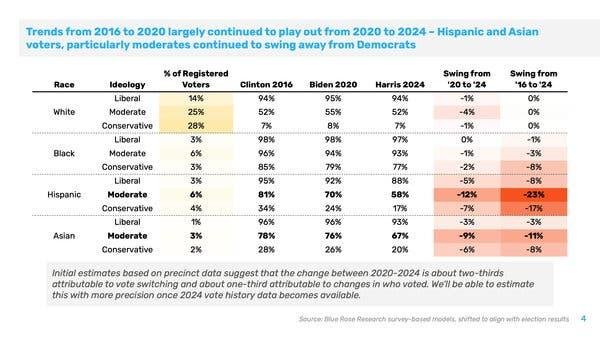
After the last election, there were all kinds of theories about where Democrats went wrong. But now, four months later, we have a lot more data – and it tells a few clear stories.
David Shor is the head of data science at Blue Rose Research, a Democratic polling firm, which does an enormous amount of surveying of the electorate. A few weeks ago, Shor was walking me through a deck he made of key charts and numbers that explain the election results. And I thought this would be good to do in public. Because this is information that doesn’t just help explain what went wrong for Democrats in 2024. It’s a set of hard truths they need to keep in mind to mount a comeback in 2026 and 2028.
This episode is also a bit of an experiment. It works great in audio. But on YouTube, you can actually see the slides. So if you’re up for a video podcast, this is a good one to start with: https://www.youtube.com/@EzraKleinShow
This episode contains strong language.