From this episode
Recommended books
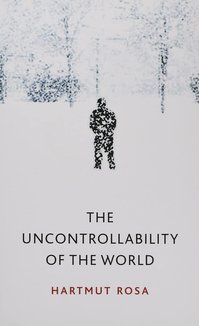
The Uncontrollability of the World
Authors:
Hartmut Rosa,
James C. Wagner
The driving cultural force of that form of life we call ‘modern’ is the desire to make the world controllable. Yet it is only in encountering the uncontrollable that we really experience the world – only then do we feel touched, moved and alive.
The driving cultural force of that form of life we call ‘modern’ is the desire to make the world controllable. Yet it is only in encountering the uncontrollable that we really experience the world – only then do we feel touched, moved and alive. A world that is fully known, in which everything has been planned and mastered, would be a dead world. Our lives are played out on the border between what we can control and that which lies outside our control. But because we late-modern human beings seek to make the world controllable, we tend to encounter the world as a series of objects that we have to conquer, master or exploit. And precisely because of this, ‘life,’ the experience of feeling alive and truly encountering the world, always seems to elude us. This in turn leads to frustration, anger and even despair, which then manifest themselves in, among other things, acts of impotent political aggression. For Rosa, to encounter the world and achieve resonance with it requires us to be open to that which extends beyond our control. The outcome of this process cannot be predicted, and this is why moments of resonance are always concomitant with moments of uncontrollability. This short book – the sequel to Rosa’s path-breaking work on social acceleration and resonance – will be of great interest students and scholars in sociology and the social sciences and to anyone concerned with the nature of modern social life.
Find this book on:


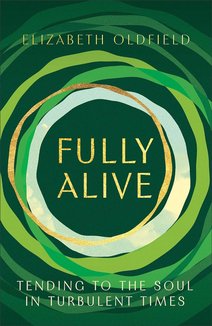
Fully Alive: Tending to the Soul in Turbulent Times
Author:
Elizabeth Oldfield
In a world experiencing turbulent change, we need people who are resilient, kind, open, generous, and brave. How do we become those people?
In a world experiencing turbulent change, we need people who are resilient, kind, open, generous, and brave. How do we become those people? In Fully Alive , popular podcaster Elizabeth Oldfield uses the seven deadly sins as a framework to explore questions such as: · How can I move from sloth to attention in order to make the most of my short life and stop getting distracted by trivialities? · Is it possible to move from wrath to peacemaking ? How do I become a depolarizing person in an age of outrage, tribalism, and division? · What might it look like to move from gluttony to awe , finding transcendence in expansive, life-giving ways--not in a tub of ice cream or a bottle of wine? · How can I move from pride to connection , overcoming the disconnection that keeps me from intimacy, community, and ultimately the divine? Oldfield shows why, in a world heavy on judgment, she still finds the concept of sin liberating--and how, to her surprise, she keeps finding in her Christian faith ways to feel fully alive. Deeply serious yet amusingly relatable, this book helps us develop spiritual strength for when things fall apart.
Find this book on:
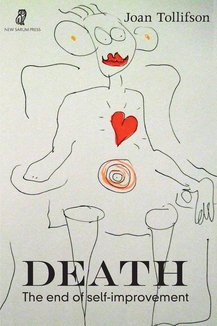
Death: The End of Self-Improvement
Author:
Joan Tollifson
This book celebrates the great stripping process of aging, dying and spiritual awakening. Beautiful, poignant, at times humorous, transcendent, messy, down to earth, refreshingly honest—the book explores death, and more importantly, being alive, through a rich mix of personal stories and spiritual reflections.
This book celebrates the great stripping process of aging, dying and spiritual awakening. Beautiful, poignant, at times humorous, transcendent, messy, down to earth, refreshingly honest—the book explores death, and more importantly, being alive, through a rich mix of personal stories and spiritual reflections. Joan writes about her mother’s final years and about being with friends and teachers at the end of their lives. She shares her own journey with aging, anal cancer, and other life challenges. She explores what it means to be alive in what may be the collapse of civilization and the possible extinction of life on earth due to climate change. Pointing beyond deficiency stories, future fantasies, and oppressive self-improvement projects, Joan invites an awakening to the immediacy of this moment and the wonder of ordinary life. She demonstrates a pathless path of genuine transformation, seeing all of life as sacred and worthy of devotion, and finding joy in the full range of our human experience. Review “The problem with most books (and articles and podcasts) about ‘being here now’ or ‘embracing the present moment’ is that they really aren’t. As often telegraphed by their cover images (sunsets, flowers, mountain peaks) they’re about embracing the nice bits of the present. And they generally imply that if you follow their advice, you could float contentedly through life, relishing simple pleasures and finding wonder in the everyday. In other words, they’re about the ideal person you might become if you weren’t so prone to irritability, boredom and gloom. So they’re not actually about embracing the present at all. They’re focused on escaping it, in pursuit of a better future. None of which could be said about Death: The End of Self-Improvement, the latest book by the spiritual teacher Joan Tollifson.” —Oliver Burkeman, from his review in The Guardian, August 15, 2020
Find this book on:
Episode overview
I like to begin each year with an episode about something I’m working through more personally. And at the end of last year, the thing I needed to work through was a pretty bad case of burnout.
So I picked up Oliver Burkeman’s latest book, “Meditations for Mortals: Four Weeks to Embrace Your Limitations and Make Time for What Counts.” Burkeman’s big idea, which he also explores in his best seller “Four Thousand Weeks: Time Management for Mortals,” is that the desire to be more productive, to squeeze out the most from each day, to try to feel on top of our lives, is ultimately insatiable. He argues that addressing burnout requires a shift in outlook — accepting that our time and energy are finite, and that there will always be something more to do. In other words: What if you began with a deeper appreciation of your own limits? How, then, would you live?
Burkeman’s book is structured as 28 short essays on this question. In this conversation, I ask him to walk me through some of them. We discuss what burnout is; what it means to accept your limitations and let go of control; the messages children absorb about productivity and work; navigating the overwhelm of information and news; and more.
This episode contains strong language.