
From this episode
Recommended books
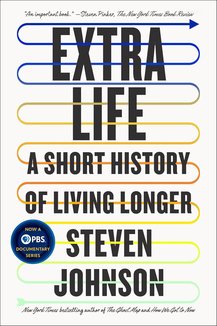
Extra Life: A Short History of Living Longer
Author:
Steven Johnson
“Offers a useful reminder of the role of modern science in fundamentally transforming all of our lives.” —President Barack Obama (on Twitter) “An important book.” —Steven Pinker, The New York Times Book Review The surprising and important story of how humans gained what amounts to an extra life, from the bestselling author of How We Got to Now and Where Good Ideas Come From In 1920, at the end of the last major pandemic, global life expectancy was just over forty years. Today, in many parts of the world, human beings can expect to live more than eighty years.
“Offers a useful reminder of the role of modern science in fundamentally transforming all of our lives.” —President Barack Obama (on Twitter) “An important book.” —Steven Pinker, The New York Times Book Review The surprising and important story of how humans gained what amounts to an extra life, from the bestselling author of How We Got to Now and Where Good Ideas Come From In 1920, at the end of the last major pandemic, global life expectancy was just over forty years. Today, in many parts of the world, human beings can expect to live more than eighty years. As a species we have doubled our life expectancy in just one century. There are few measures of human progress more astonishing than this increased longevity. Extra Life is Steven Johnson’s attempt to understand where that progress came from, telling the epic story of one of humanity’s greatest achievements. How many of those extra years came from vaccines, or the decrease in famines, or seatbelts? What are the forces that now keep us alive longer? Behind each breakthrough lies an inspiring story of cooperative innovation, of brilliant thinkers bolstered by strong systems of public support and collaborative networks, and of dedicated activists fighting for meaningful reform. But for all its focus on positive change, this book is also a reminder that meaningful gaps in life expectancy still exist, and that new threats loom on the horizon, as the COVID-19 pandemic has made clear. How do we avoid decreases in life expectancy as our public health systems face unprecedented challenges? What current technologies or interventions that could reduce the impact of future crises are we somehow ignoring? A study in how meaningful change happens in society, Extra Life celebrates the enduring power of common goals and public resources, and the heroes of public health and medicine too often ignored in popular accounts of our history. This is the sweeping story of a revolution with immense public and personal consequences: the doubling of the human life span.
Find this book on:



The Bet: Paul Ehrlich, Julian Simon, and Our Gamble over Earth's Future
Author:
Paul Sabin
Are we headed for a world of scarce resources and environmental catastrophe, or will innovation and markets yield greater prosperity In 1980, the iconoclastic economist Julian Simon challenged celebrity biologist Paul Ehrlich to a bet. Their wager on the future prices of five metals captured the public’s imagination as a test of coming prosperity or doom.
Are we headed for a world of scarce resources and environmental catastrophe, or will innovation and markets yield greater prosperity In 1980, the iconoclastic economist Julian Simon challenged celebrity biologist Paul Ehrlich to a bet. Their wager on the future prices of five metals captured the public’s imagination as a test of coming prosperity or doom. Ehrlich, author of the landmark book The Population Bomb, predicted that rising populations would cause overconsumption, resource scarcity, and famine—with apocalyptic consequences for humanity. Simon optimistically countered that human welfare would flourish thanks to flexible markets, technological change, and our collective ingenuity. Simon and Ehrlich’s debate reflected a deepening national conflict over the future of the planet. The Bet weaves the two men’s lives and ideas together with the era’s partisan political clashes over the environment and the role of government. In a lively narrative leading from the dawning environmentalism of the 1960s through the pivotal presidential contest between Jimmy Carter and Ronald Reagan and on into the 1990s, Paul Sabin shows how the fight between Ehrlich and Simon—between environmental fears and free-market confidence—helped create the gulf separating environmentalists and their critics today. Drawing insights from both sides, Sabin argues for using social values, rather than economic or biological absolutes, to guide society’s crucial choices relating to climate change, the planet’s health, and our own.
Find this book on:
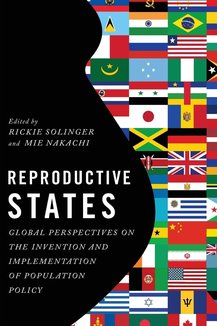
Reproductive States: Global Perspectives on the Invention and Implementation of Population Policy
Authors:
Rickie Solinger,
Mie Nakachi
When it comes to government's role in personal matters such as family planning, most bristle at any interference from the State on how to exercise their reproductive rights. China's infamous "one child" policy is a well-known example of reproductive politics, but history is filled with other examples of governmental population control to advance its interests.
When it comes to government's role in personal matters such as family planning, most bristle at any interference from the State on how to exercise their reproductive rights. China's infamous "one child" policy is a well-known example of reproductive politics, but history is filled with other examples of governmental population control to advance its interests. Reproductive States is the first volume of a collection of case studies that explores when and how some of the most populous countries in the world invented and implemented state population policies in the 20th century. The authors, scholars specializing in reproductive politics, survey population policies from key countries on five continents to provide a global perspective. Regardless of the type of government or its cultural history, many of these countries have developed similar policies to control their populations and attempt to combat social problems such as poverty and hunger. However, the common denominator is that states have used women's bodies as a political resource. Far from being just an overseas problem, this volume illustrates how other countries have developed their strategies in response to goals and tactics driven by the United Nations and the United States. Due to fears of a post-World War II "population bomb" and uncertainty of how to deal with the world's poor after the Cold War, the U.S. and the Soviet Union led the charge among nations to devise strategies to control their populations, but in different ways. The U.S. and some European countries pressed the poor and ethnic minorities to limit reproduction. China's "one child" policy targeted all ranks of society, while Soviet women (who already had few rights) were under surveillance through state-planned services such as medical care and commodity distribution to detect pregnancy. Interweaving biopolitics, gender studies, statecraft, and world systems, Reproductive States offer reflections on the outcome of such policies and their legacies in our day.
Find this book on:
Episode overview
For a long time, the story about the world’s population was that it was growing too quickly. There were going to be too many humans, not enough resources, and that spelled disaster. But now the script has flipped. Fertility rates have declined dramatically, from about five children per woman 60 years ago to just over two today. About two-thirds of us now live in a country or area where fertility rates are below replacement level. And that has set off a new round of alarm, especially in certain quarters on the right and in Silicon Valley, that we’re headed toward demographic catastrophe.
But when I look at these numbers, I just find it strange. Why, as societies get richer, do their fertility rates plummet?
Money makes life easier. We can give our kids better lives than our ancestors could have imagined. We don’t expect to bear the grief of burying a child. For a long time, a big, boisterous family has been associated with a joyful, fulfilled life. So why are most of us now choosing to have small ones?
I invited Jennifer D. Sciubba on the show to help me puzzle this out. She’s a demographer, a political scientist and the author of “8 Billion and Counting: How Sex, Death and Migration Shape Our World.” She walks me through the population trends we’re seeing around the world, the different forces that seem to be driving them and why government policy, despite all kinds of efforts, seems incapable of getting people to have more kids.