
From this episode
Recommended books
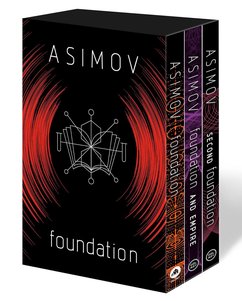
Foundation 3-Book Boxed Set: Foundation, Foundation and Empire, Second Foundation
Author:
Isaac Asimov
The original trilogy of Isaac Asimov’s bestselling science fiction masterpiece, the Foundation series, in a striking boxed set package THE EPIC SAGA THAT INSPIRED THE APPLE TV+ SERIES FOUNDATION • Nominated as one of America’s best-loved series by PBS’s The Great American Read For twelve thousand years the Galactic Empire has ruled supreme. Now it is dying.
The original trilogy of Isaac Asimov’s bestselling science fiction masterpiece, the Foundation series, in a striking boxed set package THE EPIC SAGA THAT INSPIRED THE APPLE TV+ SERIES FOUNDATION • Nominated as one of America’s best-loved series by PBS’s The Great American Read For twelve thousand years the Galactic Empire has ruled supreme. Now it is dying. But only Hari Seldon, creator of the revolutionary science of psychohistory, can see into the future—to a dark age of ignorance, barbarism, and warfare that will last thirty thousand years. To preserve knowledge and save humankind, Seldon gathers the best minds in the Empire—both scientists and scholars—and brings them to a bleak planet at the edge of the galaxy to serve as a beacon of hope for future generations. He calls his sanctuary the Foundation. Collected in this boxed set, Foundation, Foundation and Empire, and Second Foundation form the celebrated original trilogy that started it all. One of the most influential in the history of science fiction, the Foundation series is celebrated for its unique blend of breathtaking action, daring ideas, and extensive worldbuilding. Here, Asimov has written a timely and timeless saga of the best—and worst—that lies in humanity, and the power of even a few courageous souls to shine a light in a universe of darkness.
Find this book on:


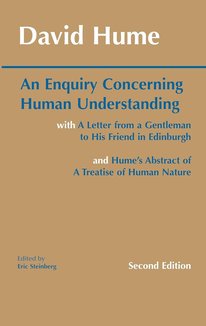
A landmark of Enlightenment thought, Hume's An Enquiry Concerning Human Understanding is accompanied here by two shorter works that shed light on it: A Letter from a Gentleman to His Friend in Edinburgh , Hume's response to those accusing him of atheism, of advocating extreme skepticism, and of undermining the foundations of morality; and his Abstract of A Treatise of Human Nature , which anticipates discussions developed in the Enquiry . In his concise Introduction, Eric Steinberg explores the conditions that led Hume to write the Enquiry and the work's important relationship to Book I of Hume's A Treatise of Human Nature .
A landmark of Enlightenment thought, Hume's An Enquiry Concerning Human Understanding is accompanied here by two shorter works that shed light on it: A Letter from a Gentleman to His Friend in Edinburgh , Hume's response to those accusing him of atheism, of advocating extreme skepticism, and of undermining the foundations of morality; and his Abstract of A Treatise of Human Nature , which anticipates discussions developed in the Enquiry . In his concise Introduction, Eric Steinberg explores the conditions that led Hume to write the Enquiry and the work's important relationship to Book I of Hume's A Treatise of Human Nature .
Find this book on:
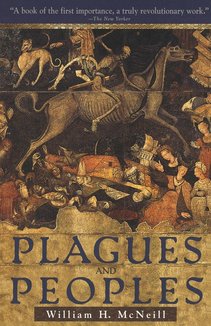
Plagues and Peoples
Author:
William H. McNeill
The history of disease is the history of humankind: an interpretation of the world as seen through the extraordinary impact—political, demographic, ecological, and psychological—of disease on cultures. "A book of the first importance, a truly revolutionary work." — The New Yorker From the conquest of Mexico by smallpox as much as by the Spanish, to the bubonic plague in China, to the typhoid epidemic in Europe, Plagues and Peoples is "a brilliantly conceptualized and challenging achievement" ( Kirkus Reviews) .
The history of disease is the history of humankind: an interpretation of the world as seen through the extraordinary impact—political, demographic, ecological, and psychological—of disease on cultures. "A book of the first importance, a truly revolutionary work." — The New Yorker From the conquest of Mexico by smallpox as much as by the Spanish, to the bubonic plague in China, to the typhoid epidemic in Europe, Plagues and Peoples is "a brilliantly conceptualized and challenging achievement" ( Kirkus Reviews) . Upon its original publication, Plagues and Peoples was an immediate critical and popular success, offering a radically new interpretation of world history. With the identification of AIDS in the early 1980s, another chapter was added to this chronicle of events, which William McNeill explores in his introduction to this edition. Thought-provoking, well-researched, and compulsively readable, Plagues and Peoples is essential reading—that rare book that is as fascinating as it is scholarly, as intriguing as it is enlightening.
Find this book on: