From this episode
Recommended books
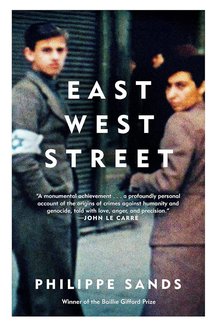
East West Street: On the Origins of "Genocide" and "Crimes Against Humanity"
Author:
Philippe Sands
A profound, important book, a moving personal detective story and an uncovering of secret pasts, set in Europe’s center, the city of bright colors—Lviv, Ukraine, dividing east from west, north from south, in what had been the Austro-Hungarian Empire. A book that explores the development of the world-changing legal concepts of “genocide” and “crimes against humanity” that came about as a result of the unprecedented atrocities of Hitler’s Third Reich.
A profound, important book, a moving personal detective story and an uncovering of secret pasts, set in Europe’s center, the city of bright colors—Lviv, Ukraine, dividing east from west, north from south, in what had been the Austro-Hungarian Empire. A book that explores the development of the world-changing legal concepts of “genocide” and “crimes against humanity” that came about as a result of the unprecedented atrocities of Hitler’s Third Reich. It is also a spellbinding family memoir, as the author traces the mysterious story of his grandfather as he maneuvered through Europe in the face of Nazi atrocities. This is “a monumental achievement ... told with love, anger and precision” (John le Carré, acclaimed internationally bestselling author). East West Street looks at the personal and intellectual evolution of the two men who simultaneously originated the ideas of “genocide” and “crimes against humanity,” both of whom, not knowing the other, studied at the same university with the same professors, in “the Paris of Ukraine,” a major cultural center of Europe, a city variously called Lemberg, Lwów, Lvov, or Lviv. Phillipe Sands changes the way we look at the world, at our understanding of history and how civilization has tried to cope with mass murder
Find this book on:


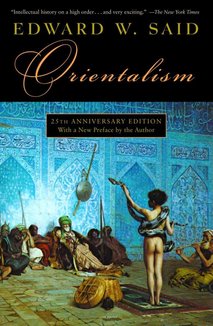
Orientalism
Author:
Edward W. Said
A groundbreaking critique of the West's historical, cultural, and political perceptions of the East that is—three decades after its first publication—one of the most important books written about our divided world. "Intellectual history on a high order ...
A groundbreaking critique of the West's historical, cultural, and political perceptions of the East that is—three decades after its first publication—one of the most important books written about our divided world. "Intellectual history on a high order ... and very exciting." — The New York Times In this wide-ranging, intellectually vigorous study, Said traces the origins of "orientalism" to the centuries-long period during which Europe dominated the Middle and Near East and, from its position of power, defined "the orient" simply as "other than" the occident. This entrenched view continues to dominate western ideas and, because it does not allow the East to represent itself, prevents true understanding.
Find this book on:
Episode overview
Before there can be any kind of stable coexistence of people in Israel and Palestine, there will have to be a stable coexistence of narratives. And that’s what we’ll be attempting this week on the show: to look at both the present and the past through Israeli and Palestinian perspectives. The point is not to choose between them. The point is to really listen to them. Even — especially — when what’s being said is hard for us to hear.
Our first episode is with Amjad Iraqi, a senior editor at +972 magazine and a policy analyst at the Al-Shabaka think tank. We discuss the history of Gaza and its role within broader Palestinian politics, the way Hamas and the Israeli government under Prime Minister Benjamin Netanyahu reached a “violent equilibrium,” why Palestinians feel “duped” by the international community, what Hamas thought it could achieve with its attack, whether Israeli security and Palestinian liberty can coexist, Iraqi’s skepticism over peace resolutions that rely on statehood and nationalism, how his own identity as a Palestinian citizen of Israel offers a glimpse at where coexistence can begin and much more.