From this episode
Recommended books
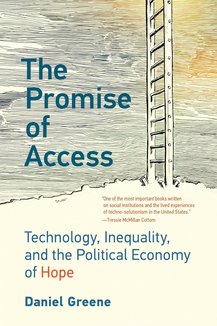
The Promise of Access: Technology, Inequality, and the Political Economy of Hope
Author:
Daniel Greene
Why simple technological solutions to complex social issues continue to appeal to politicians and professionals who should (and often do) know better. Why do we keep trying to solve poverty with technology?
Why simple technological solutions to complex social issues continue to appeal to politicians and professionals who should (and often do) know better. Why do we keep trying to solve poverty with technology? What makes us feel that we need to learn to code--or else? In The Promise of Access , Daniel Greene argues that the problem of poverty became a problem of technology in order to manage the contradictions of a changing economy. Greene shows how the digital divide emerged as a policy problem and why simple technological solutions to complex social issues continue to appeal to politicians and professionals who should (and often do) know better. Greene shows why it is so hard to get rid of the idea--which he terms the access doctrine --that the problem of poverty can be solved with the right tools and the right skills. This way of thinking is so ingrained that is adopted by organizations that fight poverty--which often refashion themselves to resemble technology startups. Drawing on years of fieldwork, Greene explores how this plays out in the real world, examining organizational change in technology startups, public libraries, and a charter school in Washington, DC. He finds that as the libraries and school pursue technological solutions, they win praise and funding but also marginalize and alienate the populations they serve. Greene calls for new political alliances that can change the terms on which we understand technology and fight poverty. Winner of the McGannon Book Award for the best book published in 2021 concerning media policy, activism, and social justice.
Find this book on:


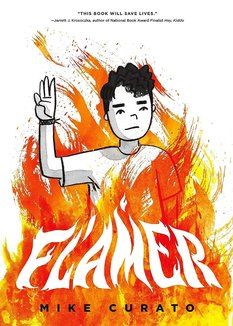
Flamer
Author:
Mike Curato
Award-winning author and artist Mike Curato draws on his own experiences in Flamer , his debut graphic novel, telling a difficult story with humor, compassion, and love. "This book will save lives." ―Jarrett J.
Award-winning author and artist Mike Curato draws on his own experiences in Flamer , his debut graphic novel, telling a difficult story with humor, compassion, and love. "This book will save lives." ―Jarrett J. Krosoczka, author of National Book Award Finalist Hey, Kiddo I know I’m not gay. Gay boys like other boys. I hate boys. They’re mean, and scary, and they’re always destroying something or saying something dumb or both. I hate that word. Gay. It makes me feel . . . unsafe. It's the summer between middle school and high school, and Aiden Navarro is away at camp. Everyone's going through changes―but for Aiden, the stakes feel higher. As he navigates friendships, deals with bullies, and spends time with Elias (a boy he can't stop thinking about), he finds himself on a path of self-discovery and acceptance. Godwin Books
Find this book on:
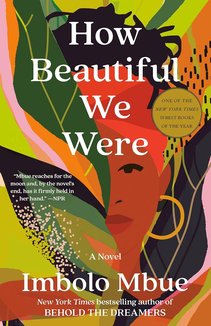
How Beautiful We Were: A Novel
Author:
Imbolo Mbue
A fearless young woman from a small African village starts a revolution against an American oil company in this sweeping, inspiring novel from the New York Times bestselling author of Behold the Dreamers . ONE OF THE TEN BEST BOOKS OF THE YEAR: The New York Times, People • ONE OF THE BEST BOOKS OF THE YEAR: The New York Times Book Review, The Washington Post, Esquire, Good Housekeeping, The Christian Science Monitor, Marie Claire , Ms.
A fearless young woman from a small African village starts a revolution against an American oil company in this sweeping, inspiring novel from the New York Times bestselling author of Behold the Dreamers . ONE OF THE TEN BEST BOOKS OF THE YEAR: The New York Times, People • ONE OF THE BEST BOOKS OF THE YEAR: The New York Times Book Review, The Washington Post, Esquire, Good Housekeeping, The Christian Science Monitor, Marie Claire , Ms. magazine, BookPage, Kirkus Reviews “Mbue reaches for the moon and, by the novel’s end, has it firmly held in her hand.”—NPR We should have known the end was near. So begins Imbolo Mbue’s powerful second novel, How Beautiful We Were . Set in the fictional African village of Kosawa, it tells of a people living in fear amid environmental degradation wrought by an American oil company. Pipeline spills have rendered farmlands infertile. Children are dying from drinking toxic water. Promises of cleanup and financial reparations to the villagers are made—and ignored. The country’s government, led by a brazen dictator, exists to serve its own interests. Left with few choices, the people of Kosawa decide to fight back. Their struggle will last for decades and come at a steep price. Told from the perspective of a generation of children and the family of a girl named Thula who grows up to become a revolutionary, How Beautiful We Were is a masterful exploration of what happens when the reckless drive for profit, coupled with the ghost of colonialism, comes up against one community’s determination to hold on to its ancestral land and a young woman’s willingness to sacrifice everything for the sake of her people’s freedom.
Find this book on:
Episode overview
Public libraries around the country have become major battlegrounds for today’s culture wars. In 2022, the American Library Association noted a record 1,269 attempts at censorship — almost double the number recorded in 2021. Library events like drag story times and other children’s programming have also attracted protest. How should we understand these efforts to control what stories children can freely access?
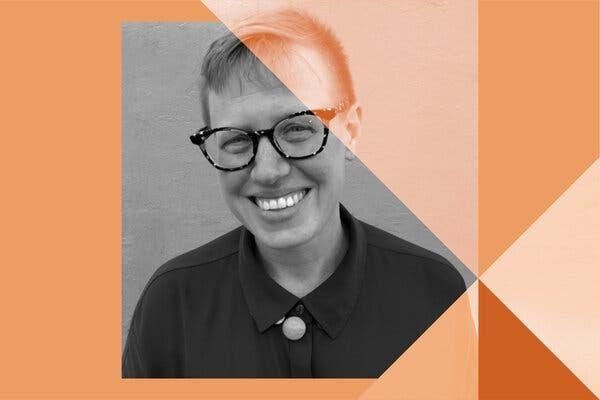
Emily Drabinski is the president of the American Library Association and an associate professor at the Queens College Graduate School of Library and Information Studies. She is steering an embattled organization at a moment when libraries — and librarians themselves — are increasingly under fire.
This conversation unpacks the political and cultural anxieties fueling the attacks on libraries. The guest host Tressie McMillan Cottom discusses with Drabinski how libraries are a bulwark against the increasing class divides of American life, how the “small infrastructure” of the public library differs from big infrastructure like highways and bridges, how library classification systems can entrench the status quo, the parallels between political attacks on the library and the U.S. Postal Service, how censorship attempts fit in the broader landscape of anti-queer and anti-trans legislation and much more.
This episode was hosted by Tressie McMillan Cottom, a columnist for Times Opinion, a professor at U.N.C. Chapel Hill and the author of “Thick: And Other Essays.” Cottom also writes a newsletter for Times Opinion that offers a sociologist’s perspective on culture, politics and the economics of our everyday lives.