
From this episode
Recommended books
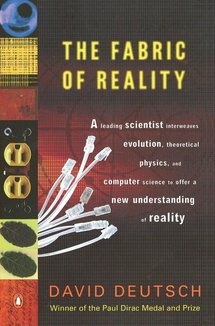
The Fabric of Reality: The Science of Parallel Universes--and Its Implications
Author:
David Deutsch
A penetrating exploration of the new physics, including time travel, quantum computers, and the multiverse – as referenced in the film “Avengers: Endgame” For David Deutsch, a young physicist of unusual originality, quantum theory contains our most fundamental knowledge of the physical world. Taken literally, it implies that there are many universes “parallel” to the one we see around us.
A penetrating exploration of the new physics, including time travel, quantum computers, and the multiverse – as referenced in the film “Avengers: Endgame” For David Deutsch, a young physicist of unusual originality, quantum theory contains our most fundamental knowledge of the physical world. Taken literally, it implies that there are many universes “parallel” to the one we see around us. This multiplicity of universes, according to Deutsch, turns out to be the key to achieving a new worldview, one which synthesizes the theories of evolution, computation, and knowledge with quantum physics. Considered jointly, these four strands of explanation reveal a unified fabric of reality that is both objective and comprehensible, the subject of this daring, challenging book. The Fabric of Reality explains and connects many topics at the leading edge of current research and thinking, such as quantum computers (which work by effectively collaborating with their counterparts in other universes), the physics of time travel, the comprehensibility of nature and the physical limits of virtual reality, the significance of human life, and the ultimate fate of the universe. Here, for scientist and layperson alike, for philosopher, science-fiction reader, biologist, and computer expert, is a startlingly complete and rational synthesis of disciplines, and a new, optimistic message about existence.
Find this book on:


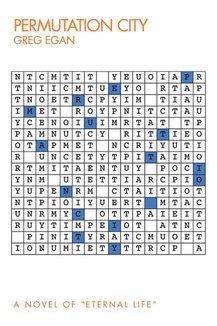
Permutation City: A Novel
Author:
Greg Egan
“Egan is determined to make sense of everything – to understand the whole world as an intelligible, rational, material (and finally manipulable) realm – even if it means abandoning comfortable and comforting illusions. This is fundamental to the whole project of SF and it’s why Egan’s Best – and his Rest – is worth any number of looks.
“Egan is determined to make sense of everything – to understand the whole world as an intelligible, rational, material (and finally manipulable) realm – even if it means abandoning comfortable and comforting illusions. This is fundamental to the whole project of SF and it’s why Egan’s Best – and his Rest – is worth any number of looks. — Locus What happens when your digital self overpowers your physical self? A life in Permutation City is unlike any life to which you’re accustomed. You have Eternal Life, the power to live forever. Immortality is a real thing, just not the thing you’d expect. Life is just electronic code. You have been digitized, scanned, and downloaded into a virtual reality program. A Copy of a Copy. For Paul Durham, he keeps making Copies of himself, but the issue is that his Copies keep changing their minds and shutting themselves down. You also have Maria Deluca, who is nothing but an Autoverse addict. She spends every waking minute with the cellular automaton known as the Autoverse, a world that lives by the mathematical “laws of physics.” Paul makes Maria an offer to design and drop a seed into the Autoverse that will allow her to indulge in her obsession. There is, however, one catch: you can no longer terminate, bail out, and remove yourself. You will never be your normal flesh-and-blood life again. The question then becomes: Is this what she really wants? Is this what we really want? From the brilliant mind of Greg Egan, Permutation City , first published in 1994, comes a world of wonder that makes you ask if you are you, or is the Copy of you the real you? Skyhorse Publishing, under our Night Shade and Talos imprints, is proud to publish a broad range of titles for readers interested in science fiction (space opera, time travel, hard SF, alien invasion, near-future dystopia), fantasy (grimdark, sword and sorcery, contemporary urban fantasy, steampunk, alternative history), and horror (zombies, vampires, and the occult and supernatural), and much more. While not every title we publish becomes a New York Times bestseller, a national bestseller, or a Hugo or Nebula award-winner, we are committed to publishing quality books from a diverse group of authors.
Find this book on:
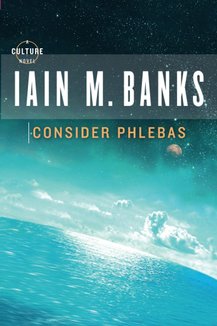
Consider Phlebas (Culture)
Author:
Iain M. Banks
The first book in Iain M. Banks's seminal science fiction series, The Culture.
The first book in Iain M. Banks's seminal science fiction series, The Culture. Consider Phlebas introduces readers to the utopian conglomeration of human and alien races that explores the nature of war, morality, and the limitless bounds of mankind's imagination. The war raged across the galaxy. Billions had died, billions more were doomed. Moons, planets, the very stars themselves, faced destruction, cold-blooded, brutal, and worse, random. The Idirans fought for their Faith; the Culture for its moral right to exist. Principles were at stake. There could be no surrender. Within the cosmic conflict, an individual crusade. Deep within a fabled labyrinth on a barren world, a Planet of the Dead proscribed to mortals, lay a fugitive Mind. Both the Culture and the Idirans sought it. It was the fate of Horza, the Changer, and his motley crew of unpredictable mercenaries, human and machine, actually to find it, and with it their own destruction. The Culture Series Consider Phlebas The Player of Games Use of Weapons The State of the Art Excession Inversions Look to Windward Matter Surface Detail The Hydrogen Sonata
Find this book on:
Episode overview
Since the release of ChatGPT, huge amounts of attention and funding have been directed toward chatbots. These A.I. systems are trained on copious amounts of human-generated data and designed to predict the next word in a given sentence. They are hilarious and eerie and at times dangerous.
But what if, instead of building A.I. systems that mimic humans, we built those systems to solve some of the most vexing problems facing humanity?
In 2020, Google DeepMind unveiled AlphaFold, an A.I. system that uses deep learning to solve one of the most important challenges in all of biology: the so-called protein-folding problem. The ability to predict the shape of proteins is essential for addressing numerous scientific challenges, from vaccine and drug development to curing genetic diseases. But in the 50-plus years since the protein-folding problem had been discovered, scientists had made frustratingly little progress.
Enter AlphaFold. By 2022, the system had identified 200 million protein shapes, nearly all the proteins known to humans. DeepMind is also building similar systems to accelerate efforts at nuclear fusion and has spun off Isomorphic Labs, a company developing A.I. tools for drug discovery.
Demis Hassabis is the chief executive of Google DeepMind and the leading architect behind AlphaFold. So I asked him on the show to talk me through how AlphaFold actually works, the kinds of problems similar systems could solve and what an alternative pathway for A.I. development could look like.