From this episode
Recommended books
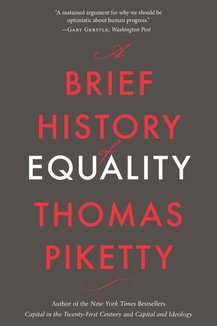
A Brief History of Equality
Authors:
Thomas Piketty,
Steven Rendall
A New York Times Book Review Editors’ Choice A Public Books Best Book of the Year “A profound and optimistic call to action and reflection. For Piketty, the arc of history is long, but it does bend toward equality.
A New York Times Book Review Editors’ Choice A Public Books Best Book of the Year “A profound and optimistic call to action and reflection. For Piketty, the arc of history is long, but it does bend toward equality. There is nothing automatic about it, however: as citizens, we must be ready to fight for it, and constantly (re)invent the myriad of institutions that will bring it about. This book is here to help.” ―Esther Duflo “A sustained argument for why we should be optimistic about human progress…[Piketty] has laid out a plan that is smart, thoughtful, and motivated by admirable political convictions.” ―Gary Gerstle, Washington Post “Thomas Piketty helped put inequality at the center of political debate. Now, he offers an ambitious program for addressing it…This is political economy on a grand scale, a starting point for debate about the future of progressive politics.” ―Michael J. Sandel, author of The Tyranny of Merit “[Piketty] argues that we’re on a trajectory of greater, not less, equality and lays out his prescriptions for remedying our current corrosive wealth disparities.” ―David Marchese, New York Times Magazine It’s easy to be pessimistic these days. We know that inequality has increased dramatically over the past two generations. Its ravages are increasingly impossible to ignore. But the grand sweep of history gives us reasons for hope. In this short and surprisingly optimistic history of human progress, the world’s leading economist of inequality shows that over the centuries we have been moving, fitfully and inconsistently but inexorably, toward greater equality. Thomas Piketty guides us through the seismic movements that have made the modern world: the birth of capitalism, the age of revolution, imperialism, slavery, two world wars, and the building of the welfare state. He shows that through it all, societies have moved toward a more just distribution of income and assets, reducing racial and gender inequalities and offering greater access to health care, education, and the rights of citizenship. To keep moving, he argues, we need to commit to legal, social, fiscal, and educational systems that can make equality a lasting reality, while resisting the temptations of cultural separatism. At stake is the quality of life for billions of people. We know we can do better. But do we dare?
Find this book on:


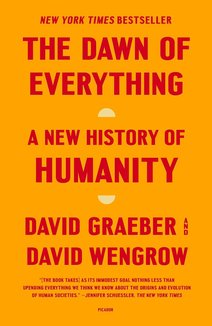
The Dawn of Everything: A New History of Humanity
Author:
David Graeber
INSTANT NEW YORK TIMES BESTSELLER A dramatically new understanding of human history, challenging our most fundamental assumptions about social evolution―from the development of agriculture and cities to the origins of the state, democracy, and inequality―and revealing new possibilities for human emancipation. For generations, our remote ancestors have been cast as primitive and childlike―either free and equal innocents, or thuggish and warlike.
INSTANT NEW YORK TIMES BESTSELLER A dramatically new understanding of human history, challenging our most fundamental assumptions about social evolution―from the development of agriculture and cities to the origins of the state, democracy, and inequality―and revealing new possibilities for human emancipation. For generations, our remote ancestors have been cast as primitive and childlike―either free and equal innocents, or thuggish and warlike. Civilization, we are told, could be achieved only by sacrificing those original freedoms or by taming our baser instincts. In their major New York Times bestseller, The Dawn of Everything , David Graeber and David Wengrow fundamentally challenge these assumptions and recast our understanding of human history. We will never again see the past in the same way. Drawing on pathbreaking research in archaeology and anthropology, Graeber and Wengrow reveal how history becomes a far more interesting place once we learn to throw off our conceptual blinders and perceive what’s really there. If humans did not spend 95 percent of their evolutionary past in tiny bands of hunter-gatherers, what were they doing during all that time? If agriculture and cities did not mean a plunge into hierarchy and domination, then what kinds of social and economic organizations did they lead to? The answers are often unexpected, and suggest that the course of human history may be less set in stone, and more open to playful, hopeful possibilities, than we tend to assume. Destined to be a classic, The Dawn of Everything signals a paradigm shift, profoundly transforming our understanding of the human past and making space to imagine new forms of freedom, new ways of organizing society. This is a monumental book of formidable intellectual and political range, animated by curiosity, moral vision, and hopefulness.
Find this book on:
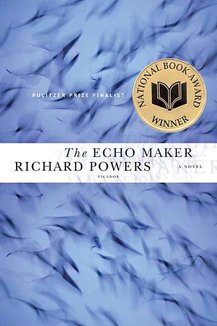
The Echo Maker
Author:
Richard Powers
Winner of the National Book Award From the Pulitzer Prize–winning author of The Overstory and the Oprah's Book Club selection Bewilderment comes Richard Powers's The Echo Make r, a powerful novel about family and loss. “Wise and elegant .
Winner of the National Book Award From the Pulitzer Prize–winning author of The Overstory and the Oprah's Book Club selection Bewilderment comes Richard Powers's The Echo Make r, a powerful novel about family and loss. “Wise and elegant . . . The mysteries unfold so organically and stealthily that you are unaware of his machinations until they come to stunning fruition . . . Powers accomplishes something magnificent.” ―Colson Whitehead, The New York Times Book Review On a winter night on a remote Nebraska road, twenty-seven-year-old Mark Schluter has a near-fatal car accident. His older sister, Karin, returns reluctantly to their hometown to nurse Mark back from a traumatic head injury. But when Mark emerges from a coma, he believes that this woman―who looks, acts, and sounds just like his sister―is really an imposter. When Karin contacts the famous cognitive neurologist Gerald Weber for help, he diagnoses Mark as having Capgras syndrome. The mysterious nature of the disease, combined with the strange circumstances surrounding Mark’s accident, threatens to change all of their lives beyond recognition. In The Echo Maker , Richard Powers proves himself to be one of our boldest and most entertaining novelists.
Find this book on:
Episode overview
Kim Stanley Robinson is one of the great living science fiction writers and one of the most astute observers of how planets look, feel and work. His Mars Trilogy imagined what it might be like for humans to settle on the red planet. His best-selling novel “The Ministry for the Future” is a masterful effort at envisioning what might happen to Earth in a future of unchecked climate change. Robinson has a rare command of both science and human nature, and his writing crystallizes how the two must work together if we are to rescue our collective planetary future from possible ruin.
In his most recent book, a rare turn to nonfiction called “The High Sierra: A Love Story,” Robinson trains his attention on the planet we inhabit in the here and now, particularly on one of his favorite places on Earth: the Sierra Nevada mountain range in California and Nevada. The new book is part memoir, part guidebook, part meditation on how time, space and even politics take shape in a wondrous geological landscape.
We discuss why Robinson decided to start writing outdoors, what it was like to experience the Sierras on psychedelics in his youth, what “actor-network theory” is and how it helps us understand our relationship to the planet and to our own bodies, why we should think of climate change more like we do plane crashes, what hiking backpacks say about American consumerism, how we should change our relationship to technology in order to be happier, why the politics of wanting are so confusing yet important, why Robinson is so excited about ideas like a wage ratio and rewilding schemes, how the “structure of feeling” around climate has changed, why Robinson is feeling more hopeful about Earth’s future these days and more.