
From this episode
Recommended books

" Postjournalism and the Death of Newspapers may be the most profound analysis of the subject since the last time Marshall McLuhan wrote about it. Mir describes a universe in which the news now chases the reader rather than the other way around.
" Postjournalism and the Death of Newspapers may be the most profound analysis of the subject since the last time Marshall McLuhan wrote about it. Mir describes a universe in which the news now chases the reader rather than the other way around. Everything is told in a wonderful epigrammatic style – you will be digging up quotes from it for years." – Martin Gurri, author of “The Revolt of the Public”. " The most important book in media theory that has been written in 40 years." – Paul Levinson, author of “Digital McLuhan”. "Andrey Mir’s Postjournalism offers a powerful, sweeping narrative of how news media have evolved over the centuries." – Arnold Kling, economist, author of “Crisis of Abundance” and “Invisible Wealth”. "In his book Postjournalism and the Death of Newspapers , Mir is here partly to praise newspapers, partly to bury them, but mostly to explain why their death is (a) inevitable and (b) a very big deal. He communicates this with a history of news media and a blizzard of concepts and neologisms." – Danyl Mclauchlan, “The Spinoff,” New Zealand. "As Mir argues, this change in the economic structure of the news media has quietly transformed journalism from a theoretically neutral means of “manufacturing consent” into a political cause that people are rallied into supporting, usually by inciting them to some form of outrage." – Murtaza Hussain, “The Intercept”. ...This book introduced the notion of "postjournalism" into contemporary media criticism. “Postjournalism and the death of newspapers” unveils the economic and cultural mechanisms of agenda-setting in the news media at the final stage of their historical existence. As advertising money has fled to the internet, the news media have been forced to switch to another source of funding – seeking readers' support. But they can no longer sell news because news is already known to people through social media newsfeeds. However, when the news is triggering, people still want somebody authoritative to validate this news' significance within certain value systems. The media have switched from news supply to news validation. Since only triggering news requires validation, the media are incentivized to select and supply agitating news. They inevitably transition to value-based coverage, declining the standards of journalism established in the 20th century, when the media were generously funded by advertising. The need to pursue reader revenue, with the news no longer being a commodity, is pushing journalism to mutate into postjournalism. Media outlets are increasingly soliciting subscriptions as donations to a cause. Journalism wanted its picture to match the world; postjournalism wants the world to match its picture. The ad-driven media manufactured consent. The reader-driven media manufacture anger. The former served consumerism. The latter serve polarization. The book explores polarization as a media effect. Other books by Andrey Mir: Human as Media. The Emancipation of Authorship. (2014). Digital Future in the Rearview Mirror: Jaspers’ Axial Age and Logan’s Alphabet Effect. (2024). The Viral Inquisitor and other essays on postjournalism and media ecology. (2024). Twitter: @Andrey4Mir
Find this book on:


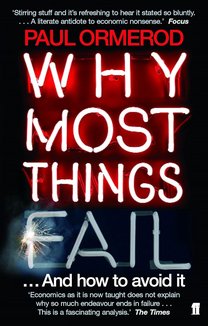
Why Most Things Fail
Author:
Paul Ormerod
From the best-selling author of The Death of Economics and Butterfly Economics , a ground-breaking look at a truth all too seldom acknowledged: most commercial and public policy ventures will not succeed. Paul Ormerod draws upon recent advances in biology to help us understand the surprising consequences of the Iron Law of Failure.
From the best-selling author of The Death of Economics and Butterfly Economics , a ground-breaking look at a truth all too seldom acknowledged: most commercial and public policy ventures will not succeed. Paul Ormerod draws upon recent advances in biology to help us understand the surprising consequences of the Iron Law of Failure. And he shows what strategies corporations, businesses and governments will need to adopt to stand a chance of prospering in a world where only one thing is certain.
Find this book on:
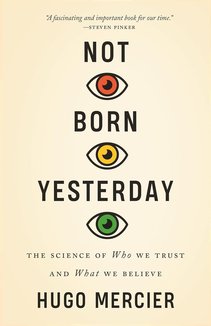
Not Born Yesterday: The Science of Who We Trust and What We Believe
Author:
Hugo Mercier
Why people are not as gullible as we think Not Born Yesterday explains how we decide who we can trust and what we should believe―and argues that we're pretty good at making these decisions. In this lively and provocative book, Hugo Mercier demonstrates how virtually all attempts at mass persuasion―whether by religious leaders, politicians, or advertisers―fail miserably.
Why people are not as gullible as we think Not Born Yesterday explains how we decide who we can trust and what we should believe―and argues that we're pretty good at making these decisions. In this lively and provocative book, Hugo Mercier demonstrates how virtually all attempts at mass persuasion―whether by religious leaders, politicians, or advertisers―fail miserably. Drawing on recent findings from political science and other fields ranging from history to anthropology, Mercier shows that the narrative of widespread gullibility, in which a credulous public is easily misled by demagogues and charlatans, is simply wrong. Why is mass persuasion so difficult? Mercier uses the latest findings from experimental psychology to show how each of us is endowed with sophisticated cognitive mechanisms of open vigilance. Computing a variety of cues, these mechanisms enable us to be on guard against harmful beliefs, while being open enough to change our minds when presented with the right evidence. Even failures―when we accept false confessions, spread wild rumors, or fall for quack medicine―are better explained as bugs in otherwise well-functioning cognitive mechanisms than as symptoms of general gullibility. Not Born Yesterday shows how we filter the flow of information that surrounds us, argues that we do it well, and explains how we can do it better still.
Find this book on:
Episode overview
In 2016, when Donald Trump won the first time, a little-known book became an unexpected phenomenon. It was “The Revolt of the Public,” self-published two years earlier by a former C.I.A. media analyst, Martin Gurri. Gurri, who is now a visiting research fellow at the Mercatus Center, argued that a revolution in how information flowed was driving political upheavals in country after country: The dynamics of modern media ecosystems naturally created distrust toward institutions and elites, and this was fueling waves of revolt against the status quo. The problem, though, was that though these dynamics could destroy existing political systems, they could not build enduring replacements.
Gurri’s book has been on my mind over the past year. In some ways, it explains 2024 better than it explains 2016. But time didn’t just change Gurri’s book; it changed Gurri. After refusing to cast a ballot for president in 2016 and 2020, he voted for Donald Trump in 2024. And in his writing for The Free Press, The New York Post and elsewhere, he’s been arguing that Trump’s second term might herald the mastery of this new informational world and the emergence of an enduring new political system.
I found myself more convinced by Gurri’s old theory than his new one. So I asked him on the show to talk about it.
(Also: If you’re interested in joining Ezra Klein on his book tour in March and April, you can see the stops and get tickets for the events here: https://www.simonandschuster.com/p/abundance-tour)