
From this episode
Recommended books
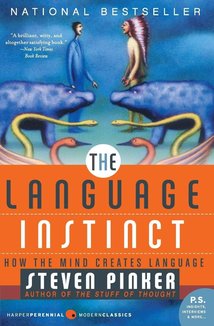
The Language Instinct: How the Mind Creates Language (Harper Perennial Modern Classics)
Author:
Steven Pinker
"A brilliant, witty, and altogether satisfying book." — New York Times Book Review The classic work on the development of human language by the world’s leading expert on language and the mind In The Language Instinct , the world's expert on language and mind lucidly explains everything you always wanted to know about language: how it works, how children learn it, how it changes, how the brain computes it, and how it evolved. With deft use of examples of humor and wordplay, Steven Pinker weaves our vast knowledge of language into a compelling story: language is a human instinct, wired into our brains by evolution.
"A brilliant, witty, and altogether satisfying book." — New York Times Book Review The classic work on the development of human language by the world’s leading expert on language and the mind In The Language Instinct , the world's expert on language and mind lucidly explains everything you always wanted to know about language: how it works, how children learn it, how it changes, how the brain computes it, and how it evolved. With deft use of examples of humor and wordplay, Steven Pinker weaves our vast knowledge of language into a compelling story: language is a human instinct, wired into our brains by evolution. The Language Instinct received the William James Book Prize from the American Psychological Association and the Public Interest Award from the Linguistics Society of America. This edition includes an update on advances in the science of language since The Language Instinct was first published.
Find this book on:


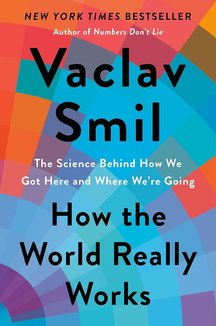
INSTANT NEW YORK TIMES BESTSELLER “A new masterpiece from one of my favorite authors… [ How The World Really Works] is a compelling and highly readable book that leaves readers with the fundamental grounding needed to help solve the world’s toughest challenges.” — Bill Gates “Provocative but perceptive . .
INSTANT NEW YORK TIMES BESTSELLER “A new masterpiece from one of my favorite authors… [ How The World Really Works] is a compelling and highly readable book that leaves readers with the fundamental grounding needed to help solve the world’s toughest challenges.” — Bill Gates “Provocative but perceptive . . . You can agree or disagree with Smil—accept or doubt his ‘just the facts’ posture—but you probably shouldn’t ignore him.” —The Washington Post An essential analysis of the modern science and technology that makes our twenty-first century lives possible—a scientist's investigation into what science really does, and does not, accomplish. We have never had so much information at our fingertips and yet most of us don’t know how the world really works. This book explains seven of the most fundamental realities governing our survival and prosperity. From energy and food production, through our material world and its globalization, to risks, our environment and its future, How the World Really Works offers a much-needed reality check—because before we can tackle problems effectively, we must understand the facts. In this ambitious and thought-provoking book we see, for example, that globalization isn’t inevitable—the foolishness of allowing 70 per cent of the world’s rubber gloves to be made in just one factory became glaringly obvious in 2020—and that our societies have been steadily increasing their dependence on fossil fuels, such that any promises of decarbonization by 2050 are a fairy tale. For example, each greenhouse-grown supermarket-bought tomato has the equivalent of five tablespoons of diesel embedded in its production, and we have no way of producing steel, cement or plastics at required scales without huge carbon emissions. Ultimately, Smil answers the most profound question of our age: are we irrevocably doomed or is a brighter utopia ahead? Compelling, data-rich and revisionist, this wonderfully broad, interdisciplinary guide finds faults with both extremes. Looking at the world through this quantitative lens reveals hidden truths that change the way we see our past, present and uncertain future.
Find this book on:
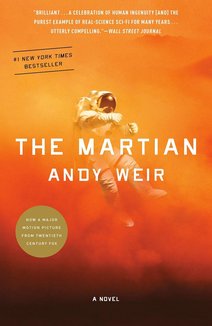
The Martian
Author:
Andy Weir
#1 NEW YORK TIMES BESTSELLER • “Brilliant . .
#1 NEW YORK TIMES BESTSELLER • “Brilliant . . . a celebration of human ingenuity [and] the purest example of real-science sci-fi for many years . . . utterly compelling.”— The Wall Street Journal The inspiration for the major motion picture Six days ago, astronaut Mark Watney became one of the first people to walk on Mars. Now, he’s sure he’ll be the first person to die there. After a dust storm nearly kills him and forces his crew to evacuate while thinking him dead, Mark finds himself stranded and completely alone with no way to even signal Earth that he’s alive—and even if he could get word out, his supplies would be gone long before a rescue could arrive. Chances are, though, he won’t have time to starve to death. The damaged machinery, unforgiving environment, or plain-old “human error” are much more likely to kill him first. But Mark isn’t ready to give up yet. Drawing on his ingenuity, his engineering skills—and a relentless, dogged refusal to quit—he steadfastly confronts one seemingly insurmountable obstacle after the next. Will his resourcefulness be enough to overcome the impossible odds against him? NAMED ONE OF PASTE ’S BEST NOVELS OF THE DECADE “A hugely entertaining novel [that] reads like a rocket ship afire . . . Weir has fashioned in Mark Watney one of the most appealing, funny, and resourceful characters in recent fiction.” — Chicago Tribune “As gripping as they come . . . You’ll be rooting for Watney the whole way, groaning at every setback and laughing at his pitchblack humor. Utterly nail-biting and memorable.” — Financial Times
Find this book on:
Episode overview
The year 2022 was jam-packed with advances in artificial intelligence, from the release of image generators like DALL-E 2 and text generators like Cicero to a flurry of developments in the self-driving car industry. And then, on November 30, OpenAI released ChatGPT, arguably the smartest, funniest, most humanlike chatbot to date.
In the weeks since, ChatGPT has become an internet sensation. If you’ve spent any time on social media recently, you’ve probably seen screenshots of it describing Karl Marx’s theory of surplus value in the style of a Taylor Swift song or explaining how to remove a sandwich from a VCR in the style of the King James Bible. There are hundreds of examples like that.
But amid all the hype, I wanted to give voice to skepticism: What is ChatGPT actually doing? Is this system really as “intelligent” as it can sometimes appear? And what are the implications of unleashing this kind of technology at scale?
Gary Marcus is an emeritus professor of psychology and neural science at N.Y.U. who has become one of the leading voices of A.I. skepticism. He’s not “anti-A.I.”; in fact, he’s founded multiple A.I. companies himself. But Marcus is deeply worried about the direction current A.I. research is headed, and even calls the release of ChatGPT A.I.’s “Jurassic Park moment.” “Because such systems contain literally no mechanisms for checking the truth of what they say,” Marcus writes, “they can easily be automated to generate misinformation at unprecedented scale.”
However, Marcus also believes that there’s a better way forward. In the 2019 book “Rebooting A.I.: Building Artificial Intelligence We Can Trust” Marcus and his co-author Ernest Davis outline a path to A.I. development built on a very different understanding of what intelligence is and the kinds of systems required to develop that intelligence. And so I asked Marcus on the show to unpack his critique of current A.I. systems and what it would look like to develop better ones.
This episode contains strong language.