From this episode
Recommended books
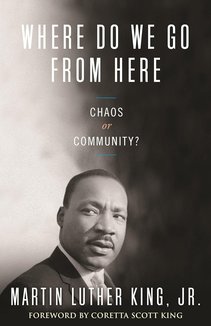
Where Do We Go from Here: Chaos or Community? (King Legacy)
Authors:
Dr. Martin Luther King Jr.,
Vincent Harding,
Coretta Scott King
In 1967, Dr. Martin Luther King, Jr., isolated himself from the demands of the civil rights movement, rented a house in Jamaica with no telephone, and labored over his final manuscript.
In 1967, Dr. Martin Luther King, Jr., isolated himself from the demands of the civil rights movement, rented a house in Jamaica with no telephone, and labored over his final manuscript. In this prophetic work, which has been unavailable for more than ten years, he lays out his thoughts, plans, and dreams for America's future, including the need for better jobs, higher wages, decent housing, and quality education. With a universal message of hope that continues to resonate, King demanded an end to global suffering, asserting that humankind-for the first time-has the resources and technology to eradicate poverty.
Find this book on:

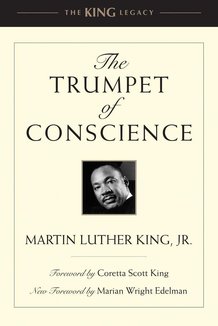
The Trumpet of Conscience (King Legacy)
Author:
Dr. Martin Luther King Jr.
In November and December 1967, Dr. Martin Luther King, Jr., delivered five lectures for the renowned Massey Lecture Series of the Canadian Broadcasting Corporation.
In November and December 1967, Dr. Martin Luther King, Jr., delivered five lectures for the renowned Massey Lecture Series of the Canadian Broadcasting Corporation. Immediately released under the title Conscience for Change after King’s assassination, it was republished as The Trumpet of Conscience. Each oration speaks prophetically to today’s perils, addressing issues of equality, conscience and war, the mobilization of young people, and nonviolence. The book concludes with “A Christmas Sermon on Peace,” a powerful lecture about nonviolence as a path to world peace that was broadcast live from Ebenezer Baptist Church on Christmas Eve in 1967.
Find this book on:

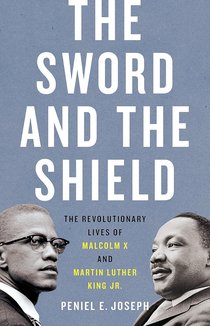
The Sword and the Shield: The Revolutionary Lives of Malcolm X and Martin Luther King Jr.
Author:
Peniel E. Joseph
This "landmark" (Ibram X. Kendi, New York Times –bestselling author of How to Be an Antiracist ) dual biography of Malcolm X and Martin Luther King upends longstanding preconceptions to transform our understanding of the twentieth century's most iconic African American leaders To most Americans, Malcolm X and Martin Luther King Jr.
This "landmark" (Ibram X. Kendi, New York Times –bestselling author of How to Be an Antiracist ) dual biography of Malcolm X and Martin Luther King upends longstanding preconceptions to transform our understanding of the twentieth century's most iconic African American leaders To most Americans, Malcolm X and Martin Luther King Jr. represent contrasting ideals: self-defense versus nonviolence, black power versus civil rights, the sword versus the shield. The struggle for black freedom is wrought with the same contrasts. While nonviolent direct action is remembered as an unassailable part of American democracy, the movement's militancy is either vilified or erased outright. In The Sword and the Shield , Peniel E. Joseph upends these misconceptions and reveals a nuanced portrait of two men who, despite markedly different backgrounds, inspired and pushed each other throughout their adult lives. This is a strikingly revisionist biography, not only of Malcolm and Martin, but also of the movement and era they came to define.
Find this book on:
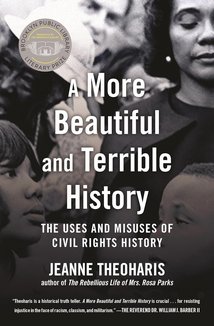
A More Beautiful and Terrible History: The Uses and Misuses of Civil Rights History
Author:
Jeanne Theoharis
This “bracing corrective to national mythology” around the American civil rights movement “shows us how little we remember, and how much more there is to understand ” ( New York Times ). “Theoharis’s view of history is expansive” as it reveals the diverse, unsung heroes of the movement and criticizes the oversimplification of complex figures like Martin Luther King, Jr.
This “bracing corrective to national mythology” around the American civil rights movement “shows us how little we remember, and how much more there is to understand ” ( New York Times ). “Theoharis’s view of history is expansive” as it reveals the diverse, unsung heroes of the movement and criticizes the oversimplification of complex figures like Martin Luther King, Jr. ( O Magazine ). The civil rights movement has become national legend, lauded by presidents from Reagan to Obama to Trump, as proof of the power of American democracy. This fable, featuring dreamy heroes and accidental heroines like Martin Luther King and Rosa Parks, anchors the movement firmly to the past, whitewashes the forces that stood in its way, and diminishes its scope. Award-winning historian Jeanne Theoharis dissects this national myth-making, teasing apart the accepted stories to show them in a strikingly different light. She makes us reckon with the fact that far from being acceptable, passive or unified, the civil rights movement was unpopular, disruptive, and courageously persevering. Activists embraced an expansive vision of justice, which a majority of Americans opposed and which the federal government feared. Her challenge of this fable reveals the immense barriers and repression activists faced. She explores the diversity of people who led the movement, especially women and young people; the work and disruption it took, including the public demonization of ‘rebels;’ and the role of the media and “polite racism” in maintaining injustice. A More Beautiful and Terrible History will change our historical frame, revealing the richness of our civil rights legacy, the uncomfortable mirror it holds to the nation, and the crucial work that remains to be done.
Find this book on:
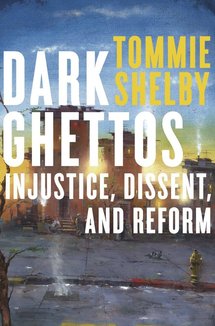
Dark Ghettos: Injustice, Dissent, and Reform
Author:
Tommie Shelby
Winner of the Spitz Prize, Conference for the Study of Political Thought Winner of the North American Society for Social Philosophy Book Award Why do American ghettos persist? Scholars and commentators often identify some factor―such as single motherhood, joblessness, or violent street crime―as the key to solving the problem and recommend policies accordingly.
Winner of the Spitz Prize, Conference for the Study of Political Thought Winner of the North American Society for Social Philosophy Book Award Why do American ghettos persist? Scholars and commentators often identify some factor―such as single motherhood, joblessness, or violent street crime―as the key to solving the problem and recommend policies accordingly. But, Tommie Shelby argues, these attempts to “fix” ghettos or “help” their poor inhabitants ignore fundamental questions of justice and fail to see the urban poor as moral agents responding to injustice. “Provocative…[Shelby] doesn’t lay out a jobs program or a housing initiative. Indeed, as he freely admits, he offers ‘no new political strategies or policy proposals.’ What he aims to do instead is both more abstract and more radical: to challenge the assumption, common to liberals and conservatives alike, that ghettos are ‘problems’ best addressed with narrowly targeted government programs or civic interventions. For Shelby, ghettos are something more troubling and less tractable: symptoms of the ‘systemic injustice’ of the United States. They represent not aberrant dysfunction but the natural workings of a deeply unfair scheme. The only real solution, in this way of thinking, is the ‘fundamental reform of the basic structure of our society.’” ―James Ryerson, New York Times Book Review
Find this book on:
Episode overview
It’s hard to think of a more celebrated figure of the 20th century than Martin Luther King Jr.
He has a national memorial in Washington, D.C. His birthday is one of just 11 federal holidays. And his words and legacy are routinely evoked by politicians of both major parties.
But the paradox of King’s legacy is that while many revere him, very few actually read him. Most of us can cite a handful of his most famous quotes, but King’s actual teachings span five books, countless speeches and sermons, and years of detailed correspondence.
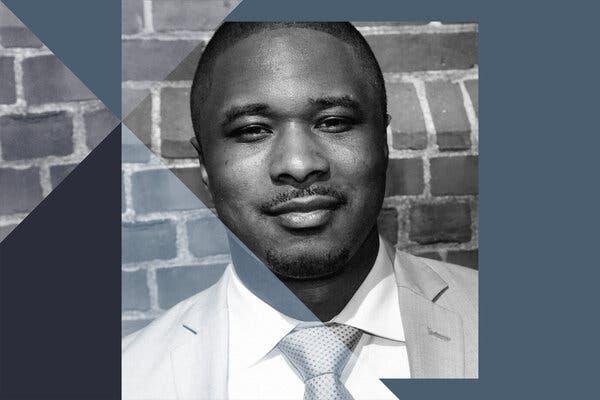
There’s perhaps no scholar working today who studies Dr. King’s political philosophy as deeply as Brandon Terry. Terry is the John L. Loeb associate professor of social sciences at Harvard, where he specializes in Black political thought. He is the co-editor of “To Shape a New World: Essays on the Political Philosophy of Martin Luther King, Jr.,” the editor of “Fifty Years Since MLK,” and the author of numerous popular and academic articles on King’s political thought. His work is committed to rescuing the nuances of Dr. King’s philosophies and forcing a confrontation with what King actually said and believed, rather than what he’s come to represent.
In this conversation, we follow the commitment that animates much of Terry’s work: to take King seriously as a philosopher, rather than as purely a political actor. And it turns out that King understood a lot about politics that we’ve lost sight of today. We discuss why a “romantic narrative” of the civil rights era stops us from taking King seriously as a philosopher; the true radicalism of King’s nonviolent philosophy; King’s complex views on the relationship between race and class; how King wrestled with the demands of “respectability politics”; King’s wide-ranging economic views, including the idea that the economy should be subservient to the community (and not the other way around); King’s enthusiasm for tenant unions and welfare rights unions as critical democratic inventions; whether the state should embrace the same nonviolence it often demands of protesters; the roots of King’s opposition to the war in Vietnam; whether we’ve lost the ability to grapple with “virtue” in politics today; and more.