
From this episode
Recommended books
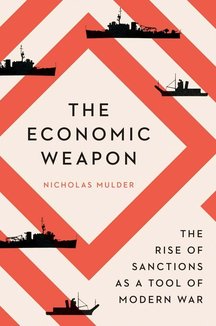
The Economic Weapon: The Rise of Sanctions as a Tool of Modern War
Author:
Nicholas Mulder
The first international history of the emergence of economic sanctions during the interwar period and the legacy of this development A Foreign Affairs Best Book of 2022 “Valuable . .
The first international history of the emergence of economic sanctions during the interwar period and the legacy of this development A Foreign Affairs Best Book of 2022 “Valuable . . . offers many lessons for Western policy makers today.”—Paul Kennedy, Wall Street Journal “The lessons are sobering.”— The Economist Economic sanctions dominate the landscape of world politics today. First developed in the early twentieth century as a way of exploiting the flows of globalization to defend liberal internationalism, their appeal is that they function as an alternative to war. This view, however, ignores the dark paradox at their core: designed to prevent war, economic sanctions are modeled on devastating techniques of warfare. Tracing the use of economic sanctions from the blockades of World War I to the policing of colonial empires and the interwar confrontation with fascism, Nicholas Mulder uses extensive archival research in a political, economic, legal, and military history that reveals how a coercive wartime tool was adopted as an instrument of peacekeeping by the League of Nations. This timely study casts an overdue light on why sanctions are widely considered a form of war, and why their unintended consequences are so tremendous.
Find this book on:


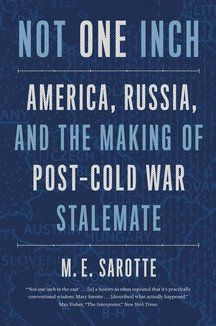
A leading expert on foreign policy reveals how tensions between America, NATO, and Russia transformed geopolitics ● A Foreign Affairs Best Book of 2021 and winner of the Pushkin House Book Prize “Sarotte has the receipts, as it were: her authoritative tale draws on thousands of memos, letters, briefs, and other once secret documents—including many that have never been published before—which both fill in and complicate settled narratives on both sides.”—Joshua Yaffa, New Yorker “The most engaging and carefully documented account of this period in East-West diplomacy currently available.”—Andrew Moravcsik, Foreign Affairs Not one inch. With these words, Secretary of State James Baker proposed a hypothetical bargain to Soviet leader Mikhail Gorbachev after the fall of the Berlin Wall: if you let your part of Germany go, we will move NATO not one inch eastward.
A leading expert on foreign policy reveals how tensions between America, NATO, and Russia transformed geopolitics ● A Foreign Affairs Best Book of 2021 and winner of the Pushkin House Book Prize “Sarotte has the receipts, as it were: her authoritative tale draws on thousands of memos, letters, briefs, and other once secret documents—including many that have never been published before—which both fill in and complicate settled narratives on both sides.”—Joshua Yaffa, New Yorker “The most engaging and carefully documented account of this period in East-West diplomacy currently available.”—Andrew Moravcsik, Foreign Affairs Not one inch. With these words, Secretary of State James Baker proposed a hypothetical bargain to Soviet leader Mikhail Gorbachev after the fall of the Berlin Wall: if you let your part of Germany go, we will move NATO not one inch eastward. Controversy erupted almost immediately over this 1990 exchange—but more important was the decade to come, when the words took on new meaning. Gorbachev let his Germany go, but Washington rethought the bargain, not least after the Soviet Union’s own collapse in December 1991. Washington realized it could not just win big but win bigger. Not one inch of territory needed to be off limits to NATO. On the thirtieth anniversary of the Soviet collapse, this book uses new evidence and interviews to show how, in the decade that culminated in Vladimir Putin’s rise to power, the United States and Russia undermined a potentially lasting partnership. Prize-winning historian M. E. Sarotte shows what went wrong.
Find this book on:
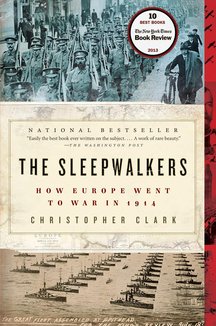
The Sleepwalkers: How Europe Went to War in 1914
Author:
Christopher Clark
“A monumental new volume. .
“A monumental new volume. . . . Revelatory, even revolutionary. . . . Clark has done a masterful job explaining the inexplicable.” — Boston Globe One of The New York Times Book Review ’s 10 Best Books of the Year • Winner of the Los Angeles Times Book Prize (History) Historian Christopher Clark’s riveting account of the explosive beginnings of World War I. Drawing on new scholarship, Clark offers a fresh look at World War I, focusing not on the battles and atrocities of the war itself, but on the complex events and relationships that led a group of well-meaning leaders into brutal conflict. Clark traces the paths to war in a minute-by-minute, action-packed narrative that cuts between the key decision centers in Vienna, Berlin, St. Petersburg, Paris, London, and Belgrade, and examines the decades of history that informed the events of 1914 and details the mutual misunderstandings and unintended signals that drove the crisis forward in a few short weeks. Meticulously researched and masterfully written, The Sleepwalkers is a dramatic and authoritative chronicle of Europe’s descent into a war that tore the world apart.
Find this book on:
Episode overview
As we enter the fourth week of Russia’s invasion of Ukraine, many of the possible pathways this conflict could take are terrifying. A military quagmire that leads to protracted death and suffering. A Russian takeover of Kyiv and installation of a puppet government. An accidental strike on Polish or Romanian territory that draws America and the rest of NATO into war. Or, perhaps worst of all, a series of escalations that culminates in nuclear exchange.
But one possibility carries a glimmer of hope. This week, Ukrainian and Russian negotiators began talks on a tentative peace plan — one that would involve Ukraine abandoning its attempts to join NATO and promising not to host foreign military bases or weaponry, in exchange for Western security guarantees and a Russian troop withdrawal. We’re still far from any kind of definitive settlement — and there are legitimate concerns over whether Putin would accept any kind of deal at this point — but it’s a start.
Emma Ashford is a senior fellow with the New American Engagement Initiative at the Scowcroft Center for Strategy and Security, and a member of the school of foreign policy thinking known as “realism.” Realists view international relations as a contest between states for power and security; they tend to focus less on the psychologies and ideologies of individual leaders and more on the strategic self-interest of the parties involved. It’s an imperfect framework but a useful one — especially when it comes to analyzing what it would take to achieve a successful negotiation or settlement.
So I invited Ashford on the show to help me think through the different trajectories the conflict could take — and what the West can do to make de-escalation more likely. We also discuss John Mearsheimer’s argument that the West’s effort to expand NATO bears responsibility for Putin’s invasion, why Ashford isn’t particularly worried about the possibility of Russian cyberattacks on the West, how Western sanctions blur the line between war and peace, whether NATO’s efforts to supply Ukraine with weapons might backfire, why sanctions might not hurt Russian elites as much as Western leaders hope and how this conflict is changing the geopolitical calculus of countries like Germany, China and India.
Book recommendations:
The Economic Weapon by Nicholas Mulder
Not One Inch by M.E. Sarotte
The Sleepwalkers by Christopher Clark
Thoughts? Guest suggestions? Email us at [email protected].
You can find transcripts (posted midday) and more episodes of “The Ezra Klein Show” at nytimes.com/ezra-klein-podcast, and you can find Ezra on Twitter @ezraklein. Book recommendations from all our guests are listed at https://www.nytimes.com/article/ezra-klein-show-book-recs.
“The Ezra Klein Show” is produced by Annie Galvin, Jeff Geld and Rogé Karma; fact-checking by Michelle Harris, Mary Marge Locker and Kate Sinclair; original music by Isaac Jones; mixing by Jeff Geld; audience strategy by Shannon Busta. Our executive producer is Irene Noguchi. Special thanks to Kristin Lin and Kristina Samulewski.