
From this episode
Recommended books
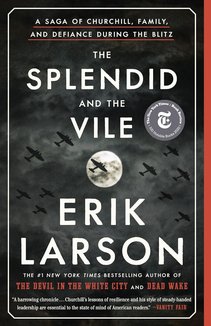
#1 NEW YORK TIMES BESTSELLER • The author of The Devil in the White City and Dead Wake delivers an intimate chronicle of Winston Churchill and London during the Blitz—an inspiring portrait of courage and leadership in a time of unprecedented crisis “One of [Erik Larson’s] best books yet . .
#1 NEW YORK TIMES BESTSELLER • The author of The Devil in the White City and Dead Wake delivers an intimate chronicle of Winston Churchill and London during the Blitz—an inspiring portrait of courage and leadership in a time of unprecedented crisis “One of [Erik Larson’s] best books yet . . . perfectly timed for the moment.”— Time • “A bravura performance by one of America’s greatest storytellers.”—NPR NAMED ONE OF THE BEST BOOKS OF THE YEAR BY The New York Times Book Review • Time • Vogue • NPR • The Washington Post • Chicago Tribune • The Globe & Mail • Fortune • Bloomberg • New York Post • The New York Public Library • Kirkus Reviews • LibraryReads • PopMatters On Winston Churchill’s first day as prime minister, Adolf Hitler invaded Holland and Belgium. Poland and Czechoslovakia had already fallen, and the Dunkirk evacuation was just two weeks away. For the next twelve months, Hitler would wage a relentless bombing campaign, killing 45,000 Britons. It was up to Churchill to hold his country together and persuade President Franklin Roosevelt that Britain was a worthy ally—and willing to fight to the end. In The Splendid and the Vile , Erik Larson shows, in cinematic detail, how Churchill taught the British people “the art of being fearless.” It is a story of political brinkmanship, but it’s also an intimate domestic drama, set against the backdrop of Churchill’s prime-ministerial country home, Chequers; his wartime retreat, Ditchley, where he and his entourage go when the moon is brightest and the bombing threat is highest; and of course 10 Downing Street in London. Drawing on diaries, original archival documents, and once-secret intelligence reports—some released only recently—Larson provides a new lens on London’s darkest year through the day-to-day experience of Churchill and his family: his wife, Clementine; their youngest daughter, Mary, who chafes against her parents’ wartime protectiveness; their son, Randolph, and his beautiful, unhappy wife, Pamela; Pamela’s illicit lover, a dashing American emissary; and the advisers in Churchill’s “Secret Circle,” to whom he turns in the hardest moments. The Splendid and the Vile takes readers out of today’s political dysfunction and back to a time of true leadership, when, in the face of unrelenting horror, Churchill’s eloquence, courage, and perseverance bound a country, and a family, together.
Find this book on:


The Anarchy
Author:
William Dalrymple
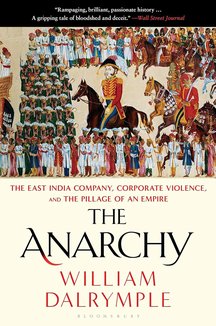
ONE OF PRESIDENT BARACK OBAMA'S FAVORITE BOOKS OF THE YEAR NAMED A BEST BOOK OF THE YEAR BY The Wall Street Journal and NPR The epic story of how the East India Company took over large swaths of Asia, and the devastating results of the corporation running a country. In August 1765, the East India Company defeated the young Mughal emperor and set up, in his stead, a government run by English traders who collected taxes through means of a private army.
ONE OF PRESIDENT BARACK OBAMA'S FAVORITE BOOKS OF THE YEAR NAMED A BEST BOOK OF THE YEAR BY The Wall Street Journal and NPR The epic story of how the East India Company took over large swaths of Asia, and the devastating results of the corporation running a country. In August 1765, the East India Company defeated the young Mughal emperor and set up, in his stead, a government run by English traders who collected taxes through means of a private army. Over the course of the next 47 years, the company's reach grew until almost all of India south of Delhi was essentially ruled from a boardroom in the city of London. The Anarchy tells one of history's most remarkable stories: how the Mughal Empire-which dominated world trade and manufacturing and possessed almost unlimited resources-fell apart and was replaced by a multinational corporation answerable only to shareholders, most of whom had never even seen India and had no idea about the country whose wealth provided their dividends. Using previously untapped sources, William Dalrymple provides a devastating portrait of the brutality that results when a company becomes a colonial power.
Find this book on:

India: A Story Through 100 Objects
Author:
Vidya Dehejia
We are constantly surrounded by objects, by ‘things' that channel and dictate our everyday life, ‘things' that we take for granted. But these objects speak to us, and speak about us.
We are constantly surrounded by objects, by ‘things' that channel and dictate our everyday life, ‘things' that we take for granted. But these objects speak to us, and speak about us. They have a story to tell that reflects our values and aspirations, our achievements and dreams, and reveal more about us than we realize! This richly illustrated book focuses on 100 objects to tell a story of India that unravels in a series of thematic sections that allow the objects to take center-stage. The stories that some objects tell will be new to readers; at other times, the objects themselves may be familiar but the story they tell may not be obvious. The 100 objects shed light on the varying priorities and the differing strands of achievement that arose over time to create the rich multi-cultural medley that is today's India.
Find this book on:
Episode overview
Government is a bureaucratic, slow-moving institution. It’s too easily captured by special interests. It’s often incapable of acting at the speed and scale our problems demand. And when it does act, it can make things worse. Look no further than the Food and Drug Administration’s slowness to approve rapid coronavirus tests or major cities’ inability to build new housing and public transit or Congress’s failure to pass basic voting rights legislation.
This criticism is typically weaponized as an argument for shrinking government and outsourcing its responsibilities to the market. But the past two years have revealed the hollowness of that approach. A pandemic is a problem the private sector simply cannot solve. The same is true for other major challenges of the 21st century, such as climate change and technology-driven inequality. Ours is an age in which government needs to be able to do big things, solve big problems and deliver where the market cannot or will not.
Alex Tabarrok is an economist at George Mason University, a blogger at Marginal Revolution and for years has been one of the sharpest libertarian critics of big government. But the experience of the pandemic has changed his thinking in key ways. “Ninety-nine years out of 100, I’m a libertarian,” he told me last year. “But then there’s that one year out of 100.”
So this conversation is about the central tension that Tabarrok and I are grappling with right now: Government failure has never been more apparent — and yet we need government more than ever.
We discuss (and debate) the public choice theory of government failure, why it’s so damn hard to build things in America, how reforms intended to weaken special interests often empower them, why the American right is responsible for much of the government dysfunction it criticizes, the case for state capacity libertarianism, the appropriate size of the welfare state, the political importance of massive economic inequality and how the crypto world’s pursuit of decentralization could backfire.