From this episode
Recommended books
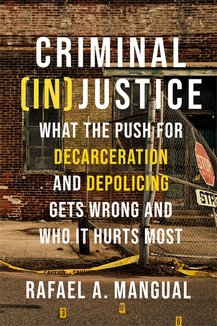
Criminal (In)Justice: What the Push for Decarceration and Depolicing Gets Wrong and Who It Hurts Most
Author:
Rafael A. Mangual
In his impassioned-yet-measured book, Rafael A. Mangual offers an incisive critique of America's increasingly radical criminal justice reform movement, and makes a convincing case against the pursuit of "justice" through mass-decarceration and depolicing.
In his impassioned-yet-measured book, Rafael A. Mangual offers an incisive critique of America's increasingly radical criminal justice reform movement, and makes a convincing case against the pursuit of "justice" through mass-decarceration and depolicing. After a summer of violent protests in 2020—sparked by the deaths of George Floyd, Breonna Taylor, and Rayshard Brooks—a dangerously false narrative gained mainstream acceptance: Criminal justice in the United States is overly punitive and racially oppressive . But, the harshest and loudest condemnations of incarceration, policing, and prosecution are often shallow and at odds with the available data. And the significant harms caused by this false narrative are borne by those who can least afford them: black and brown people who are disproportionately the victims of serious crimes. In Criminal (In)Justice , Rafael A. Mangual offers a more balanced understanding of American criminal justice, and cautions against discarding traditional crime control measures. A powerful combination of research, data-driven policy journalism, and the author's lived experiences, this book explains what many reform advocates get wrong, and illustrates how the misguided commitment to leniency places America's most vulnerable communities at risk. The stakes of this moment are incredibly high. Ongoing debates over criminal justice reform have the potential to transform our society for a generation—for better or for worse. Grappling with the data—and the sometimes harsh realities they reflect—is the surest way to minimize the all-too-common injustices plaguing neighborhoods that can least afford them.
Find this book on:


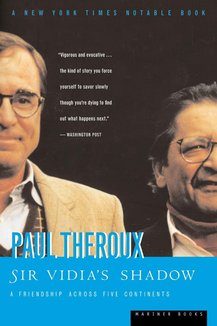
Sir Vidia's Shadow: A Friendship Across Five Continents
Author:
Paul Theroux
This heartfelt and revealing account of Paul Theroux's thirty-year friendship with the legendary V. S.
This heartfelt and revealing account of Paul Theroux's thirty-year friendship with the legendary V. S. Naipaul is an intimate record of a literary mentorship that traces the growth of both writers' careers and explores the unique effect each had on the other. Built around exotic landscapes, anecdotes that are revealing, humorous, and melancholy, and three decades of mutual history, this is a personal account of how one develops as a writer and how a friendship waxes and wanes between two men who have set themselves on the perilous journey of a writing life.
Find this book on:
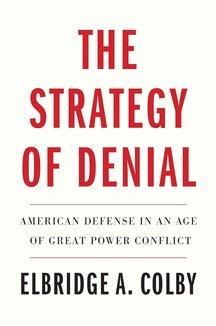
The Strategy of Denial: American Defense in an Age of Great Power Conflict
Author:
Elbridge A. Colby
Why and how America’s defense strategy must change in light of China’s power and ambition—A Wall Street Journal best book of 2021 “This is a realist’s book, laser-focused on China’s bid for mastery in Asia as the 21st century’s most important threat.”—Ross Douthat, New York Times “Colby’s well-crafted and insightful Strategy of Denial provides a superb and, one suspects, essential departure point for an urgent and much-needed debate over U.S. defense strategy.”—Andrew F.
Why and how America’s defense strategy must change in light of China’s power and ambition—A Wall Street Journal best book of 2021 “This is a realist’s book, laser-focused on China’s bid for mastery in Asia as the 21st century’s most important threat.”—Ross Douthat, New York Times “Colby’s well-crafted and insightful Strategy of Denial provides a superb and, one suspects, essential departure point for an urgent and much-needed debate over U.S. defense strategy.”—Andrew F. Krepinevich, Jr., Foreign Affairs Elbridge A. Colby was the lead architect of the 2018 National Defense Strategy, the most significant revision of U.S. defense strategy in a generation. Here he lays out how America’s defense must change to address China’s growing power and ambition. Based firmly on the realist tradition but deeply engaged in current policy, this book offers a clear framework for what America’s goals in confronting China must be, how its military strategy must change, and how it must prioritize these goals over its lesser interests. The most informed and in-depth reappraisal of America’s defense strategy in decades, this book outlines a rigorous but practical approach, showing how the United States can prepare to win a war with China that we cannot afford to lose—precisely in order to deter that war from happening.
Find this book on:
Episode overview
“There is definitely a contest for the future of the center right,” says Reihan Salam, the president of the Manhattan Institute, a conservative think tank. In his telling, one side in this contest is “deeply pessimistic about the prospect of a diversifying America, explicitly anti-urban and increasingly willing to embrace redistribution and centralized power,” more so than conservatism before Donald Trump. This populist right has received a lot of attention since Trump’s election, and we’ve done other shows to try to understand it.
But Salam is advancing a very different set of ideas with a very different theory of the electorate. He’s identified what he sees as a core fissure between the progressive elites who run the Democratic Party and the working-class voters of color who make up a large part of its base — particularly on issues of race and gender. And he believes that by putting forward an “urban conservative” agenda centered on education, housing and public safety, Republicans can exploit those internal cleavages and begin to win over demographics that have been central to the Democratic coalition.
So for the final episode in our “The Rising Right” series, I wanted to use Salam’s thoughts to explore this alternate path for the American right. We discuss why the Republican Party has turned against major cities, whether antiracism is the right framework for addressing racial inequality, why he believes that children of Latino and Asian immigrants could become a core G.O.P. constituency, the difference between antiracism and “antiracialism,” the tactics of the anti-critical-race-theory movement, why he thinks there’s been an “overcorrection” on the right in favor of state power and redistribution, what a supply-side conservatism beyond just tax cuts could look like, why he believes we could be entering an era of “fiscal constraints” that could radically reshape policymaking on both the left and right and more.