
From this episode
Recommended books
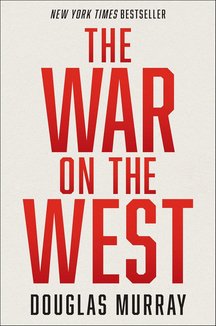
The War on the West
Author:
Douglas Murray
An Instant New York Times Bestseller! China has concentration camps now .
An Instant New York Times Bestseller! China has concentration camps now . Why do Westerners claim our sins are unique? It is now in vogue to celebrate non-Western cultures and disparage Western ones. Some of this is a much-needed reckoning, but much of it fatally undermines the very things that created the greatest, most humane civilization in the world. In The War on the West , Douglas Murray shows how many well-meaning people have been fooled by hypocritical and inconsistent anti-West rhetoric. After all, if we must discard the ideas of Kant, Hume, and Mill for their opinions on race, shouldn’t we discard Marx, whose work is peppered with racial slurs and anti-Semitism? Embers of racism remain to be stamped out in America, but what about the raging racist inferno in the Middle East and Asia? It’s not just dishonest scholars who benefit from this intellectual fraud but hostile nations and human rights abusers hoping to distract from their own ongoing villainy. Dictators who slaughter their own people are happy to jump on the “America is a racist country” bandwagon and mimic the language of antiracism and “pro-justice” movements as PR while making authoritarian conquests. If the West is to survive, it must be defended. The War on the West is not only an incisive takedown of foolish anti-Western arguments but also a rigorous new apologetic for civilization itself.
Find this book on:



The Mandibles: A Family, 2029-2047
Author:
Lionel Shriver
“Instead of 1984 , read this.” — Washington Post From New York Times bestselling author Lionel Shriver, a near-future novel that explores the aftershocks of an economically devastating U.S. sovereign debt default on four generations of a once-prosperous American family In 2029, the United States is engaged in a bloodless world war that will wipe out the savings of millions of American families.
“Instead of 1984 , read this.” — Washington Post From New York Times bestselling author Lionel Shriver, a near-future novel that explores the aftershocks of an economically devastating U.S. sovereign debt default on four generations of a once-prosperous American family In 2029, the United States is engaged in a bloodless world war that will wipe out the savings of millions of American families. Overnight, on the international currency exchange, the “almighty dollar” plummets in value, to be replaced by a new global currency, the “bancor.” In retaliation, the president declares that America will default on its loans. “Deadbeat Nation” being unable to borrow, the government prints money to cover its bills. What little remains to savers is rapidly eaten away by runaway inflation. The Mandibles have been counting on a sizable fortune filtering down when their ninety-seven-year-old patriarch dies. Once the inheritance turns to ash, each family member must contend with disappointment, but also—as the U.S. economy spirals into dysfunction—the challenge of sheer survival. Recently affluent, Avery is petulant that she can’t buy olive oil, while her sister, Florence, absorbs strays into her cramped household. An expat author, their aunt, Nollie, returns from abroad at seventy-three to a country that’s unrecognizable. Her brother, Carter, fumes at caring for their demented stepmother, now that an assisted living facility isn’t affordable. Only Florence’s oddball teenage son, Willing, an economics autodidact, will save this formerly august American family from the streets. The Mandibles is about money. Thus it is necessarily about bitterness, rivalry, and selfishness—but also about surreal generosity, sacrifice, and transformative adaptation to changing circumstances.
Find this book on:
Episode overview
The 2024 Republican presidential primary is officially underway, and Donald Trump is dominating the field. But this is a very different contest than it was in 2016. Back then, the Republican Party was the party of foreign policy interventionism, free trade and cutting entitlements, and Trump was the insurgent outsider unafraid to buck the consensus. Today, Trump and his views have become the consensus.
The primary, then, raises some important questions: How has Donald Trump changed the Republican Party over the past eight years? Is Trumpism an actual set of policy views or just a political aesthetic? And if Trump does become the nominee again, where does the party go from here?
Ben Domenech is a longtime conservative writer who served as a speechwriter in George W. Bush’s administration and co-founded several right-leaning outlets, including RedState and The Federalist. He’s currently a Fox News contributor, an editor at large at The Spectator and the author of the newsletter The Transom. From these different perches, he has closely traced the various ways the Republican Party has and, crucially, has not changed over the past decade.
This conversation explores whether Donald Trump really did break open a G.O.P. policy consensus in 2016, the legacy of what Domenech calls “boomer Republicanism,” how to reconcile Trump’s continued dominance with his surprisingly poor electoral record, the rise of “Barstool conservatism” and other new cultural strands on the right, whether conservatives actually want “National Review conservatism policy” with a “Breitbart conservatism attitude,” what Domenech thinks a G.O.P. candidate would need to do to outperform Trump and more.
This episode contains strong language.
This episode was hosted by Jane Coaston, a staff writer for Times Opinion. Previously, she hosted “The Argument,” a New York Times Opinion podcast. Before that she was the senior politics reporter at Vox, with a focus on conservatism and the G.O.P.