From this episode
Recommended books
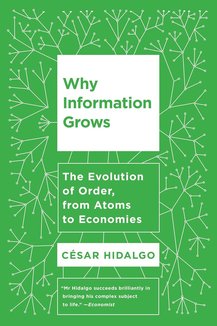
Why Information Grows
Author:
César Hidalgo
"Hidalgo has made a bold attempt to synthesize a large body of cutting-edge work into a readable, slender volume. This is the future of growth theory." -- Financial Times What is economic growth?
"Hidalgo has made a bold attempt to synthesize a large body of cutting-edge work into a readable, slender volume. This is the future of growth theory." -- Financial Times What is economic growth? And why, historically, has it occurred in only a few places? Previous efforts to answer these questions have focused on institutions, geography, finances, and psychology. But according to MIT's antidisciplinarian Cér Hidalgo, understanding the nature of economic growth demands transcending the social sciences and including the natural sciences of information, networks, and complexity. To understand the growth of economies, Hidalgo argues, we first need to understand the growth of order. At first glance, the universe seems hostile to order. Thermodynamics dictates that over time, order-or information-disappears. Whispers vanish in the wind just like the beauty of swirling cigarette smoke collapses into disorderly clouds. But thermodynamics also has loopholes that promote the growth of information in pockets. Although cities are all pockets where information grows, they are not all the same. For every Silicon Valley, Tokyo, and Paris, there are dozens of places with economies that accomplish little more than pulling rocks out of the ground. So, why does the US economy outstrip Brazil's, and Brazil's that of Chad? Why did the technology corridor along Boston's Route 128 languish while Silicon Valley blossomed? In each case, the key is how people, firms, and the networks they form make use of information. Seen from Hidalgo's vantage, economies become distributed computers, made of networks of people, and the problem of economic development becomes the problem of making these computers more powerful. By uncovering the mechanisms that enable the growth of information in nature and society, Why Information Grows lays bear the origins of physical order and economic growth. Situated at the nexus of information theory, physics, sociology, and economics, this book propounds a new theory of how economies can do not just more things, but more interesting things.
Find this book on:



Find this book on:
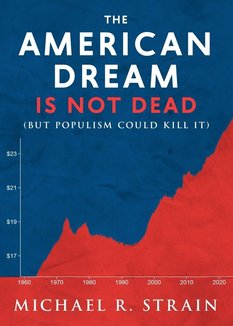
The American Dream Is Not Dead: (But Populism Could Kill It) (New Threats to Freedom Series)
Author:
Michael R. Strain
Populists on both sides of the political aisle routinely announce that the American Dream is dead. According to them, the game has been rigged by elites, workers can’t get ahead, wages have been stagnant for decades, and the middle class is dying.
Populists on both sides of the political aisle routinely announce that the American Dream is dead. According to them, the game has been rigged by elites, workers can’t get ahead, wages have been stagnant for decades, and the middle class is dying. Michael R. Strain, director of economic policy studies at the American Enterprise Institute, disputes this rhetoric as wrong and dangerous. In this succinctly argued volume, he shows that, on measures of economic opportunity and quality of life, there has never been a better time to be alive in America. He backs his argument with overwhelming—and underreported—data to show how the facts favor realistic optimism. He warns, however, that the false prophets of populism pose a serious danger to our current and future prosperity. Their policies would leave workers worse off. And their erroneous claim that the American Dream is dead could discourage people from taking advantage of real opportunities to better their lives. If enough people start to believe the Dream is dead, they could, in effect, kill it. To prevent this self-fulfilling prophecy, Strain’s book is urgent reading for anyone feeling the pull of the populists. E. J. Dionne and Henry Olsen provide spirited responses to Strain’s argument.
Find this book on:
Episode overview
“The Jetsons” premiered in 1962. And based on the internal math of the show, George Jetson, the dad, was born in 2022. He’d be a toddler right now. And we are so far away from the world that show imagined. There were a lot of future-trippers in the 1960s, and most of them would be pretty disappointed by how that future turned out.
So what happened? Why didn’t we build that future?
The answer, I think, lies in the 1970s. I’ve been spending a lot of time studying that decade in my work, trying to understand why America is so bad at building today. And James Pethokoukis has also spent a lot of time looking at the 1970s, in his work trying to understand why America is less innovative today than it was in the postwar decades. So Pethokoukis and I are asking similar questions, and circling the same time period, but from very different ideological vantages.
Pethokoukis is a senior fellow at the American Enterprise Institute, and author of the book “The Conservative Futurist: How to Create the Sci-Fi World We Were Promised.” He also writes a newsletter called Faster, Please! “The two screamingly obvious things that we stopped doing is we stopped spending on science, research and development the way we did in the 1960s,” he tells me, “and we began to regulate our economy as if regulation would have no impact on innovation.”
In this conversation, we debate why the ’70s were such an inflection point; whether this slowdown phenomenon is just something that happens as countries get wealthier; and what the government’s role should be in supporting and regulating emerging technologies like A.I.