
From this episode
Recommended books
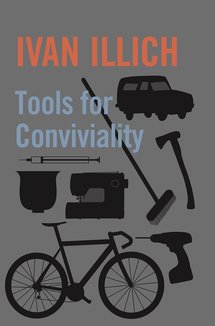
Tools for Conviviality
Author:
Ivan Illich
Ivan Illich argues for individual personal control over life, the tools and energy we use. A work of seminal importance.
Ivan Illich argues for individual personal control over life, the tools and energy we use. A work of seminal importance. The conviviality for which noted social philosopher Ivan Illich is arguing is one in which the individual’s personal energies are under direct personal control and in which the use of tools is responsibly limited. A work of seminal importance, this book claims our attention for the urgency of its appeal, the stunning clarity of its logic and the overwhelmingly human note that it sounds.
Find this book on:



The Human Condition: Second Edition
Authors:
Hannah Arendt,
Danielle Allen,
Margaret Canovan
The past year has seen a resurgence of interest in the political thinker Hannah Arendt, “the theorist of beginnings,” whose work probes the logics underlying unexpected transformations—from totalitarianism to revolution. A work of striking originality, The Human Condition is in many respects more relevant now than when it first appeared in 1958.
The past year has seen a resurgence of interest in the political thinker Hannah Arendt, “the theorist of beginnings,” whose work probes the logics underlying unexpected transformations—from totalitarianism to revolution. A work of striking originality, The Human Condition is in many respects more relevant now than when it first appeared in 1958. In her study of the state of modern humanity, Hannah Arendt considers humankind from the perspective of the actions of which it is capable. The problems Arendt identified then—diminishing human agency and political freedom, the paradox that as human powers increase through technological and humanistic inquiry, we are less equipped to control the consequences of our actions—continue to confront us today. This new edition, published to coincide with the sixtieth anniversary of its original publication, contains Margaret Canovan’s 1998 introduction and a new foreword by Danielle Allen. A classic in political and social theory, The Human Condition is a work that has proved both timeless and perpetually timely.
Find this book on:
Technology and the Character of Contemporary Life: A Philosophical Inquiry
Author:
Albert Borgmann
Blending social analysis and philosophy, Albert Borgmann maintains that technology creates a controlling pattern in our lives. This pattern, discernible even in such an inconspicuous action as switching on a stereo, has global effects: it sharply divides life into labor and leisure, it sustains the industrial democracies, and it fosters the view that the earth itself is a technological device.
Blending social analysis and philosophy, Albert Borgmann maintains that technology creates a controlling pattern in our lives. This pattern, discernible even in such an inconspicuous action as switching on a stereo, has global effects: it sharply divides life into labor and leisure, it sustains the industrial democracies, and it fosters the view that the earth itself is a technological device. He argues that technology has served us as well in conquering hunger and disease, but that when we turn to it for richer experiences, it leads instead to a life dominated by effortless and thoughtless consumption. Borgmann does not reject technology but calls for public conversation about the nature of the good life. He counsels us to make room in a technological age for matters of ultimate concern—things and practices that engage us in their own right.
Find this book on:
Episode overview
We all know by now that Zoom causes fatigue, social media spreads misinformation and Google Maps is wiping out our sense of direction. We also know, of course, that Zoom allows us to cooperate across continents, that social media connects us to our families and Google Maps keeps us from being lost. A lot of technological criticism today is about weighing whether a technology is good or bad, or judging its various uses. But there’s an older tradition of criticism that asks a more fundamental and nuanced question: How do these technologies change the people who use them, both for good and for bad? And what do the people who use them — all of us, in other words — actually want? Do we even know?
L.M. Sacasas explores these questions in his great newsletter, “The Convivial Society.” His work is marrying the theorists of the 20th century — Hannah Arendt, C.S. Lewis, Ivan Illich, Marshall McLuhan, Neil Postman and more — to the technologies of the present day. I’ve found this merging of past thinkers and contemporary concerns revelatory in an era when we tend to take the shape of our world for granted and forget how it would look to those who stood outside it, or how it looked to those who were there at the inception of these tools and mediums.
Sacasas recently published a list of 41 questions we should ask of the technologies and tools that shape our lives. What I loved about these questions is how they invite us to think not just about technologies, but about ourselves, and how we act and what we want and what, in the end, we truly value. So I asked him on the show to talk through some of them, and to see what light they shed on the lives we live.